
There is a romantic idea that changing your identity is beautiful.
We imagine a person stepping into the light, leaving the old life behind, finally becoming free. And sometimes it does feel like that. There are moments of clarity, courage, excitement and deep inner knowing.
But there is another side to identity change that is rarely spoken about.
Sometimes becoming someone new is painful.
Sometimes the old life does not fall away gently. Sometimes it tears. Sometimes it takes relationships, income, certainty, family belonging, emotional safety and a clear sense of direction with it.
We like to talk about transformation as if it is a clean upgrade. But real transformation can feel like a breakdown before it feels like a breakthrough.
When an old identity begins to dissolve, everything connected to it can become unstable.
The career that once gave us income may no longer nourish us.
The marriage that once held a shared story may no longer survive the change.
The family that once recognised us may struggle to understand who we are becoming.
The beliefs that once gave us certainty may begin to collapse.
The future that once looked planned may become strangely empty.
This is not failure.
It is the difficult middle passage between the life we have outgrown and the life we have not yet fully built.
In my own life, the change in identity has been extremely painful. It has led to lower income, divorce, years of searching for purpose and meaning, estrangement from family, a new relationship with its own challenges to face, and the continuing attempt to use AI, creativity and spiritual insight to rebuild my work and mission.
In many ways, I am still working through the transition.
That is an important thing for me to admit.
Because awakening is not always a finished state. Sometimes it is a long, uneven process of being pulled out of one version of life while not yet feeling fully established in the next.
There are days when the old identity still looks tempting, not because it was fulfilling, but because it was familiar. Familiar pain can sometimes feel safer than unfamiliar freedom.
A salary, a role, a marriage, a family structure, a business model, a social identity — these things give shape to life. When they fall away or become unstable, we can feel exposed. We may ask, “Have I made a mistake?” or “Why has following truth cost me so much?”
But perhaps the cost feels so high because identity is not just an idea. It is woven into our nervous system, our relationships, our finances, our reputation, our routines and our sense of belonging.
When identity changes, life often has to reorganise around it.
That reorganisation can take years.
And this is where compassion is needed.
We cannot shame ourselves into becoming whole. We cannot bully ourselves through a spiritual transition. We cannot pretend we are peaceful when we are grieving. Part of awakening is learning to tell the truth about the pain without allowing the pain to become our final identity.
There is grief in becoming.
We grieve the person we used to be.
We grieve the life that did not turn out as planned.
We grieve relationships that could not survive our change.
We grieve the years spent trying to fit into roles that slowly drained us.
We grieve the certainty we once had, even if that certainty was built on illusion.
But grief is not the opposite of growth.
Sometimes grief is the proof that something real is being released.
The danger is that we may interpret the pain of transition as evidence that we are on the wrong path. But pain does not always mean wrong direction. Sometimes pain means the old structure is breaking apart because it can no longer contain the life trying to emerge.
You will intuitively know whether or not you are moving in the right direction, even if it feels painful, if you have the courage to seek the truth.
The soul does not always lead us into comfort. Sometimes it leads us into truth.
And truth can be disruptive.
It asks us to stop pretending. It asks us to look at what is no longer working. It asks us to face the parts of ourselves that were built around fear, approval, survival and duty. It asks us to become more honest than the old life allowed.
That is not easy work.
But it may be sacred work.
The question is not, “Why is this so painful?”
The deeper question may be:
What part of me is being born through this pain?
Because perhaps the transition is not punishment.
Perhaps it is initiation.
Perhaps the old identity had to crack because it had become too small for the person I was being called to become.
And perhaps the task now is not to rush the process, deny the grief, or pretend the journey has been easy.
Perhaps the task is to keep walking.
One honest step at a time.
Not because the path is painless.
But because the old cage is no longer home.
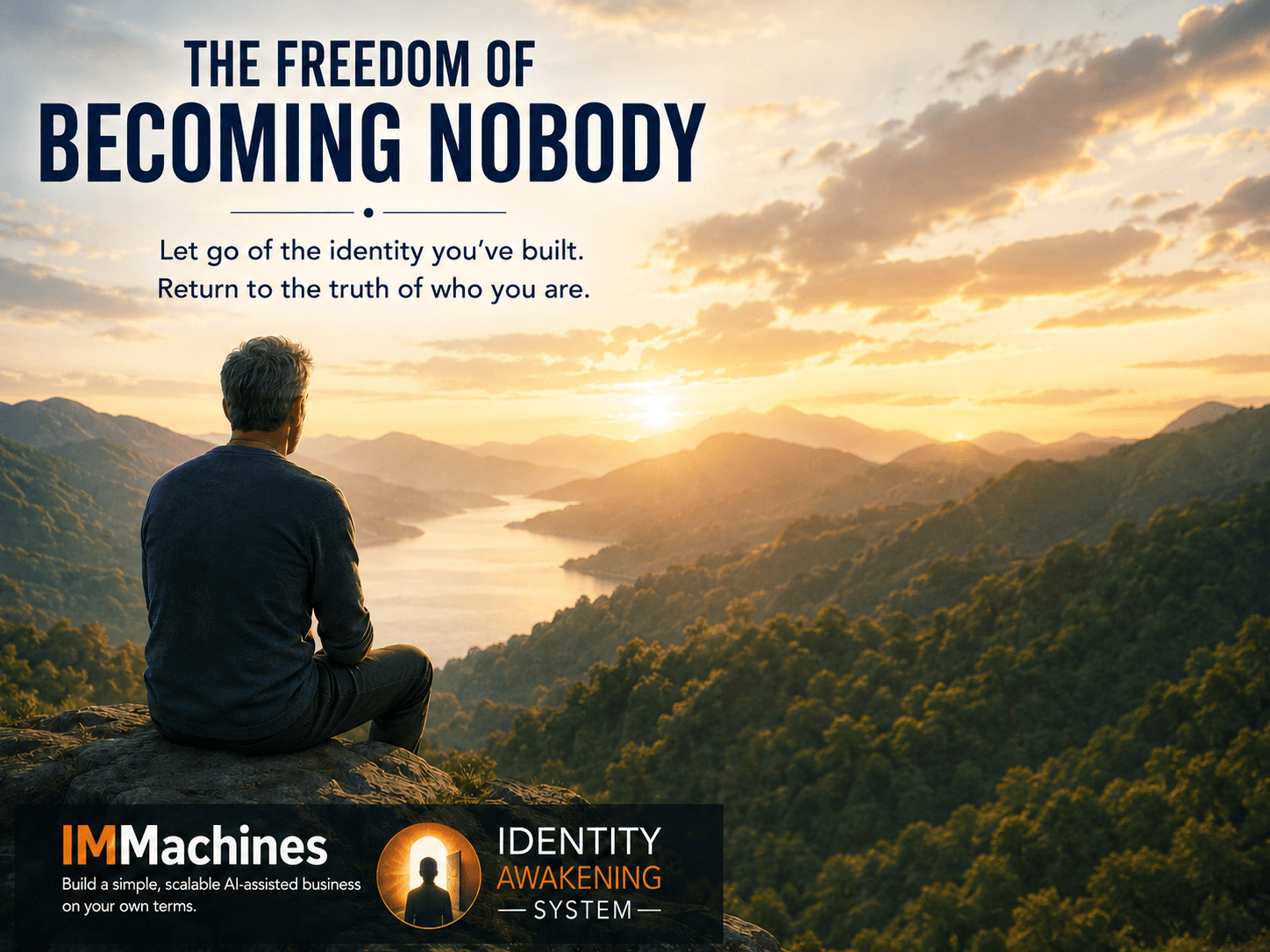
And the Identity Awakening System will support you through the pain of awakening.