
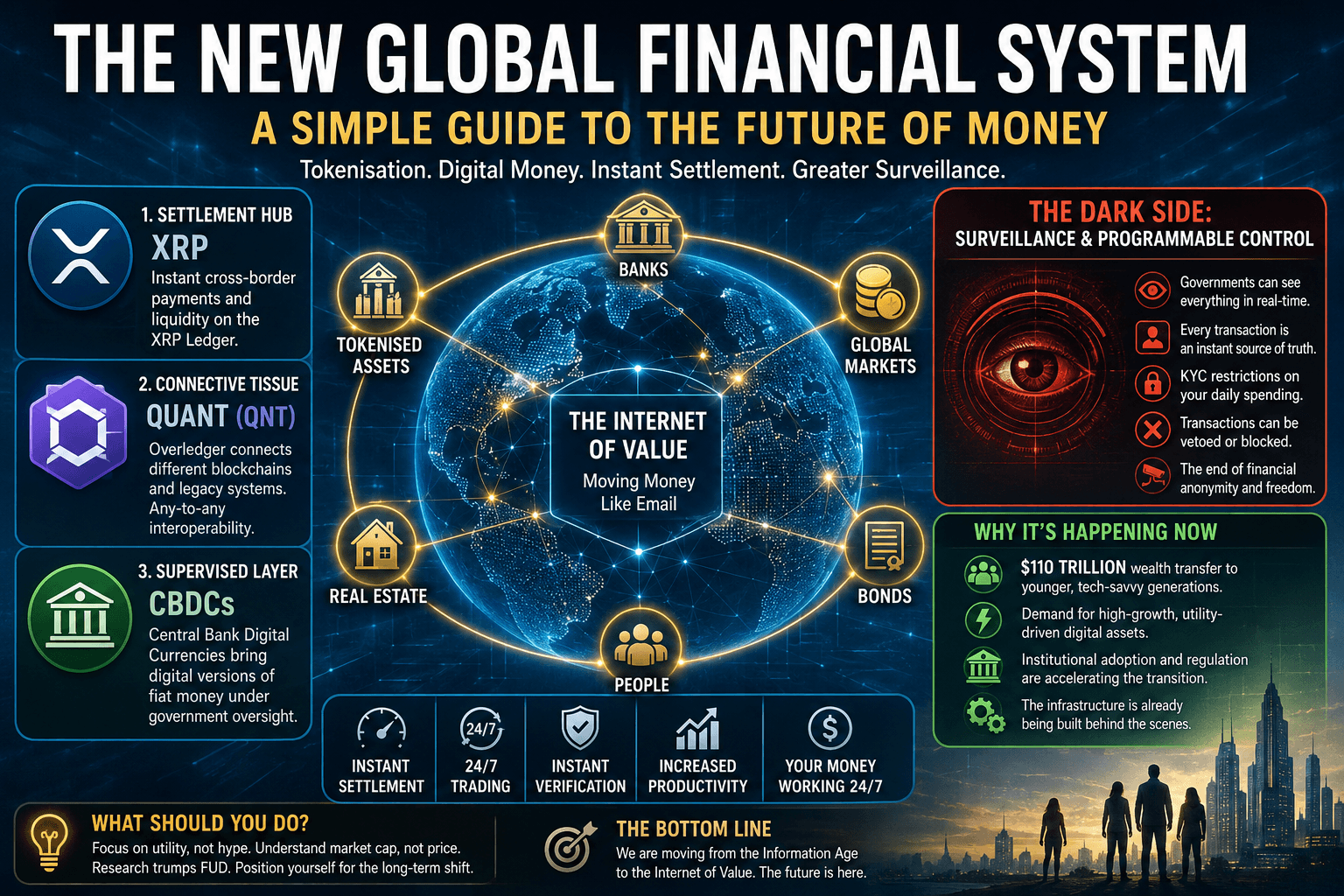
The global financial system is changing.
For decades, money has moved through a slow, fragmented network of banks, clearing houses, payment providers, and international settlement systems. Cross-border payments can still take days, involve several middlemen, and create high costs.
Now a new financial infrastructure is being built around digital ledgers, tokenised assets, stablecoins, and central bank digital currencies.
Supporters describe this as the beginning of an “Internet of Value” — a system in which money and assets could move as quickly as information moves across the internet.
This may become one of the biggest financial changes of our lifetime.
However, it is important to separate what is already happening from what is still speculative.
Tokenisation is real.
Digital currencies are being tested.
Banks are exploring blockchain-based settlement.
But claims that one particular cryptocurrency will become the centre of the entire global system remain predictions, not established facts.
Why is the financial system changing?
The current financial system has several weaknesses.
International payments can be slow and expensive. Different banking systems do not always communicate easily. Settlement often involves delays, reconciliation, and multiple intermediaries.
There is also growing concern about:
- high government debt
- inflation
- ageing financial infrastructure
- increasing dependence on digital payments
- the need for faster and more efficient settlement
The answer being explored by banks, governments, and financial institutions is tokenisation.
Tokenisation means creating a digital representation of a real asset on a secure digital ledger.
That asset could be:
- a bond
- a property
- a share
- a commodity
- a bank deposit
- a government currency
The idea is that tokenised assets could be bought, sold, verified, and settled much faster than they are today.
The Triffin Dilemma
The new system may also be the answer to ‘the Triffin Dilemma’. Any currency that is the Reserve Asset currency has to run a trade deficit with other currencies in order to supply sufficient currency to fund trade, which weakens the value of that currency. The IMF attempted to tackle this dilemma in the 1980’s by giving Central Banks Special Drawing Rights but this failed because there was insufficient liquidity in the system. XRP and Ripple is the new system that could address this problem as, if the IMF takes over Ripple, this system will not be owned by any one country but by 190 countries who support the IMF.
What does tokenisation mean in simple terms?
Imagine a house worth £300,000.
In the traditional system, ownership is recorded through legal documents, land registries, banks, and solicitors.
In a tokenised system, the ownership rights could also be represented digitally.
That does not mean the house becomes imaginary. It means the record of ownership becomes easier to transfer, track, and verify.
The same idea can apply to bonds, funds, property, art, commodities, and other assets.
Supporters believe tokenisation could make markets:
- faster
- cheaper
- more transparent
- available around the clock
- easier to access globally
Critics warn that it could also create new risks around privacy, cybersecurity, control, and regulation.
The main parts of the emerging system
The new financial system is unlikely to rely on one single digital currency.
It will probably involve several layers working together.
1. Digital settlement networks
Some blockchain networks are designed to move value quickly between banks, institutions, and countries.
XRP is often discussed in this context because it was designed as a bridge asset for fast cross-border settlement.
The basic idea is simple.
A bank in Britain may want to send value to a bank in Japan. Instead of relying entirely on slow correspondent banking arrangements, a digital asset could temporarily act as a bridge between pounds and yen.
This could reduce friction and improve speed.
However, it is important to say clearly that the future role of XRP is still uncertain. It may become more widely used, but it is not yet guaranteed to become the central settlement asset of the global financial system.
2. Interoperability networks
A major problem with digital finance is that many blockchains and banking systems do not naturally communicate with one another.
This is where interoperability platforms come in.
Quant and its Overledger technology are often described as tools that could help connect different blockchains and traditional financial systems.
In simple terms, Quant aims to help different digital networks “speak the same language.”
This could be useful if a tokenised bond exists on one network while a digital currency exists on another.
Again, this is a developing area. The technology may prove important, but its final role is not yet settled.
3. Stablecoins and central bank digital currencies
Stablecoins are digital tokens designed to track the value of a normal currency such as the dollar or pound.
Central bank digital currencies, or CBDCs, are different.
A CBDC would be an official digital form of national currency issued or backed by a central bank.
Governments and central banks are exploring these because they could make payments and settlement faster.
But they also raise serious questions.
A CBDC could, depending on how it is designed, give authorities much greater visibility over how money moves.
That is one of the most important debates in the future of finance.
The possible benefits
The new system could offer real advantages.
Payments could settle faster. International transfers could become cheaper. Fraud and duplication may be easier to detect. Ownership records could become more accurate.
Businesses may be able to raise money more efficiently. Investors may gain access to assets that were previously difficult to buy.
Markets could operate 24 hours a day rather than only during normal trading hours.
Some supporters also believe that digital finance could reduce the amount of money sitting idle inside slow and inefficient systems.
The dangers: surveillance and programmable control
The biggest risk is not technical.
It is political.
A fully digital financial system could give governments, banks, and institutions far greater power to monitor transactions.
Cash allows a degree of privacy. A digital currency leaves a record.
If every payment is linked to your identity, authorities may be able to see:
- what you buy
- where you buy it
- when you buy it
- who you send money to
- how often you spend
- whether your behaviour fits their rules
The most serious concern is programmable money.
In theory, a digital currency could be designed with restrictions.
Money could be:
- limited to certain purchases
- blocked in certain locations
- made to expire
- frozen instantly
- restricted according to government policy
- linked to identity or compliance systems
This does not mean every CBDC will automatically work this way.
But the technology could allow it. This is therefore a potential threat by the State to personal freedom and sovereignty and, in my opinion, we must not be complacent about this potential danger!
That means the debate must not focus only on speed and convenience. It must also include:
- privacy
- civil liberties
- due process
- the right to use cash
- who controls the system
- what happens when authorities abuse that control
A financial system can be efficient and still be dangerous if too much power is concentrated in too few hands.
The generational wealth transfer
Another major trend is the transfer of wealth from older generations to younger ones.
Large amounts of property, savings, pensions, and investments are expected to pass from Baby Boomers to younger generations over the coming years.
Younger investors are generally more comfortable with digital platforms, mobile banking, and cryptocurrency.
This could accelerate interest in tokenised assets and digital finance.
But it does not mean younger investors will automatically abandon traditional investments.
Most people are likely to use a mixture of:
- shares
- property
- pensions
- funds
- digital assets
- cash
The change may be gradual rather than sudden.
Understanding price and market capitalisation
Crypto investors often make a simple mistake.
They assume a token with a low price is cheap.
That is not necessarily true.
A token’s value should also be judged by its market capitalisation.
Market capitalisation is calculated like this:
Token price × number of tokens in circulation
A token priced at £1 may still have a much larger total valuation than another token priced at £50.
This happens because some projects have billions of tokens, while others have only a few million.
Supply matters.
However, market capitalisation does not tell you whether an asset is a good investment. It only gives you a better way to compare size.
You also need to consider:
- real-world use
- competition
- regulation
- management
- token supply
- security
- adoption
- liquidity
Why small cryptocurrencies can rise faster — and fall faster
Smaller digital assets can sometimes grow much faster than large ones.
That is because less money is needed to move their market value.
But the same principle works in reverse.
Small-cap cryptocurrencies can also fall much harder.
They may have:
- low liquidity
- high volatility
- weak regulation
- limited adoption
- greater risk of manipulation
- a higher chance of failure
A possible 10-fold return usually comes with the possibility of a very large loss.
That is why high-return claims should always be treated carefully.
Is regulation real or just “theatre”?
Some commentators argue that legal disputes and regulatory delays are simply part of a larger plan to prepare the market.
That may be one interpretation, but it should not be presented as fact without strong evidence.
Regulation is often slow because governments are trying to balance:
- innovation
- consumer protection
- financial stability
- tax collection
- fraud prevention
- national security
Some officials later join private companies, which can create legitimate concerns about conflicts of interest.
But that does not prove every legal case or policy debate is staged.
A more reasonable conclusion is that governments and financial institutions are actively shaping the rules of digital finance while trying to retain control over the system.
Are XRP, QNT, and XDC guaranteed winners?
No, but they are in a powerful position. The YouTube channel ‘Apex Crypto Insights‘ reveals that XRP and Quant are the likely infrastructure for the new financial system, with the International Monetary Fund likely to take over Ripple (as the lender of last resort) when the new system is up and running.
But no token is currently guaranteed to succeed.
The future may involve:
- public blockchains
- private bank networks
- central bank systems
- stablecoins
- new technologies that do not yet exist
Some current projects may become important.
Others may be replaced.
Anyone investing should remember that a good story is not the same as proof.
What should the average person do?
The most sensible approach is not panic and not blind excitement.
It is education.
Understand the basic ideas:
- tokenisation
- stablecoins
- CBDCs
- blockchain settlement
- market capitalisation
- privacy risks
- regulation
Be cautious with claims of guaranteed wealth.
Do not invest money you cannot afford to lose.
Do not assume that global financial institutions have already chosen one particular cryptocurrency as the winner.
And do not ignore the civil-liberty questions surrounding fully digital money.
Conclusion
The financial system is moving toward greater digitisation.
Tokenised assets, stablecoins, digital settlement networks, and possible CBDCs are likely to play a larger role in the years ahead. America is waiting for the Clarity Act to pass in order for the crypto market to be properly regulated.
This could make finance faster and more efficient.
It could also create a system of unprecedented surveillance and control.
That is why the real question is not simply:
Will the new financial system work?
It is:
Who will control it, what protections will exist, and how much freedom will ordinary people retain?
The future of money should not be decided only by banks, governments, technology companies, and institutional investors.
The public must understand what is being built.
Because financial efficiency is valuable.
But freedom, privacy, and personal sovereignty are valuable too.
————————————————————————————————————
This is an excerpt from a post by Proletario1, who I subscribe to on Patreon. I think it is important to underline the impact of the Clarity Act on what is about to happen, particularly as it is likely to be put to the vote in the US Senate next week beginning 3rd August 2026 in the face of strong resistance from beneficiaries of the legacy systems.
The Clarity Act as the Death Blow to the Rothschild Banking Cartel
The Clarity Act is not just another piece of legislation, it is the final nail in the coffin of the Rothschild banking cartel and its centuries-old web of financial control.
This Act will dismantle the mechanisms that have allowed these bloodlines to operate in the shadows, laundering money, funding wars, and manipulating global economies. Here’s how it will expose and dismantle their operations:
1. The End of Shell Companies and Tax Havens
– The Clarity Act will mandate full transparency for all financial transactions, effectively ending the use of shell companies registered in tax havens like Panama, Belize, and the Cayman Islands. These havens have long been used by the Rothschilds and their allies to launder money, hide assets, and fund clandestine operations.
– The Act will require all financial institutions to disclose the true beneficial owners of accounts, making it impossible for these bloodlines to hide behind layers of corporate veils. This will expose the true extent of their wealth and the illicit activities they have funded.
2. The Collapse of Swiss Private Banks
– Swiss private banks, long the safe haven for Nazi gold, Vatican black ops funds, and Rothschild wealth, will be forced to comply with U.S.-mandated transparency or lose access to dollar clearing altogether. This will cut off a major artery of their financial network.
– The Act will require these banks to disclose all accounts held by individuals and entities linked to the Rothschild cartel, including those tied to the Vatican, the Jesuits, and other secret societies. This will expose the flow of funds used to finance wars, coups, and other destabilizing activities.
3. The Exposure of Secret Societies and Their Financial Networks
– The Clarity Act will force secret societies like the Freemasons (Scottish Rite/York Rite/Shriners/Knight Templar), Jesuits (Society of Jesus), and Skull & Bones (Order of Death/Yale University) to disclose their financial activities. These organizations have long served as recruitment grounds for future leaders and have used their networks to launder money and fund illicit activities.
– The Act will require these organizations to disclose their membership lists, financial transactions, and the true purpose of their activities. This will expose the extent to which they have infiltrated governments, corporations, and financial institutions.
4. The Dismantling of the Rothschild Bloodline’s Financial Empire
– The Rothschilds and their allied bloodlines Kassel, Brabant, Orange-Nassau, Bourbon-Parma, Savoy-Carignano-Genoa, Aosta, Doria-Pamphili-Landi-Ruspoli-Colonna-Orsini-Aldobrandini-Borghese-Chigi-Altemps-Pallavicini-Odescalchi-Torlonia-Boncompagni have long controlled global finance through a network of central banks, private banks, and investment firms.
– The Clarity Act will force these bloodlines to disclose their financial holdings and transactions, exposing the true extent of their wealth and the illicit activities they have funded. This will include the disclosure of their investments in arms manufacturing, drug trafficking, and human trafficking.
5. The Role of the White Hats and Military Tribunals
– The White Hats within US Military Intelligence, who have been waging a silent war against this cabal since JFK’s assassination, will finally have the tools they need to expose every last one of these traitors and bring them to justice before military tribunals at Guantanamo Bay Naval Base in Cuba.
– The Clarity Act will provide the legal framework for these tribunals, allowing for the prosecution of individuals and entities involved in financial crimes, war crimes, and crimes against humanity. This will include the prosecution of members of the Rothschild cartel, their allies, and their enablers.
6. The End of the Federal Reserve and the Return to the Gold Standard
– The Clarity Act will pave the way for the end of the Federal Reserve and the return to the gold standard. This will strip the Rothschilds and their allies of their ability to manipulate the global economy through the issuance of fiat currency.
– The Act will require the US Treasury to disclose the true extent of the national debt and the assets backing it. This will expose the fraud that has been perpetrated on the American people and the world, and will pave the way for a new financial system based on sound money and transparency.
7. The Exposure of the Deep State Cabal
– The Clarity Act will expose the Deep State Cabal, a network of individuals and entities that have infiltrated governments, corporations, and financial institutions around the world. This network has been used to manipulate elections, fund wars, and control the global economy.
– The Act will require the disclosure of all financial transactions involving members of the Deep State Cabal, exposing their illicit activities and paving the way for their prosecution.
8. The Role of Q-Drops and Breadcrumbs
– The Q-Drops have provided a roadmap for the exposure of the Deep State Cabal and the Rothschild banking cartel. The Clarity Act will provide the legal framework for the prosecution of these individuals and entities, and will pave the way for the restoration of the Republic.
– The breadcrumbs left by Q have led to the exposure of key players in the Deep State Cabal, including members of the Rothschild cartel, their allies, and their enablers. The Clarity Act will provide the legal framework for the prosecution of these individuals and entities, and will pave the way for the restoration of the Republic.