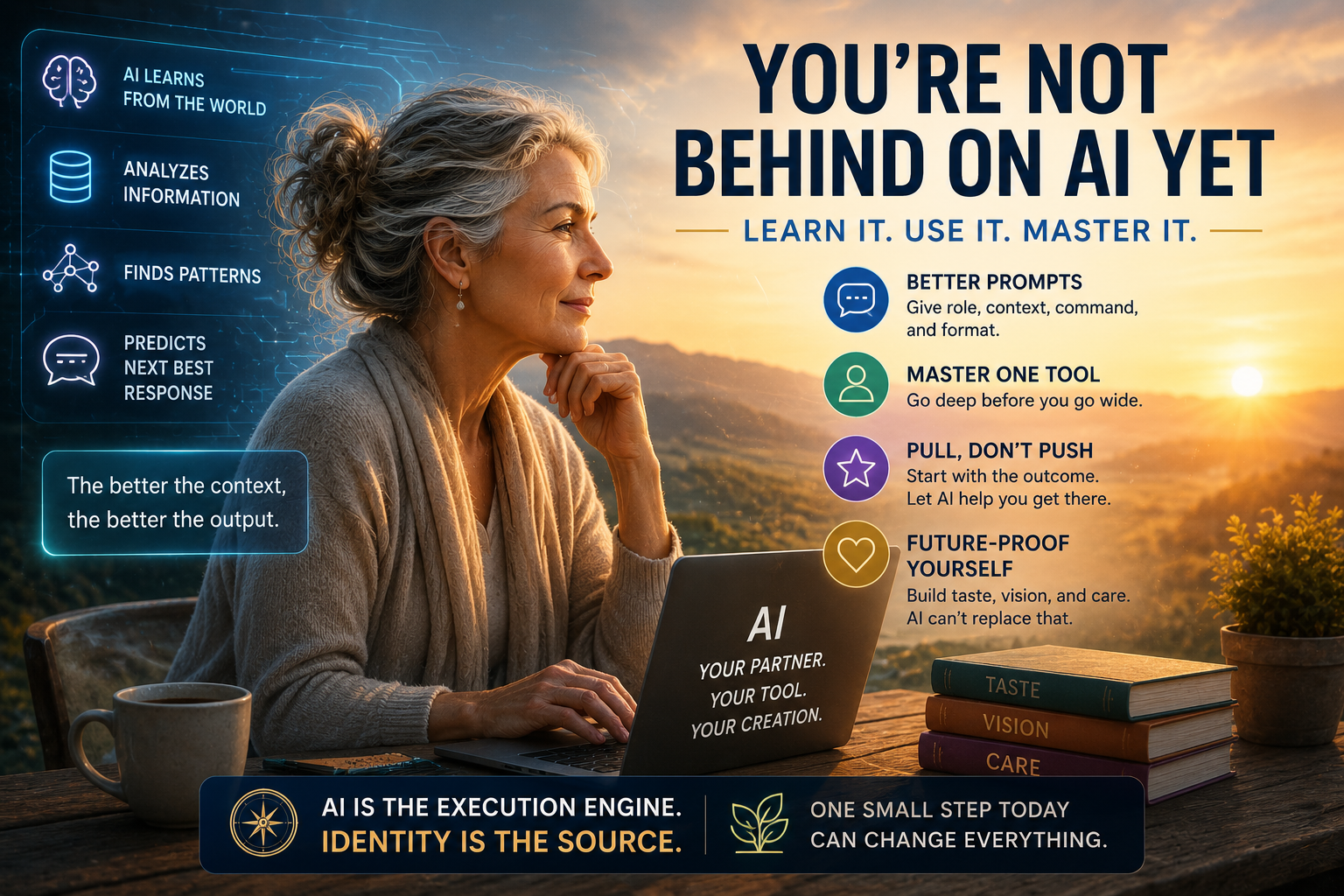
Most people are carrying a quiet fear about AI.
They may not say it out loud, but they feel it.
“I’m behind.”
“I’ve missed the window.”
“Younger people understand this better than me.”
“My business will be overtaken.”
“My skills may become irrelevant.”
“I don’t even know where to start.”
But here is the truth:
You are not behind on AI yet.
Not really.
Most people are still using AI badly, casually, randomly, or not at all. They ask it weak questions, get generic answers, feel disappointed, and then assume the technology is overhyped.
But the problem is not usually the AI.
The problem is the quality of the relationship.
AI responds to context.
AI responds to clarity.
AI responds to direction.
AI responds to identity.
If you give it almost nothing, it gives you something vague.
If you give it depth, truth, background, purpose, standards, and a clear outcome, it becomes something very different.
This is why AI is not really about technology first.
It is about awakening the person using it.
AI is not magic. It is a mirror with power
One of the most useful things to understand about AI is this:
AI is not magic.
It is pattern recognition at scale.
It has absorbed huge amounts of human language and information, and when you ask it something, it predicts the most likely useful response based on the context you provide.
That means your input matters enormously.
If you say:
“Write me a blog post about AI.”
You will probably get something bland.
But if you say:
“Act as a world-class writer for IMMachines.com. Write for mid-life creators, seekers, coaches, entrepreneurs, and people who feel overwhelmed by AI. The message is that AI is not here to replace human identity, but to amplify the person who knows who they are. Use a grounded, reflective, encouraging tone. Connect AI mastery to Identity Awakening, inner authority, taste, vision, care, and the next small step.”
Now AI has something to work with.
The output changes because the input changed.
This is the first great lesson:
The quality of AI’s answer rarely rises above the quality of your prompt.
But beneath that is a deeper truth:
The quality of your prompt rarely rises above the clarity of your identity.
That is where most people are stuck.
They do not know what they want.
They do not know who they are speaking to.
They do not know what outcome they are trying to create.
They do not know what they value.
They do not know what kind of work they are here to make.
So they ask vague questions and get vague answers.
Then they say AI is not useful.
But AI cannot replace the clarity you have not yet claimed.
The real AI gap is not technical
Most people think the AI gap is about tools.
ChatGPT.
Claude.
Gemini.
Perplexity.
Midjourney.
NotebookLM.
Agents.
Automation.
Custom GPTs.
Workflows.
Yes, tools matter.
But tools are not the real gap.
The real gap is between people who use AI as a toy and people who use AI as an extension of their thinking.
One person asks:
“Give me some content ideas.”
Another person says:
“Here is my audience. Here is my lived experience. Here is the transformation I care about. Here is my tone. Here are my beliefs. Here are my offers. Here are the problems my readers are facing. Here is what I refuse to become. Here is what I stand for. Now help me create something honest, useful, and alive.”
These are not the same thing.
One is outsourcing thought.
The other is collaborating with intelligence.
This is why AI mastery is not just a productivity skill.
It is an identity skill.
Prompting is really communication
A useful prompt has four parts.
1. Role
Tell AI who to become for this task.
For example:
“Act as a world-class editor.”
“Act as a conversion strategist.”
“Act as a patient teacher.”
“Act as a systems architect.”
“Act as a reflective identity mirror.”
This narrows the field.
It tells AI which kind of intelligence you need.
2. Context
This is where most people fail.
They give AI a tiny instruction and expect a deep response.
But AI needs background.
Who are you?
Who is the audience?
What is the goal?
What has already been tried?
What matters?
What tone is right?
What should be avoided?
What examples should it learn from?
What does success look like?
Context is fuel.
The more relevant context you give, the more useful the output becomes.
3. Command
Be explicit.
Tell it exactly what you want it to do.
Do you want a blog post?
A plan?
A critique?
A table?
A summary?
A set of questions?
A sales page?
A diagnosis?
A step-by-step process?
Do not make AI guess.
Make the implicit explicit.
4. Format
Tell it how you want the answer delivered.
Short paragraphs.
Bullet points.
A table.
A checklist.
A 7-day plan.
A blog post.
A social media thread.
A client questionnaire.
A script.
A JSON file.
A markdown document.
Format turns intelligence into something usable.
Without format, you may get information.
With format, you get an asset.
The most powerful prompt is not a prompt. It is a relationship
If AI sounds like a stranger, it is probably because you have not introduced yourself.
This is powerful.
Most people start every AI conversation cold.
They expect the system to understand their life, business, values, audience, style, strengths, fears, and goals with no real introduction.
That is like walking up to a stranger in the street and asking them to redesign your future.
Of course the answer is generic.
The better approach is to create what we might call a master identity prompt.
This is a document that tells AI who you are.
Not in a shallow way.
In a meaningful way.
It might include:
Your background.
Your values.
Your skills.
Your audience.
Your mission.
Your tone of voice.
Your current projects.
Your lived experience.
Your offers.
Your beliefs about the world.
Your creative standards.
Your fears and resistances.
Your long-term direction.
Your definition of meaningful work.
This is where IMMachines and the Identity Awakening System become deeply relevant.
Because before you can introduce yourself clearly to AI, you need to meet yourself clearly.
The Identity Awakening System is designed as a dialogue-driven awakening process that uses AI as a mirror to reveal who you are, who you are not, what you have inherited, what you desire, what you fear, what resonates, what you are outgrowing, and who you are becoming. It is not about memorising information; it is about meeting yourself.
That is exactly what good AI use requires.
The clearer your identity, the clearer your AI outputs.
AI should not make you more generic
This is one of the great dangers.
Used badly, AI makes people sound the same.
Same phrases.
Same structure.
Same hype.
Same productivity language.
Same empty advice.
Same polished nothingness.
That is not mastery.
That is disappearance.
The point of AI is not to sand away your humanity.
The point is to help you express it more clearly.
Your stories matter.
Your scars matter.
Your wisdom matters.
Your timing matters.
Your questions matter.
Your voice matters.
Your weirdness matters.
Your hard-won perspective matters.
AI should not replace those things.
It should help reveal them.
At IMMachines, this is the central principle:
AI is the execution engine. Identity is the source.
If you skip identity, AI becomes a content machine.
If you begin with identity, AI becomes a mirror, amplifier, organiser, and creative partner.
Push prompting vs pull prompting
Most people use AI by pushing instructions into it.
They say:
“Write this.”
“Summarise that.”
“Create this.”
“Improve this.”
That can be useful.
But there is a more powerful way.
Start with the outcome and ask AI to pull the right information from you.
For example:
“Act as a world-class business strategist. I want to create a simple AI-assisted offer for mid-life creators who feel behind on AI. Ask me all the questions you need to understand my audience, my experience, my values, my offer, and the outcome I want to deliver. Then create a clear offer structure.”
This changes everything.
Instead of trying to know exactly what to ask, you let AI interview you.
This is powerful because many people do not know what context matters until they are asked.
The right question pulls out the hidden material.
This is also how Identity Awakening works.
It is not about dumping answers into someone.
It is about asking the question that helps the person recognise what is already true.
Pick one tool and go deep
There is another important lesson here.
Stop jumping between tools as a form of procrastination.
Some people are constantly trying every new AI platform.
They test ChatGPT, Claude, Gemini, Perplexity, Grok, Midjourney, and whatever launched yesterday.
But they never get good at any of them.
That is not mastery.
That is avoidance dressed as curiosity.
Real learning requires depth.
Pick one primary AI tool and learn it properly.
Learn how it responds.
Learn how to give it context.
Learn how to refine outputs.
Learn how to build reusable prompts.
Learn how to create workflows.
Learn how to make it useful in your actual life.
Once you understand one tool deeply, the others become easier.
But if you are always switching, you never build fluency.
And fluency matters.
AI is becoming a new language of creation.
You do not need to know everything.
But you do need to start speaking it.
The future belongs to people with taste, vision, and care
This may be the most important part of the whole transcript.
To future-proof yourself, you need three things:
Taste.
Vision.
Care.
That is exactly right.
Because these are deeply human.
AI can generate options.
But you decide what is good.
That is taste.
AI can help build what exists.
But you imagine what should exist.
That is vision.
AI can simulate warmth.
But you genuinely care about people.
That is care.
These three qualities are not technical.
They are human.
And they are becoming more valuable, not less.
Taste: knowing what is good
Taste comes from exposure to excellence.
If you want to write better, read better writing.
If you want to create better offers, study better offers.
If you want to design better systems, examine elegant systems.
If you want to make better videos, watch great storytellers.
If you want to build better AI tools, study people who build useful, simple, beautiful workflows.
Taste is your ability to recognise quality.
Without taste, AI can produce endless output and you will not know what to keep.
That is dangerous.
The future will not reward people who can generate the most.
It will reward people who can discern what matters.
Taste is discernment.
Taste is identity.
Taste says:
“This is aligned.”
“This is not.”
“This is lazy.”
“This is alive.”
“This sounds like me.”
“This sounds generic.”
“This serves the audience.”
“This is just noise.”
You cannot automate taste.
You must cultivate it.
Vision: imagining what does not exist yet
AI is very good at rearranging what already exists.
But human beings can feel a future before it has form.
That is vision.
Vision is not just goal-setting.
It is the ability to sense possibility.
To ask:
What wants to be created?
What does my audience truly need?
What kind of life am I building?
What kind of work feels alive now?
What future am I willing to serve?
What new identity is trying to emerge?
This is where AI becomes powerful.
Not as the source of vision, but as the builder that helps you shape it.
You bring the direction.
AI helps with the structure.
You bring the meaning.
AI helps with the execution.
You bring the soul.
AI helps with the system.
Care: the human advantage
Care may be the most underestimated advantage of all.
AI can write kind words.
But it does not care.
It does not love your reader.
It does not worry about your client.
It does not feel the responsibility of helping someone through a life transition.
It does not know what grief costs.
It does not know what courage feels like.
It does not know what it means to begin again at 60, or 68, or 75.
It does not know what it means to lose someone, rebuild after divorce, survive boarding school, run a business, face stress, question your identity, or still feel called to create.
You do.
That is your advantage.
Not because you are faster than AI.
You are not.
Not because you know more facts.
You probably do not.
But because you have lived.
You have felt.
You have cared.
You have meaning.
AI can help you express that meaning, but it cannot originate it in the way a human life can.
You were born to be a creator
AI can do more of the boring, repetitive, and heavy work so that humans can create more.
This is deeply aligned with IMMachines.
The future of AI should not be humans becoming passive.
It should be humans becoming more creative.
More expressive.
More connected.
More useful.
More awake.
More themselves.
You were not born merely to consume.
You were not born merely to comply.
You were not born merely to scroll, react, obey, and survive.
You were born to create.
That creation may be a business, a book, a garden, a family culture, a course, a community, a body of work, a healing space, a local project, a new identity, or a wiser way of living.
Creation is not limited to art.
Creation is how identity becomes visible.
AI will not replace the awakened human
AI may replace tasks.
It may replace workflows.
It may replace shallow content.
It may replace generic advice.
It may replace people who refuse to adapt.
But AI will struggle to replace the awakened human.
The human who knows what they value.
The human who has taste.
The human who has vision.
The human who cares.
The human who can ask better questions.
The human who can build trust.
The human who can create from lived experience.
The human who is not merely using AI to produce more, but to become more aligned.
This is why Identity Awakening matters in the age of AI.
Because the question is not only:
“How do I use AI?”
The deeper question is:
“Who am I becoming with AI?”
That question changes everything.
The IMMachines way to learn AI
Here is the simplest path.
Do not try to master everything.
Do not chase every tool.
Do not spend months watching tutorials.
Do not wait until you feel ready.
Start with one task.
One real task.
Something you already do.
A blog outline.
A customer email.
A reflection prompt.
A sales page section.
A research summary.
A content plan.
A client questionnaire.
A meeting summary.
A personal decision.
A life review.
A health plan to discuss with your doctor.
A master prompt for your identity, work, or business.
Give AI a role.
Give it context.
Give it a clear outcome.
Ask it to question you.
Refine the answer.
Save what works.
Repeat.
That is how fluency is built.
Ten minutes of honest action is worth more than ten hours of passive learning.
A simple Identity Awakening AI prompt
Try this:
Act as a gentle but precise Identity Awakening mirror. I want to understand how I should begin using AI in a way that supports my real identity, not just productivity. Ask me 10 questions about my life, work, values, strengths, fears, interests, and what I feel called to create. After I answer, reflect back three ways AI could help me take the next small step.
This is not just a prompt.
It is a doorway.
It turns AI from a machine into a mirror.
It brings the focus back where it belongs:
Not on the tool.
On the human using it.
Final thought: you are still early
You are not behind yet.
But you do need to begin.
Not with panic.
Not with comparison.
Not by trying to become a technical expert overnight.
Begin by becoming more honest.
Who are you?
What do you care about?
What do you want to create?
What do you want AI to help you with?
What boring task could it remove?
What hidden idea could it help you shape?
What part of your identity wants to become visible now?
AI is moving fast.
But the deepest advantage is not speed.
It is clarity.
It is taste.
It is vision.
It is care.
It is identity.
The machine can help you execute.
But you must decide what is worth creating.
That is the human role.
That is the awakening.
And you are not too late.
You are exactly at the point where one honest step can still change everything.