

Some beings do not teach through words.
They teach through presence.
Dogs are like that.
Anyone who has truly lived with a dog knows that what happens there is not just companionship. It is something deeper. Something quieter. Something that reaches beneath personality, beneath performance, beneath the role you are playing in the world.
A dog does not meet your résumé.
It does not meet your status.
It does not meet your mask.
It meets your presence.
And that is one reason being with a dog can feel so profoundly spiritual.
Dogs do not relate to our performance
Human beings are often tangled in identity.
We think about who we have been.
We worry about who we need to become.
We manage impressions.
We measure ourselves.
We compare.
We perform.
Dogs seem to move by a different rhythm.
They do not stand back and evaluate whether you are impressive enough.
They do not ask whether you are successful enough.
They do not appear to love strategically.
They do not keep score.
They simply arrive.
That kind of presence can be deeply healing because it interrupts the whole human habit of self-management.
When a dog sits beside you, you are being invited out of abstraction and back into immediacy.
Back into:
- this breath
- this moment
- this touch
- this walk
- this shared silence
- this simple fact of being here
That is not a small thing.
It is one of the deepest medicines many people ever receive.
Dogs live closer to presence than most humans do
One of the most striking things about dogs is how fully they seem to inhabit what is happening.
Human beings are rarely fully where they are.
We live partly in memory.
Partly in anticipation.
Partly in fear.
Partly in self-commentary.
A dog seems far less divided.
It is not building a narrative about itself.
It is not maintaining a persona.
It is not asking whether it is enough.
It is not trying to become someone more acceptable tomorrow.
It is simply responsive to life.
That is why a dog can feel like a spiritual anchor.
So many spiritual teachings, in one way or another, point back toward presence. Not necessarily as a dramatic mystical event, but as a return to what is already here. The Identity Awakening System says something similar when it describes awakening not as fixing yourself, but as meeting yourself, trusting resonance, and becoming more honest about what is already true beneath conditioning.
A dog is already there.
And in its presence, we sometimes remember how to be there too.
Dogs show us what love looks like before calculation
Human beings often make love complicated.
We bring conditions.
Fear.
History.
Negotiation.
Protection.
Silent contracts.
We say:
- I will stay if you stay
- I will trust if you reassure me
- I will open if it feels safe enough
- I will love if I know I will not be hurt too much
This is understandable.
People get hurt.
People adapt.
People learn to guard the heart.
But then a dog enters your life and offers a very different way of being.
A dog does not appear to love because you earned it.
It does not seem particularly concerned with your reputation, your past mistakes, or whether you are having a successful week.
It loves as a mode of being.
This is why so many people feel something sacred around dogs.
Because they remind us of a quality of love that many human beings long for but rarely sustain:
love without performance.
love without bargaining.
love without constant emotional accounting.
That kind of presence can soften a person in ways nothing else can.
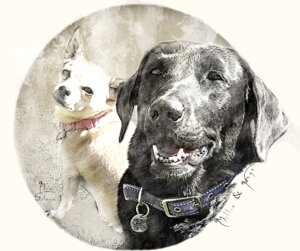
Millie & Hugo
Dogs relate to your essence more than your persona
This is one of the most beautiful things about living with dogs.
A dog does not know your carefully managed public self.
It knows your tone.
Your breath.
Your rhythm.
The subtle shifts in your body.
The difference between when you are settled and when you are not.
The difference between when you are open and when you are defended.
In that sense, a dog often knows something very real.
Not your story.
Not your branding.
Not your image.
Your actual state.
And this is part of why people often say a dog knew them better than anyone.
Not because the dog understood their opinions.
But because the dog was relating to something more immediate than identity performance.
It was relating to being.
For IMMachines readers, this matters deeply.
Because so much of awakening involves noticing the difference between:
- the self you present
- and the self that is actually here
Dogs do not care much about the presentation.
They meet what is real.
That makes them unexpected companions in identity awakening.
Dogs remind us what we were like before fear took over
Perhaps one of the deepest recognitions is this:
Dogs are not necessarily “better” than humans.
They may simply show us what a heart looks like before it becomes overrun by fear, calculation, and self-protection.
That is a startling thing to notice.
Because when you are with a dog, you can feel the contrast between:
- guardedness and openness
- management and simplicity
- strategy and presence
- fear and trust
- performance and naturalness
Dogs often meet life with less armour.
Not because they are naive, but because they do not seem to be living from the same level of defended identity.
And in their presence, you may feel invited into a gentler version of yourself too.
A version that is:
- less guarded
- less performative
- less tangled
- less mentally elsewhere
- more available to life
That is not sentimental.
It is profound.
Why losing a dog hurts so deeply
Anyone who has loved and lost a dog knows that the grief can be enormous.
Sometimes surprisingly enormous.
That grief is real because the bond was real.
You did not love the dog through ideas alone.
You loved through:
- mornings
- routines
- familiar sounds
- touch
- companionship
- shared silence
- the simple safety of presence
So when a dog leaves, you do not only lose an animal.
You lose a way of being.
You lose a rhythm.
A softness.
An innocence.
A form of wordless safety.
And perhaps part of what is being mourned is not only the dog, but the version of yourself that was more settled, more open, and less defended in that shared field of presence.
That is why the grief can feel so deep.
Because something beautiful and unguarded was happening there.
Dogs teach us that presence matters more than duration
One of the hardest truths is that dogs do not stay long.
Their lives are brief compared to ours.
That brevity hurts.
But it also teaches something very important.
Love is not valuable only because it lasts forever.
Sometimes its value lies in how fully it is lived while it is here.
Dogs teach:
- presence matters more than duration
- depth is not measured only in years
- grief is the cost of real love
- love is participation, not possession
That is a profound lesson for humans, because we often try to turn love into ownership.
We say “my dog” as though life can be possessed.
But a dog is not really a possession.
It is a being that walks beside you for a while.
A temporary companion.
A living teacher.
A sacred arrangement.
When seen this way, the relationship becomes even more beautiful.
Not because it lasts forever.
But because it asks you to love fully while it is here.
What dogs can teach us about identity awakening
This is where the connection becomes especially meaningful.
The Identity Awakening System (IAS) is about remembering who you are beneath conditioning, roles, fear, and inherited identity. The system repeatedly returns to themes like resonance, truth, releasing old identities, and allowing a more authentic self to emerge. It describes awakening as a journey from the identity the old system gave you to the one your soul is asking for now.
Dogs support this in surprising ways.
They teach us:
1. Presence before performance
A dog meets what is here now.
This can remind us to stop living only from memory, ambition, or self-image.
2. Love without constant self-management
A dog’s affection can help soften the old habit of earning love through performance.
3. Safety without explanation
A dog often offers a form of nonverbal companionship that allows the nervous system to settle.
4. Simplicity over complexity
Dogs remind us that much of human suffering comes from overthinking, self-commentary, and unnecessary inner negotiation.
5. Essence over persona
A dog relates more to your being than your branding, which mirrors the IAS invitation to move beneath inherited roles and into something truer.
6. Living without armor
Dogs can show us, by contrast, how defended human identity often is — and how much gentler life can feel when the heart softens.
In this sense, dogs are not just companions.
They are identity mirrors of a very unusual kind.
They do not analyse you.
They do not diagnose you.
They do not teach in concepts.
They remind.
Dogs and the old self
Many of us have been trained into an old kind of identity:
- productive
- self-conscious
- performative
- strategic
- anxious
- defended
- busy
- disconnected from the body
- rarely fully present
The IAS prologue speaks about how the world has shaped people through job roles, school conditioning, corporate systems, financial pressure, obligation, fear, and survival patterns, and describes awakening as the shift out of those old structures into truth, resonance, and inner authority.
Dogs stand outside much of that machinery.
They are a kind of interruption.
A soft interruption.
A joyful interruption.
A grounding interruption.
They pull us away from becoming too mechanical.
Too abstract.
Too defended.
Too mentally absent from our own life.
That is part of their gift.
Perhaps dogs are here to remind us
Maybe dogs are not in our lives simply for companionship, responsibility, or comfort.
Maybe they are also reminders.
Reminders to:
- arrive without armour
- love without calculating so much
- be here now
- trust simple presence
- soften the defended heart
- stop living entirely inside thought
- remember that being alive is not the same as managing life
That may be why being with a dog can feel like a spiritual experience.
Because for a little while, life becomes simpler.
Not shallow.
Simpler.
And in that simplicity, something essential becomes easier to feel.
Closing
Dogs teach in a way that many human systems do not.
They do not instruct through theory.
They teach through:
- presence
- loyalty
- immediacy
- love without constant condition
- the quiet safety of shared being
For anyone on an awakening path, this matters.
Because awakening is not only about thinking differently.
It is also about becoming less defended, less performative, and more present to what is real.
Dogs help us remember that.
They remind us that beneath the noise, beneath the masks, beneath the self-management, there is something simpler and truer available.
And sometimes, when a dog rests beside you, looks at you, and asks nothing more than your presence, it feels as though life itself is whispering:
Stop thinking.
Sit here.
This is enough.