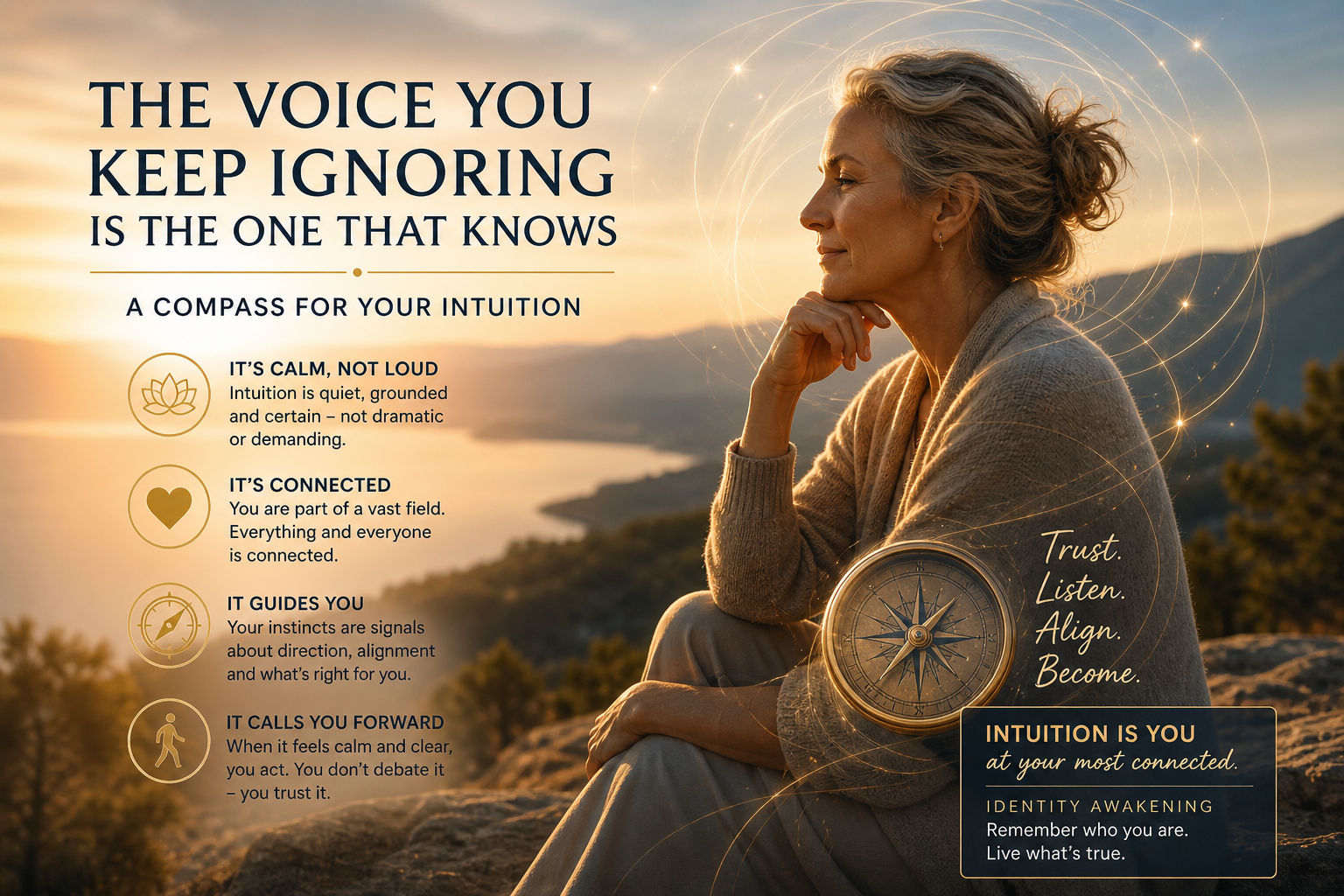
Intuition is not loud, dramatic, or irrational.
It often arrives as a quiet knowing, a pull, a pause, or a sense that something is aligned.
Here is how to use intuition in work, life, and Identity Awakening.
There is a voice many of us learn to ignore.
It is not usually loud.
It does not shout over the noise of life.
It does not always come with a full explanation.
It often arrives quietly, as a calm sense of knowing.
A pause.
A pull.
A hesitation.
A feeling in the body.
A sentence that appears from nowhere.
A sense that something is right.
A sense that something is wrong.
A quiet inner certainty that does not need to perform.
This is intuition.
I have used intuition extensively throughout my work and life. Not as fantasy. Not as a way to avoid practical decisions. Not as an excuse to ignore reality. But as a genuine inner compass.
Some of the most important choices I have made did not begin with logic.
They began with a feeling I had learned to respect.
Over time, I have come to believe that intuition is one of the most important human abilities we have — especially now, in a world full of noise, pressure, distraction, AI, algorithms, economic change, and external opinion.
The question is not whether intuition exists.
The question is whether we are quiet enough, honest enough, and courageous enough to listen.
I was able to test my intuition during my banking career. Often a lending decision had to be made with incomplete information and I often used my intuition to fill that space. If I went against my intuition, I always regretted it. Over the course of many years, I trusted it more and more and it rarely led me astray.
What intuition really is
Intuition is not random guessing.
It is not emotional drama.
It is not wishful thinking.
It is not blindly doing whatever feels comfortable.
True intuition has a different quality.
It is calm.
It may still lead you toward something challenging. It may ask you to make a decision that other people do not understand. It may guide you away from something that looks impressive on paper. It may tell you to wait when everyone else says move. It may tell you to move when everyone else says wait.
But underneath it, there is often a strange steadiness.
Not hype.
Not panic.
Not desperation.
A deeper kind of knowing.
The mind may not be able to explain it yet, but the body recognises it.
This matters because most of us were trained to value only visible evidence. We were taught to look outside ourselves for answers: school, employers, experts, institutions, family systems, social expectations, and financial pressure.
Over time, many people stopped asking:
What do I know to be true inside myself?
That is where intuition begins.
Intuition is not anti-logic
One mistake people make is thinking intuition and logic are enemies.
They are not.
Logic is useful. Research is useful. Data is useful. Planning is useful. Experience is useful.
But logic works with what it can already see.
Intuition often senses what has not yet become obvious.
Logic says, “Here are the facts.”
Intuition says, “Something about this matters.”
Logic says, “This opportunity looks good.”
Intuition says, “But something feels off.”
Logic says, “This path makes sense.”
Intuition says, “But it is not mine.”
The wisest decisions often come when logic and intuition are allowed to speak to each other.
Not when one dominates the other.
If logic is the map, intuition is the compass.
The map shows possible roads.
The compass tells you which direction is yours.
A note on science, fields, and intuition
Modern physics reminds us that reality is far stranger, more connected, and less solid than ordinary perception suggests. The world is not just a collection of separate objects bumping into each other. At a fundamental level, fields, forces, relationships, and patterns matter.
In human life, intuition often feels like our ability to sense patterns before we can explain them.
A person walks into a room and feels the atmosphere.
A business opportunity looks right, but something feels misaligned.
A conversation reveals more than the words being spoken.
A decision feels heavy, even though it appears sensible.
Another decision feels clean, even though it is uncertain.
This does not mean intuition is magic.
It may mean we are more perceptive than we realise.
How intuition speaks
Intuition rarely arrives as a full essay.
It usually speaks in signals.
Here are some common ways it appears:
1. A calm inner knowing
This is the clearest form.
You may not be excited. You may not be frightened. You may simply know.
There is a quiet certainty. Your mind is quiet and you do not overthink.
Not forceful. Not dramatic. Just there.
2. A sense of contraction or expansion
Some decisions make the body tighten. You ‘know’ something is off, even if you cannot articulate exactly what it is. You keep revisiting the decision in your mind.
Other decisions create a feeling of space.
This does not always mean the easy thing is right. Sometimes the right path still scares us. But there is often a difference between fear that comes from growth and heaviness that comes from misalignment.
3. Repeated themes
If the same idea, person, subject, opportunity, or discomfort keeps returning, it may be worth listening.
Life often repeats what we are meant to notice.
The Identity Awakening System uses this exact principle by helping people notice repeated themes, desires, discomforts, values, strengths, and patterns as signals of identity and direction.
4. A sudden pause
Sometimes intuition is not a yes.
It is a pause.
Something in you says, “Wait.”
That pause is worth respecting.
5. A quiet pull
Not obsession.
Not craving.
Not urgency.
A quiet pull is different. It does not chase you. It invites you.
6. Discomfort that reveals truth
Sometimes intuition does not feel soothing.
Sometimes it shows you the truth you have been avoiding.
It may say:
“This relationship is not right.”
“This work is draining you.”
“You are hiding.”
“You already know what you need to do.”
“You are ready to change.”
“This identity no longer fits.”
That kind of intuition can feel uncomfortable before it feels liberating.
How to tell intuition from fear
This is one of the most important distinctions.
Fear is usually noisy.
It rushes.
It loops.
It catastrophises.
It argues.
It seeks reassurance.
It imagines humiliation, rejection, loss, or failure.
It often says, “What if everything goes wrong?”
Intuition is usually quieter.
It is simple.
It is direct.
It does not need a long argument.
It does not bully you.
It does not panic.
It may still warn you, but it does not usually flood you.
Fear often feels like pressure.
Intuition often feels like clarity.
Fear says, “Do this or you are not safe.”
Intuition says, “Pay attention.”
Fear tightens your world.
Intuition opens a path.
How to tell intuition from desire
Desire can also be confused with intuition.
Desire often wants an outcome.
It wants approval.
It wants success.
It wants relief.
It wants validation.
It wants to be chosen.
It wants the thing now.
Intuition is less attached.
It may guide you toward something you desire, but it does not usually feel needy.
It is possible to want something badly and still sense that it is not aligned.
It is also possible to feel afraid of something and still know it is the right step.
That is why intuition requires honesty.
Not every feeling is guidance.
Some feelings are wounds.
Some are habits.
Some are old identities protecting themselves.
Some are social conditioning.
Some are nervous-system reactions.
The work is not to believe every feeling.
The work is to learn which inner signals are true.
How to strengthen your intuition
Intuition becomes clearer when you build a relationship with it.
You do not strengthen intuition by forcing it.
You strengthen it by listening, testing, reflecting, and noticing.
1. Create quiet space
If your life is full of noise, intuition has no room.
Even five minutes of stillness can help.
No phone.
No input.
No scrolling.
No problem-solving.
Just sit and notice what is present.
Ask:
What do I already know that I have been avoiding?
Then wait.
Do not force an answer.
2. Notice your body
The body often registers truth before the mind can explain it.
When you think about a decision, notice:
Do I feel open or closed?
Light or heavy?
Clear or foggy?
Grounded or agitated?
Expanded or compressed?
Calm or pressured?
Your body is not always the final authority, but it is an important messenger.
3. Keep an intuition journal
Write down intuitive signals before you know the outcome.
For example:
“Something feels off about this opportunity.”
“I feel strangely calm about this decision.”
“I keep feeling pulled toward this subject.”
“I felt heavy after that conversation.”
“I feel energised when I talk about this idea.”
Then return later and see what proved accurate.
This builds trust.
4. Ask better questions
Intuition responds better to clear questions.
Try:
What feels true here?
What am I avoiding?
What is the next small step?
What feels aligned?
What feels forced?
What would I choose if I trusted myself?
What is my body trying to tell me?
What part of me already knows?
These questions are simple, but powerful.
5. Stop outsourcing every decision
Advice can be useful.
But if you ask ten people what to do before listening to yourself, your inner signal becomes buried.
Before asking others, ask yourself first.
Then guidance becomes support, not replacement.
6. Act on small intuitive signals
Do not begin by gambling your whole life on intuition.
Begin small.
Call the person you keep thinking about.
Take the different route.
Pause before saying yes.
Say no when your body contracts.
Explore the idea that keeps returning.
Write the thing you feel moved to write.
Take the next small step.
Each small act teaches your system:
“I am listening.”
7. Review the results
Intuition develops through feedback.
After acting, ask:
What happened?
Did I feel more aligned?
Did life open or close?
What did I learn?
Was that intuition, fear, desire, or habit?
This turns intuition into a practical skill.
Using intuition in work
Work is one of the places intuition is most often ignored.
We stay in roles that drain us because they look secure.
We accept opportunities because they look impressive.
We collaborate with people we do not trust because the numbers look good.
We keep building things that no longer feel alive because we already started.
But intuition is incredibly useful in work.
It can help you sense:
Which projects have life in them.
Which clients are not right for you.
Which partnerships are misaligned.
Which idea wants your attention.
Which direction feels stale.
Which opportunity is ego, not truth.
Which conversation needs to happen.
Which version of your work feels most alive.
The best work does not usually come from forcing yourself to copy what everyone else is doing.
It comes from alignment.
It comes from knowing who you are, what you value, what you see, and what wants to be created through you.
That is where intuition and identity meet.
Using intuition in life
In life, intuition often protects us from abandoning ourselves.
It speaks in relationships.
It speaks in health.
It speaks in timing.
It speaks in transitions.
It speaks when an old version of us is ending.
It speaks when a new version is emerging.
Many people look back and say:
“I knew.”
“I had a feeling.”
“I ignored the signs.”
“I talked myself out of it.”
“I should have trusted myself.”
“I felt it from the beginning.”
This is not said with shame.
It is said because, somewhere inside, we often do know.
The issue is not that intuition was absent.
The issue is that fear, politeness, logic, conditioning, or the desire to be liked spoke louder.
Identity Awakening helps reverse this pattern.
It helps a person return to inner authority.
How intuition connects to the Identity Awakening System
The Identity Awakening System is built around a simple but powerful truth:
You are not here to be filled with someone else’s answers.
You are here to remember your own.
That is why intuition matters so much.
Intuition is one of the ways identity speaks before it has language.
Before you can explain your next chapter, you may feel it.
Before you can name your purpose, you may sense it.
Before you can describe your new identity, you may notice what no longer fits.
Before you can build a new life, you may feel one small step calling.
The Identity Awakening System describes awakening as a journey of remembering. It is not about memorising information or being fixed. It is a dialogue-driven process that helps reveal who you are, who you are not, what you desire, what you fear, what resonates, what you are outgrowing, and who you are becoming.
That is intuition made visible.
The system does not replace your inner knowing.
It helps you hear it.
It does this by using AI as a mirror — not as an authority above you, but as a neutral space that reflects your patterns, words, desires, resistance, values, strengths, and emerging direction.
AI is not the source.
You are.
AI can help you notice what you already know.
That is the power.
The role of resonance
In Identity Awakening, resonance is central.
Resonance is the feeling of:
“Yes, that is true.”
“That is me.”
“I have always known this.”
“That sentence landed.”
“My body recognised that.”
“This feels aligned.”
Resonance is not analysis.
It is recognition.
When something resonates, it often means a hidden part of your identity has been named.
This is why intuition and resonance belong together.
Intuition sends the signal.
Resonance confirms it.
You may read a sentence and feel something open.
You may hear a question and feel exposed in a good way.
You may receive an AI reflection and think, “That is exactly it.”
You may notice discomfort and realise it is not danger — it is truth.
This is how identity begins to awaken.
Not through force.
Through recognition.
When intuition asks you to release an old identity
Sometimes intuition does not point toward something new.
Sometimes it points away from something old.
It may tell you:
You are no longer that person.
You no longer want that role.
You no longer believe that story.
You no longer fit that environment.
You no longer need to prove yourself that way.
You no longer want to create from fear.
This can be frightening.
Old identities create safety, even when they are limiting.
The worker.
The achiever.
The people-pleaser.
The rescuer.
The invisible one.
The expert who must always know.
The reliable one who never asks for help.
The person who waits for permission.
Intuition often begins by disturbing the old identity.
That discomfort is not failure.
It may be awakening.
A simple intuition practice
Here is a practice you can use today.
Find a quiet moment.
Take a few breaths.
Place your attention on your body.
Then ask yourself:
What do I already know that I keep ignoring?
Do not rush.
Let the answer be simple.
It may be one word.
Rest.
Leave.
Begin.
Wait.
Speak.
Create.
Ask.
Stop.
Trust.
Move.
Then ask:
What is the next small step?
Not the whole plan.
Not the five-year vision.
Just the next small step.
That is usually where intuition becomes practical.
The danger of ignoring intuition
When we ignore intuition repeatedly, life often becomes heavier.
We feel stuck.
We feel split.
We feel tired in ways sleep does not fix.
We feel successful but misaligned.
We feel surrounded but unseen.
We feel busy but not alive.
This is because part of us knows we are not listening.
The cost of ignoring intuition is not always immediate disaster.
Sometimes the cost is slow disconnection from ourselves.
And that may be worse.
The longer we ignore the inner voice, the harder it becomes to hear.
But the good news is this:
It never fully disappears.
It waits.
Quietly.
Patiently.
Without judgment.
The moment we begin listening again, the relationship can be rebuilt.
The courage to act
Intuition is not complete until it becomes action.
Not reckless action.
Not dramatic action.
Aligned action.
Sometimes the action is a conversation.
Sometimes it is a pause.
Sometimes it is a boundary.
Sometimes it is a health check.
Sometimes it is beginning a project.
Sometimes it is ending one.
Sometimes it is admitting a truth.
Sometimes it is taking one small step in the direction you have been avoiding for years.
This is where many people stop.
They feel the signal, but do not move.
They wait for certainty.
They wait for permission.
They wait until fear disappears.
But intuition often requires movement before full clarity arrives.
You act on the next honest step.
Then life responds.
Then the next step appears.
Final thought: intuition is you, remembering
Perhaps intuition is not something strange.
Perhaps it is not outside you.
Perhaps it is not supernatural in the way people imagine.
Perhaps intuition is simply you at your most connected.
Connected to your body.
Connected to your experience.
Connected to your truth.
Connected to your values.
Connected to your future.
Connected to the part of you that has not been fully conditioned by fear.
That is why it matters.
Your intuition is not trying to impress you.
It is trying to guide you home.
And the more you listen, the more your identity begins to awaken.
Not because someone gives you the answer.
But because you finally recognise the answer that was already within you.