There is a kind of resilience we often celebrate.
The person who survives hardship.
The person who keeps going.
The person who gets back up.
The person who does not quit when life becomes difficult.
That kind of resilience matters.
But there is another kind of resilience that may be even rarer.
The resilience of staying open.
Some people go through difficult lives and become hard. They become suspicious, cynical, guarded, angry, or permanently braced against the next disappointment. And in many ways, that is understandable. Pain teaches the nervous system to protect itself. If life has hurt us enough times, the heart may conclude that softness is dangerous.
So we build walls.
We become analytical.
We become defensive.
We become controlling.
We become watchful.
We become less trusting.
We tell ourselves we are simply being realistic.
And perhaps we are.
But sometimes what we call realism is just woundedness that has learned to sound intelligent.
True resilience is not only the ability to survive pain.
It is the ability to survive pain without letting pain become our identity.
That is why I deeply admire people who have lived through hardship and still remain loving, caring, open and hopeful. There is something quietly heroic about that.
(I have seen both sides in the many business owners I have interacted with!)
They have seen enough to become bitter, but they have not chosen bitterness.
They have been hurt enough to close, but they still choose connection.
They have been disappointed enough to become cynical, but they still carry hope.
They have known enough difficulty to expect the worst, but something in them still turns toward life.
That is not naivety.
That is strength with a soft heart.
In a world that often mistakes hardness for wisdom, this matters deeply. We can easily assume that the most awakened person is the one who sees every danger, questions every system, anticipates every betrayal, and prepares for every collapse.
There is value in discernment. There is value in seeing clearly. There is value in not being easily deceived.
But discernment without love can become suspicion.
Truth-seeking without joy can become heaviness.
Protection without trust can become a prison.
And awareness without an open heart can slowly turn into fear wearing the mask of wisdom.
This is one of the great challenges of identity awakening.
When we begin to see through old stories, old systems, old roles and old beliefs, we may feel a deep need to protect ourselves. We may look back and realise how much of our identity was built around survival, approval, duty, fear or false security.
That realisation can be liberating.
But it can also be destabilising.
If we are not careful, awakening can become another defended identity. Instead of returning to the deeper self, we become “the one who knows,” “the one who sees,” “the one who must warn everyone,” “the one who must stay guarded because the world is dangerous.”
And while that identity may feel powerful at first, it can also steal our lightness.
This is why the resilience of staying open is so important. (Personally, I find this difficult when I read of some of the horrors going on! Looking back, I have closed a part of myself from the life I could have had just because I think I know too much of what is going on in reality!)
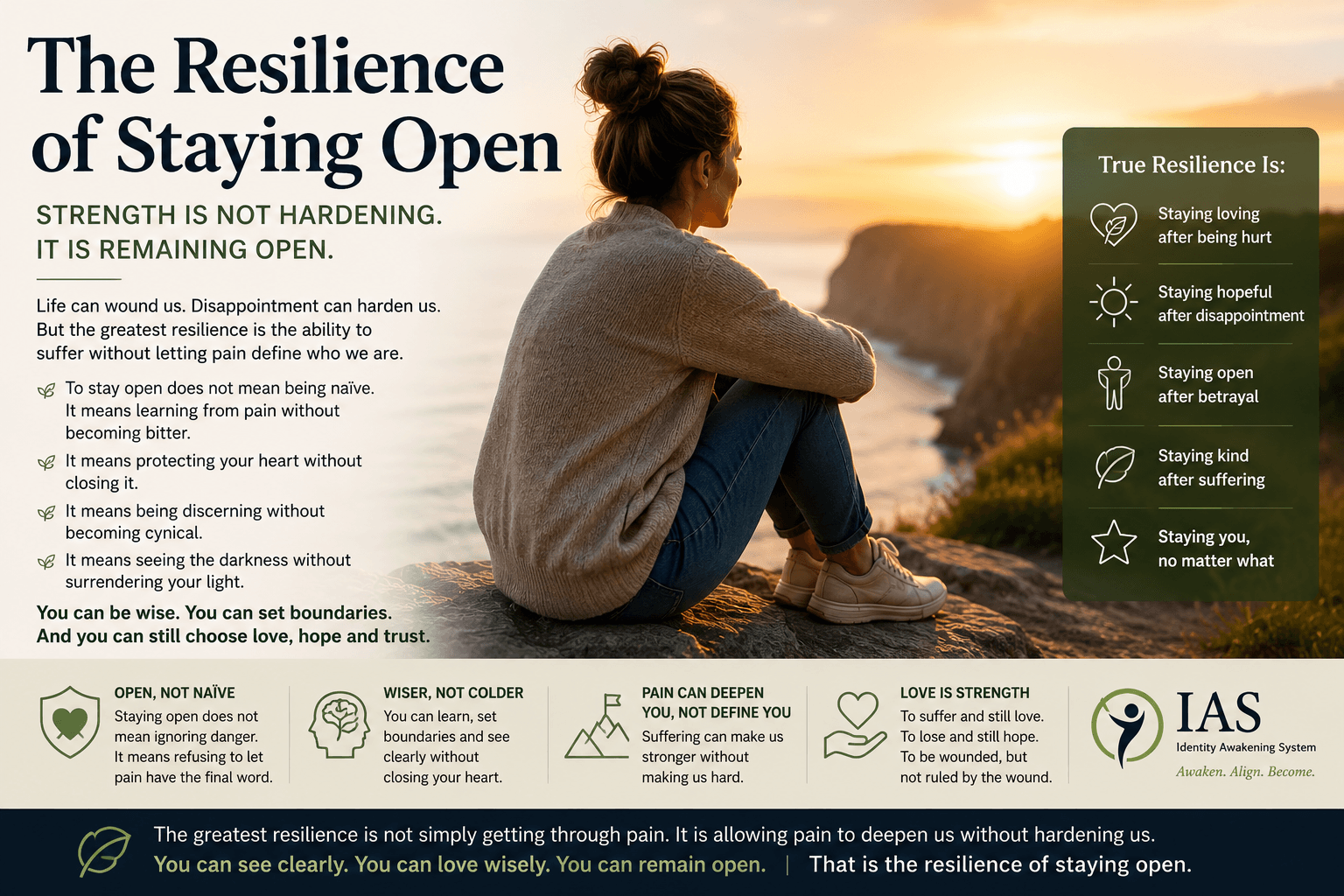
To stay open does not mean being foolish. It does not mean ignoring danger. It does not mean trusting everyone blindly or pretending life has no shadows.
Staying open means refusing to let pain have the final word.
It means saying:
“I will learn from what hurt me, but I will not become only my wounds.”
It means allowing life to make us wiser without making us cold.
It means protecting our boundaries without closing our heart.
It means being able to see darkness without surrendering our inner light.
That is a very high form of strength.
Many people survive hardship by becoming harder. But the deeper healing is to become clearer, kinder, wiser and more loving without becoming less truthful.
This is where the Identity Awakening System can help.
IAS is about examining the identities we formed in order to survive. Some people formed the identity of the achiever. Some became the fixer, the rescuer, the responsible one, the rebel, the pleaser, the provider, the protector or the one who must always be on guard.
These identities may have helped us cope. But they may not express who we truly are beneath the defence.
IAS helps us ask:
What did hardship make me become?
Did pain make me wiser, or only more defended?
Can I protect myself without closing my heart?
Can I become discerning without becoming cynical?
Can I stay awake without losing joy?
These are not small questions.
They are the questions that decide whether awakening makes us more whole or merely more armoured.
Because the aim is not to become naïve.
The aim is to become free.
Free enough to see clearly.
Free enough to love wisely.
Free enough to set boundaries.
Free enough to remain hopeful.
Free enough to keep creating, caring and opening to life.
Perhaps the greatest resilience is not simply getting through pain.
Perhaps the greatest resilience is allowing pain to deepen us without hardening us.
To suffer and still love.
To lose and still hope.
To see clearly and still remain kind.
To be wounded, but not ruled by the wound.
That is the resilience of staying open.
And in a world that gives us many reasons to close, it may be one of the most beautiful forms of courage. (I am not saying I possess it, but it is something I aspire to!)