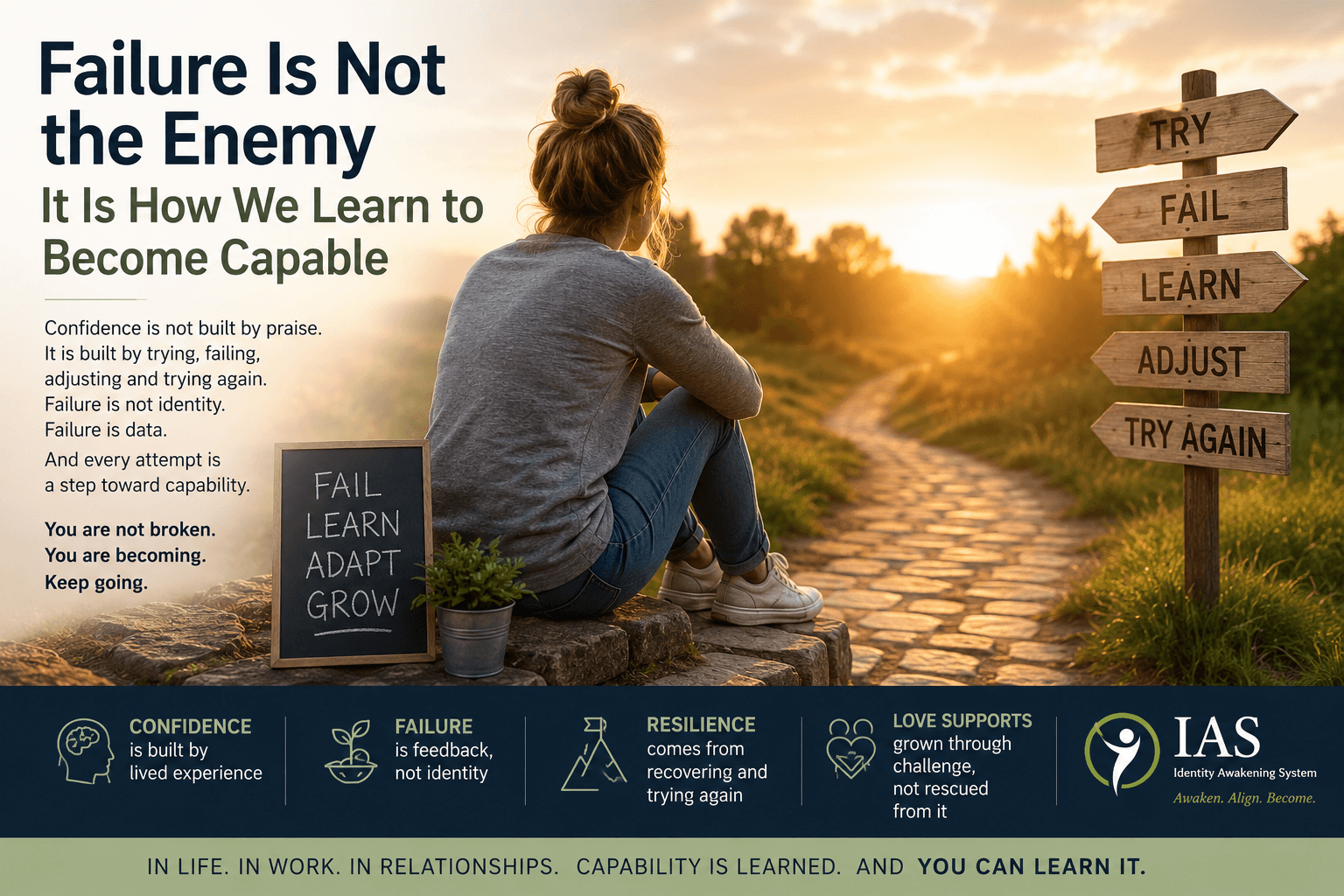
Failure is not the enemy. It is how we learn to become capable. Confidence is not built mainly by praise, but by trying, failing, adjusting and discovering that we can recover. This reflection explores why failure is not identity — it is feedback.
One of the hardest things to watch is someone we care about making choices that may weaken them.
Not because we want to control them. Not because we think we know everything. But because we can sometimes see the lesson coming before they can.
We see that if a person is protected from too much ordinary responsibility, they may not develop the practical confidence needed for real life.
They may be loved.
They may be supported.
They may be cared for.
They may even be spared discomfort.
But if they are never expected to contribute, try, fail, adjust, and try again, something important may not develop.
Capability.
This is one of the hidden truths of life.
Confidence is not built mainly by praise. It is built by evidence.
A person becomes confident because they have lived through small moments of difficulty and discovered:
“I can handle this.”
They tried something.
They made a mistake.
They adjusted.
They learned.
They survived the embarrassment.
They became a little stronger.
This is how practical life teaches us.
It teaches through doing. It teaches through inconvenience. It teaches through responsibility. It teaches through the small failures that show us we are not as fragile as we feared.
But in a world that often tries to protect people from discomfort, we may unintentionally protect them from growth.
If a young person never has to contribute to the household, they may not learn to notice what needs doing. If they are always rescued from difficulty, they may not learn how to recover from failure. If ordinary responsibilities are removed from their life, they may enter adulthood without the emotional muscle needed to cope when life pushes back.
And life always pushes back… eventually.
This matters far beyond household chores.
It applies to work.
It applies to relationships.
It applies to business.
It applies to driving tests.
It applies to health.
It applies to money.
It applies to the future of AI, creativity and self-employment.
Many people are now facing a world where the old systems may no longer protect them in the way they once did. Jobs are changing. Institutions are becoming less reliable. AI is reshaping work. The old instruction-based path — go to school, get a job, follow the rules, retire safely — is becoming less certain.
That means practical resilience is becoming more important, not less.
The future will require people who can learn, adapt, experiment, fail, recover and keep moving.
But that is difficult for people who have been trained to avoid failure rather than learn from it.
Failure becomes terrifying when we see it as identity. (I think schooling may teach us this!)
“I failed” becomes “I am a failure.”
That is the wound.
A failed test, a failed business idea, a failed relationship, a failed attempt at creating something new — none of these should become a verdict on the self. They are feedback. They are information. They are part of the process of becoming capable.
Failure is not identity.
Failure is data.
This is especially important for creators, solopreneurs and people going through identity change.
When we leave an old role behind, we often become beginners again. That can feel humiliating. A person who was once competent in a job, marriage, profession or social role may suddenly feel clumsy in a new chapter.
Starting a business feels awkward.
Creating content feels exposed.
Using AI feels confusing.
Building a new identity feels uncertain.
Trying something new brings the risk of visible failure.
But this is where growth happens.
A person cannot become creative without experimenting. They cannot become entrepreneurial without testing ideas. They cannot become resilient without meeting resistance. They cannot become spiritually mature without facing the parts of themselves that want certainty before courage.
This is where the Identity Awakening System can help.
IAS is not about pretending life will be easy. It is about helping people understand the roles, beliefs, fears and identities that shape how they respond to life. It helps people notice when failure has become tied to self-worth. It helps them separate who they truly are from the outcome of one test, one attempt, one business idea, one relationship, or one painful season.
In simple terms, IAS helps people move from:
“If I fail, I am not enough.”
to:
“If I fail, I can learn, adjust and grow.”
That shift is life-changing.
Because many people are not stuck because they lack intelligence. They are stuck because they lack permission to be imperfect while learning.
They have been trained to wait until they feel confident before acting. But confidence usually comes after action, not before it.
We become capable by doing.
We become resilient by recovering.
We become wise by learning from what did not work.
This does not mean we should be harsh, careless or indifferent to people’s struggles. Compassion matters. Support matters. Encouragement matters. But real love does not always remove every difficulty from someone’s path.
Sometimes real love helps them face the difficulty with support.
Sometimes it says:
“You can try.”
“You can fail.”
“You can feel shaken.”
“You can recover.”
“You can go again.”
“You are not broken because this was hard.”
That is the message many people need.
Not rescue from life.
Support in becoming strong enough to live it.
The question, then, is not:
How do I prevent every failure?
The deeper question is:
How do I help myself and others become the kind of people who can learn from failure without losing themselves?
That is the real work.
Because failure is not the enemy.
The real enemy is the identity that says failure means we are not enough.
And once that identity begins to dissolve, life becomes less frightening.
We can try.
We can fall.
We can learn.
We can rise.
And slowly, through lived evidence, we begin to discover:
“I can handle this.”