Many of the beliefs that shape our lives were never consciously chosen.
They were not calmly examined.
They were not tested in freedom.
They were not formed in peace.
They were formed in families.
And in some families, they were formed in pain.
This is one of the hardest truths to understand gently:
family trauma does not only create painful memories.
It also creates beliefs.
Beliefs about:
- safety
- love
- trust
- worth
- power
- truth
- silence
- belonging
- what is normal
- what must never be said
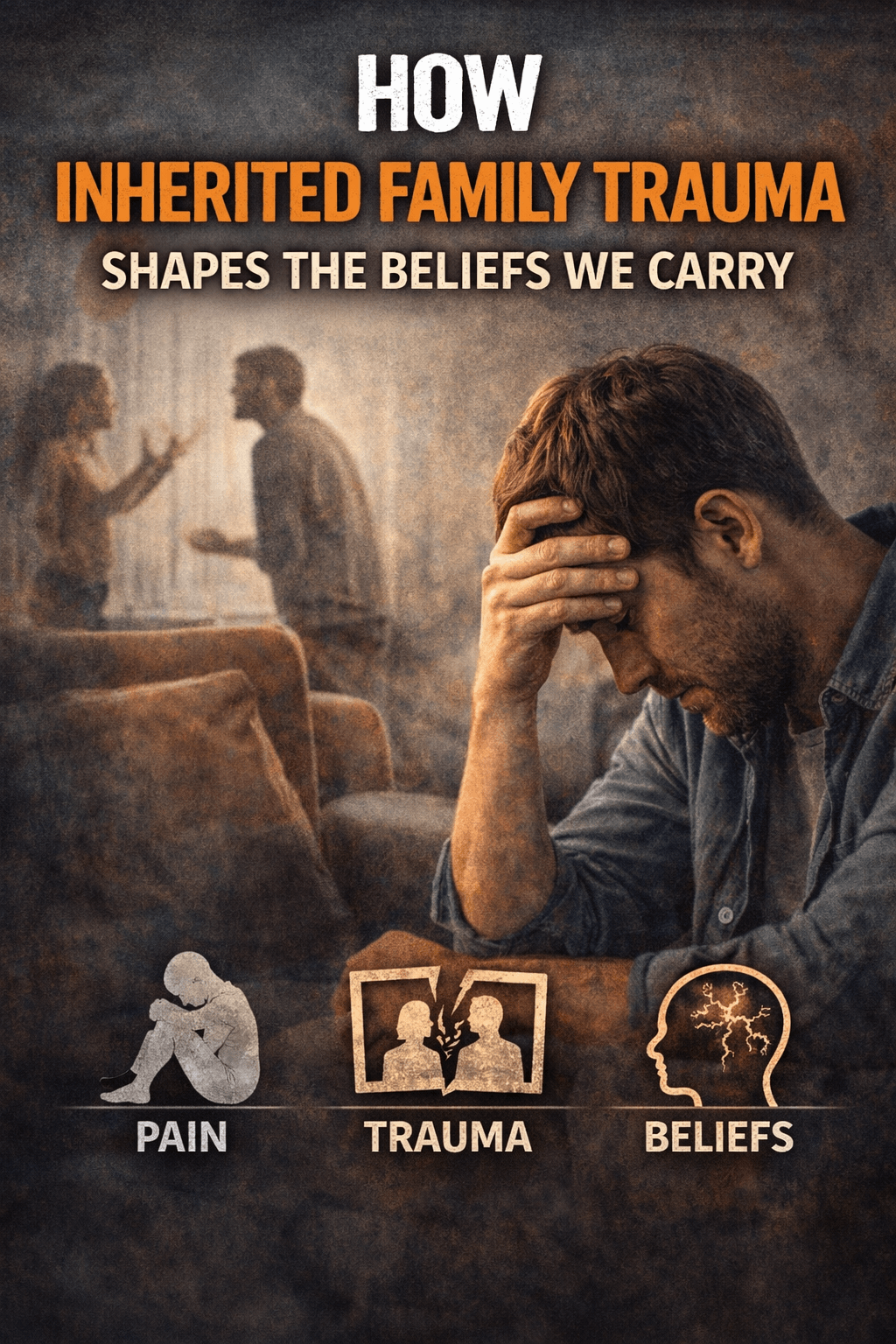
That is why inherited family trauma can shape identity so deeply.
Because trauma is not only something that happened.
It becomes a lens through which life is interpreted.
Trauma does not stay in one generation
Family trauma often moves silently from one generation to the next.
Not always because people are cruel.
Often because what was wounded was never understood, never healed, and never named clearly.
So it gets passed on through:
- behaviour
- nervous system responses
- emotional atmosphere
- silence
- over-control
- fear
- shame
- addiction
- volatility
- emotional absence
- family rules
- what is allowed and not allowed
A parent may never sit a child down and say, “You are not safe.”
But if the child grows up in a home shaped by fear, rage, instability, neglect, or emotional unpredictability, that belief may form anyway.
That is how trauma becomes belief.
Inherited trauma often feels normal from the inside
One of the most difficult parts is that children do not know they are growing up inside trauma-shaped patterns.
They only know:
- this is home
- this is family
- this is how life feels
- this is what love looks like
- this is what people are like
- this is what I have to do to get through
So what may later be recognised as trauma often began as normality.
That is why many adults do not realise how deeply family trauma has shaped their beliefs.
They do not think:
“I inherited trauma.”
They think:
“This is just who I am.”
“This is just how life is.”
“This is just how families are.”
“This is just how relationships work.”
But often it is deeper than that.
Trauma creates protective beliefs
When a child grows up around trauma, the mind and body begin forming beliefs that help them survive it.
These beliefs may once have been adaptive.
They may have helped the child:
- stay safe
- avoid punishment
- minimise conflict
- anticipate danger
- stay connected
- reduce emotional pain
- survive unpredictability
But later in life, those same beliefs can become limiting.
A child raised in trauma may come to believe:
- I must stay small
- I must not upset people
- I must always be alert
- love is unsafe
- my needs are dangerous
- I have to earn care
- truth causes trouble
- silence is safer
- people cannot be trusted
- I must stay in control
- I deserve mistreatment
- chaos is normal
These are not random thoughts.
They are survival beliefs.
Family abuse shapes belief in profound ways
Family abuse needs to be spoken about clearly here.
Abuse may be:
- physical
- emotional
- verbal
- sexual
- psychological
- coercive
- controlling
- neglectful
- spiritually manipulative
And abuse does not only hurt in the moment.
It shapes what a child comes to believe about themselves and the world.
A child who is abused may come to believe:
- I am not safe
- I am powerless
- my boundaries do not matter
- my body is not mine
- love and harm are mixed together
- I deserve this
- I should not speak
- no one will protect me
- truth makes things worse
- I am too much
- I am not enough
- I must disconnect to survive
These beliefs often become deeply embedded.
Not because they are true.
But because in a traumatic environment, they may feel necessary to survive.
Emotional abuse can be just as identity-shaping
Not all family trauma leaves visible bruises.
Some of the deepest wounds are emotional.
Emotional abuse may include:
- humiliation
- mockery
- constant criticism
- manipulation
- gaslighting
- emotional withdrawal
- love used as control
- never being allowed to feel or speak honestly
- walking on eggshells all the time
A child living in that atmosphere may become highly adapted.
They may become:
- pleasing
- vigilant
- quiet
- perfect
- numb
- hyper-responsible
- emotionally split off
And beneath that adaptation, beliefs form such as:
- my feelings are a problem
- I must not be real
- I have to perform to be loved
- I will be punished if I tell the truth
- I must manage other people’s emotions
- I do not have the right to exist as I am
This is how abuse becomes identity-level belief.
Trauma can also be inherited through silence
Some families do not speak about what happened.
There may be:
- abuse no one names
- grief no one expresses
- violence everyone minimises
- addiction everyone works around
- shame buried for decades
- secrets protected at all costs
Children feel this.
Even when they do not know the details.
They feel:
- tension
- fragmentation
- fear
- emotional absence
- something unspoken
- something not making sense
And from that, beliefs still form.
For example:
- do not ask questions
- do not go there
- truth is dangerous
- appearances matter more than reality
- loyalty matters more than honesty
- silence keeps the family together
This is how trauma can be inherited without ever being properly explained.
Trauma shapes the nervous system, not just the mind
This matters deeply.
Inherited family trauma is not only about thought.
It lives in the nervous system.
A person may believe life is unsafe not because they decided that intellectually, but because their whole body learned to expect danger.
They may:
- overreact to small signals
- fear conflict intensely
- struggle to relax
- freeze when truth is needed
- panic when someone is angry
- feel guilty for having needs
- confuse peace with danger because calm feels unfamiliar
This is important because trauma beliefs are often embodied.
They are felt before they are spoken.
That is one reason they can be so hard to change.
Why people stay loyal to trauma-based beliefs
This can feel confusing.
Why would someone hold onto beliefs that hurt them?
Because those beliefs may still feel tied to:
- loyalty
- belonging
- family identity
- emotional survival
- what love meant in the past
Questioning the belief may feel like questioning:
- your parents
- your childhood
- your place in the family
- the meaning of your pain
- the strategies that once kept you alive
That is why awakening around family trauma must be gentle.
Not because the truth should be softened beyond recognition.
But because the nervous system often needs safety before it can release what it built to survive.
Common trauma-shaped beliefs people carry into adulthood
These are some very common beliefs formed through inherited family trauma:
- I am only safe when I stay quiet
- love always comes with pain
- I have to earn care
- I must not trust my instincts
- I need to monitor everyone else
- I am responsible for keeping things stable
- if I tell the truth, something bad will happen
- my boundaries will not be respected
- I am hard to love
- I must be useful to matter
- my body is not fully safe
- conflict means danger
- I should expect betrayal
- I must not need too much
Many people carry beliefs like these without realising where they came from.
They simply experience them as “my personality” or “how life is.”
This is not about blaming parents simplistically
This is important to say.
Understanding inherited trauma does not require simplistic blame.
Some parents were carrying trauma they never understood.
Some repeated what was done to them.
Some loved their children and still passed on fear, shame, silence, or harm.
Some caused very real damage.
Some were deeply unsafe.
The point is not to flatten every family into the same story.
The point is to become honest about what shaped us.
Because healing does not begin with pretending everything was fine.
It begins with clearer seeing.
How identity awakening helps
The Identity Awakening System helps people begin separating:
- who they are
- from what they inherited
- from what trauma taught them
- from what survival required
- from what family systems rewarded
- from what abuse made them believe
It helps you ask:
- What beliefs did my family trauma install in me?
- What did I have to become in order to survive my early world?
- What still feels true in my body but may not actually be true now?
- What did abuse or instability teach me about love, safety, and worth?
- What am I ready to outgrow?
- Who am I beneath what trauma taught me?
This is sacred work.
Because for many people, awakening begins the moment they realise:
Some of what I thought was my identity was actually survival.
A gentler truth
If inherited family trauma has shaped the beliefs you carry, that does not mean you are broken.
It means you adapted.
It means your system learned what it had to learn to get through.
That deserves compassion.
But adaptation is not the same as truth.
And survival identity is not the deepest self.
There comes a point when the beliefs that once protected you begin to feel too painful, too small, or no longer true.
That is often where awakening begins.
Closing
Inherited family trauma shapes beliefs in deep and often invisible ways.
It shapes what feels safe.
What feels possible.
What feels normal.
What feels lovable.
What feels dangerous.
And who we believe we have to be.
But not every belief formed in trauma is the truth of who you are.
Some beliefs were survival.
Some were protection.
Some were the child’s attempt to make sense of pain.
Awakening begins when you can gently ask:
What did trauma teach me to believe?
What did abuse make feel normal?
What am I still carrying that is not truly mine?
That is where identity begins to come home to itself.