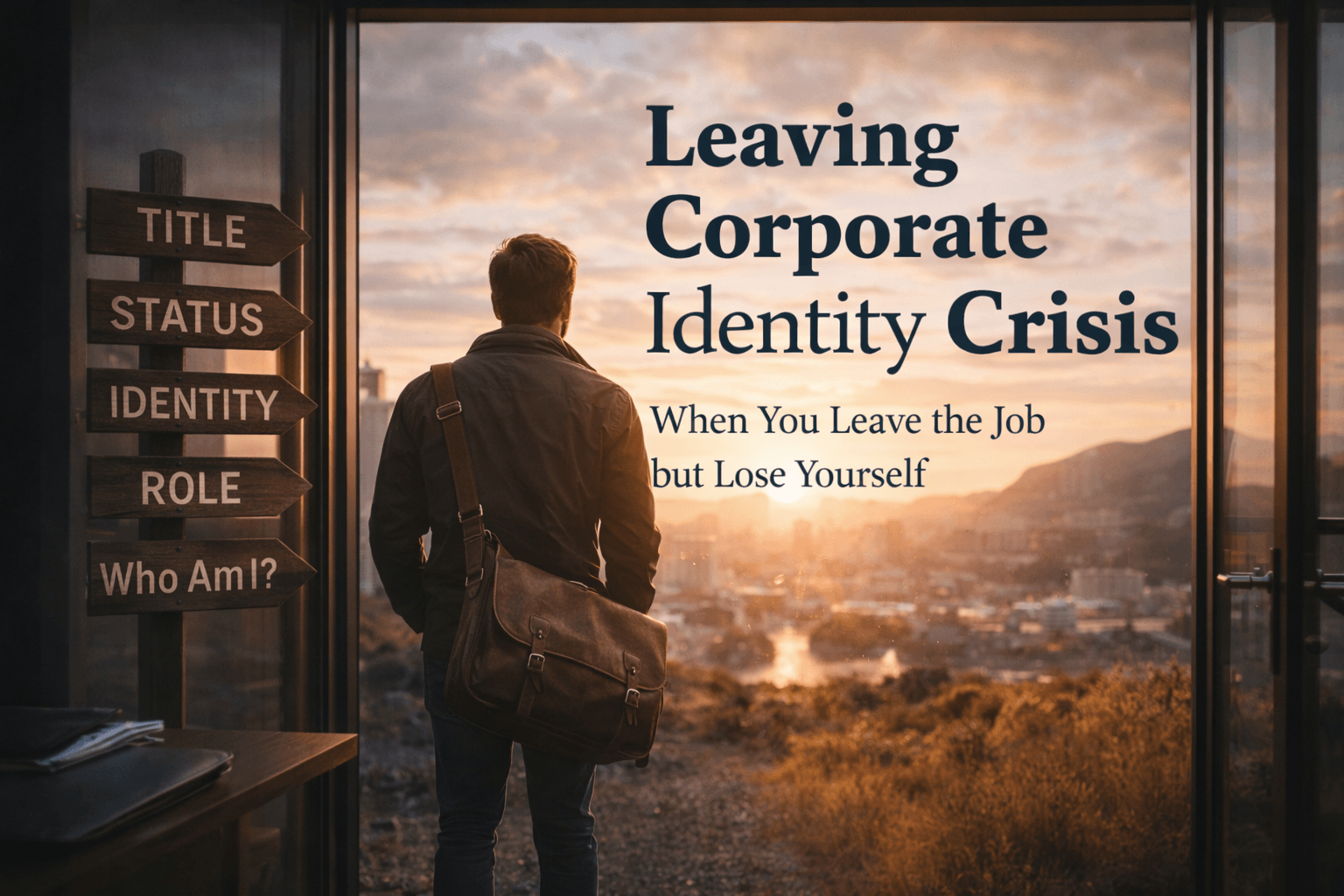
Personal Story:
I voluntarily left corporate banking in 2001 to set up my own business consultancy – the transition from corporate banker to entrepreneur was a much harder transition than I anticipated because I was effectively adopting a new identity.
I wish I could have gone through the self-reflection process that is my Identity Awakening System before I embarked on my personal journey. If you are in this position now, then my strongest recommendation is that you pause and give some space for yourself by going through my system. You will find it an extremely valuable exercise, I promise!
Joining the dots backwards from what I am doing today… in the course of my consulting I bought a manufacturing business out of liquidation and sold it after a year spent turning it around. I then created a bookkeeping business but shortly after transitioned into internet marketing and then I started researching (it has been 10 years now) the globalist deep state, which President Trump is currently dismantling! I read every one of the 5,000 Q posts in an effort to understand what US military intelligence was planning.
I am currently exploring AI which led me into the topic of Identity Awakening which I believe will be critically helpful for most people given that we have entered a fast-paced period of change caused by the combination of AI, robotics and the release of 6,000 suppressed patents that will be released soon. Many job roles will change or be lost and our collective ability to deal with the change of identity that entails will be critical to our well-being.
Leaving corporate life is often imagined as freedom. (I certainly did!)
More space.
More time.
More authenticity.
More breathing room.
A chance to finally live on your own terms.
And sometimes it is.
But there is another side to leaving corporate that many people do not expect.
It can feel disorienting.
Lonely.
Unsettling.
Emotionally flat.
Even like part of you has disappeared.
Because sometimes when you leave corporate, you are not only leaving a job.
You are leaving an identity.
The part no one talks about
For years, corporate life may have given you far more than an income.
It may have given you:
- structure
- status
- routine
- belonging
- recognition
- momentum
- direction
- self-worth
- a clear role in the world
You knew who you were in that environment.
You knew how to speak.
How to perform.
How to measure yourself.
How to succeed.
How to be seen.
How to matter.
So when you leave, the loss is not always only practical.
It can feel deeply personal.
You may suddenly find yourself asking:
- Who am I without this role?
- What am I now?
- Why do I feel flat when I thought I would feel free?
- Why does life feel strangely empty?
- Why do I miss something I no longer even want?
These are not small questions.
They point to something deeper than career transition.
They point to identity.
Why leaving corporate can trigger an identity crisis
Many people in corporate life build a self around being:
- productive
- capable
- needed
- respected
- high-functioning
- responsible
- in demand
- in control
These qualities can become central to identity.
Not just things you do.
Things you are.
Over time, the corporate role can become the main structure around which self-worth is organised.
So when you leave, you may lose:
- the title
- the pace
- the external validation
- the hierarchy
- the targets
- the meetings
- the feeling of relevance
- the daily proof that you matter
That can create a strange internal vacuum.
Not because you truly have less value.
But because the identity that helped you feel stable is no longer holding you in the same way.
That is why leaving corporate can trigger a real identity crisis.
Freedom can feel unfamiliar at first
This is one of the hardest parts.
People often assume that once the pressure is gone, peace will arrive immediately.
But if your nervous system and identity have been shaped around pressure, structure, and performance for years, freedom can feel unfamiliar.
Even uncomfortable.
You may find yourself:
- restless when things are quiet
- guilty when not being productive
- unsure what matters without goals
- disconnected from yourself outside the role
- strangely empty without the pace
- missing the structure even when you do not miss the job
This does not mean you made the wrong decision.
It may simply mean that corporate life shaped more of your identity than you realised.
The loss of status can be surprisingly painful
One of the quiet wounds of leaving corporate is the loss of status.
Not because status is everything.
But because people are often treated differently when they have a role, title, or visible importance.
In corporate life, people may have listened to you.
Needed you.
Deferred to you.
Recognised you.
You had a place in the system.
When that disappears, the silence can feel strange.
You may feel less visible.
Less relevant.
Less certain of your place.
This can be hard to admit.
But it is real.
Because for many people, corporate identity was not only about work.
It was about significance.
Why some people feel lost after leaving corporate
People often think they are supposed to bounce straight into a new chapter.
A business.
A passion project.
Consulting.
Freedom.
A fresh purpose.
Sometimes that happens.
But often there is a gap first.
A messy middle.
A season where the old self has faded, but the new one is not yet clear.
This can feel like:
- loss of direction
- emotional flatness
- drifting
- uncertainty
- not knowing what you want anymore
- not knowing who you are without the old world
This is not always failure.
Sometimes it is the honest middle stage of identity change.
The old self no longer fits.
But the deeper self has not fully taken form yet.
You may not miss the job — you may miss the identity it gave you
This is an important distinction.
Many people say they miss corporate life, but what they often miss is not the work itself.
They miss:
- certainty
- structure
- relevance
- momentum
- social identity
- external validation
- feeling useful in a familiar way
That is why the longing can feel confusing.
Part of you may know you do not want to go back.
But another part still misses what that life gave your identity.
Seeing that clearly can be a turning point.
Because then the question changes.
Not:
Should I go back?
But:
What has this role been giving me that I have not yet learned to hold in a deeper way?
This is not just a career problem
That is the key.
Leaving corporate identity crisis is not only about finding your next job, project, or plan.
It is about understanding:
- who you became inside that world
- what that world rewarded in you
- what parts of you were overdeveloped
- what parts of you were neglected
- what identity was built around performance
- what is left when the system no longer defines you
This is why surface-level answers often do not feel sufficient.
Because the real issue is not only practical.
It is existential.
You are more than the role you played
This can take time to truly feel.
When you have spent years being recognised through your role, it is easy to mistake the role for the self.
But you were never only:
- the title
- the position
- the performer
- the decision-maker
- the corporate persona
Those things may have expressed part of you.
But they were never the whole of you.
Leaving corporate can become painful when a person has nowhere deeper to stand than the identity the role provided.
That is why this season, difficult as it may be, can also become important.
It can become the moment when you begin asking a deeper question:
Who am I when I am no longer being defined by the system?
How the Identity Awakening System helps
The Identity Awakening System was created for moments exactly like this.
It helps people understand the deeper identity shift happening underneath life transition.
Instead of only asking what comes next, IAS helps you explore:
- what identity you have been living from
- what role became too central
- how corporate life shaped your self-image
- what you have been measuring yourself by
- what no longer feels true
- what values feel more alive now
- who you may really be beneath the role
This matters because you cannot build a peaceful next chapter from an identity that was built only to survive or succeed inside an old system.
You need something deeper.
Something more honest.
Something that remains when the title falls away.
You do not need to solve it all at once
If you are leaving corporate and feeling lost, there may be a temptation to fix it quickly.
To define a new plan.
To find a new identity.
To prove you are still relevant.
To become productive again as fast as possible.
But sometimes the most important thing is not speed.
It is truth.
It is allowing yourself to ask:
- What did corporate life give me emotionally?
- What did it cost me?
- What part of me was shaped by that world?
- What part of me was hidden by it?
- What do I value now that I can hear myself more clearly?
- Who am I when performance is no longer the centre?
These questions take courage.
But they open something real.
A gentler reframe
If you are moving through a leaving corporate identity crisis, you may not be failing to adapt.
You may be waking up to how much of your self was organised around a system that no longer fits.
That can feel painful.
But it can also become liberating.
Because once you see that the old structure was never the whole of you, space opens for something deeper to emerge.
Not a performance.
Not another mask.
But a truer identity.
Closing
Leaving corporate can look like freedom on the outside and still feel like identity loss on the inside.
That does not mean you are broken.
It means the transition may be deeper than you expected.
If you are in that place, the Identity Awakening System offers a gentle way to begin understanding what has fallen away, what no longer fits, and who you may be beneath the old corporate self.
Not with pressure.
Not with performance.
But with truth.
Explore the Identity Awakening System