
Why the Future May Belong to Creators, Not Workers
For most of modern history, human identity has been tightly linked to work.
We ask children:
“What do you want to be when you grow up?”
What we really mean is:
“What job will define you?”
For over two centuries, work has been the central organizing force of society. It provides income, structure, status, and identity. Entire education systems, economic models, and cultural expectations have been built around the idea that human beings exist primarily to work and produce economic value.
But something profound is now changing.
Artificial intelligence and automation are beginning to challenge the very foundation of this system.
And as machines become capable of performing more tasks than humans ever could, a deeper question is emerging:
If machines do the work… what is the purpose of humans?
The AI Disruption: More Than an Economic Shift
Many discussions about AI focus on economics:
-
job displacement
-
productivity gains
-
technological acceleration
-
new industries
But the deeper disruption may not be economic at all.
It may be existential.
For the first time in history, large numbers of people are beginning to ask questions like:
-
What am I for if machines can do everything?
-
What gives life meaning without work?
-
What does it mean to be human in an automated world?
These are not just technological questions.
They are identity questions.
The Hidden Identity Crisis of the Automation Age
For generations, society offered a simple identity formula:
This structure shaped how people saw themselves.
Your job wasn’t just how you earned money.
It was who you were.
-
Doctor
-
Engineer
-
Teacher
-
Manager
-
Accountant
Work became the lens through which individuals understood their role in society.
But automation is slowly dissolving that structure.
When AI systems can perform intellectual tasks, and machines can produce goods at scale, the traditional link between work and identity begins to weaken.
And when identity weakens, people often experience something deeper:
a crisis of meaning.
Why So Many People Feel Lost Today
This is why millions of people increasingly report feeling:
-
disconnected
-
purposeless
-
uncertain about the future
The world is changing faster than the identities people were taught to build.
For many, the question is no longer:
“How do I get a better job?”
It is becoming:
This is where many people begin what could be called an identity awakening.
They begin searching for something deeper than economic survival.
They begin searching for meaning.
Humans Were Never Designed Only to Work
Modern society often assumes that human beings exist primarily to produce economic output.
But history tells a different story.
Before industrialization, human life revolved around:
-
storytelling
-
art
-
invention
-
exploration
-
philosophy
-
community building
In other words, humans were not simply workers.
They were creators.
The industrial era temporarily shifted civilization toward efficiency and productivity. But automation may now be reversing that trend.
When machines handle production, something unexpected happens.
Humans are freed to focus on what machines cannot replicate easily:
-
imagination
-
meaning-making
-
creativity
-
expression
-
exploration
These are not side activities.
They are core human traits.
The Return of the Creator
If automation continues expanding, the future may not be a world where humans are replaced.
It may be a world where humans are redefined.
In such a world, identity may gradually shift from:
to something far more fundamental:
Creation can take many forms:
-
building ideas
-
writing stories
-
designing systems
-
cultivating gardens
-
inventing technologies
-
nurturing communities
-
expressing art and philosophy
In a post-work environment, creation becomes one of the most meaningful ways humans engage with the world.
And this shift could lead to something remarkable:
a renaissance of human creativity.
The Post-Work Renaissance
When survival is no longer tied exclusively to labor, civilization can evolve in new directions.
Instead of competing primarily for jobs, people may increasingly focus on:
-
exploration
-
learning
-
creativity
-
contribution
-
innovation
Cities could become centers of:
-
invention
-
culture
-
experimentation
Communities might form around shared interests rather than purely economic necessity.
In such a world, the question becomes:
What do I want to create with my life?
Not:
What job can I survive doing?
The Role of Identity in This Transition
However, transitions like this are rarely easy.
When old identity systems collapse, people often experience confusion before new ones emerge.
The shift from worker identity to creator identity requires something deeper than new technologies.
It requires self-understanding.
People must rediscover:
-
what inspires them
-
what feels meaningful
-
what they want to build or contribute
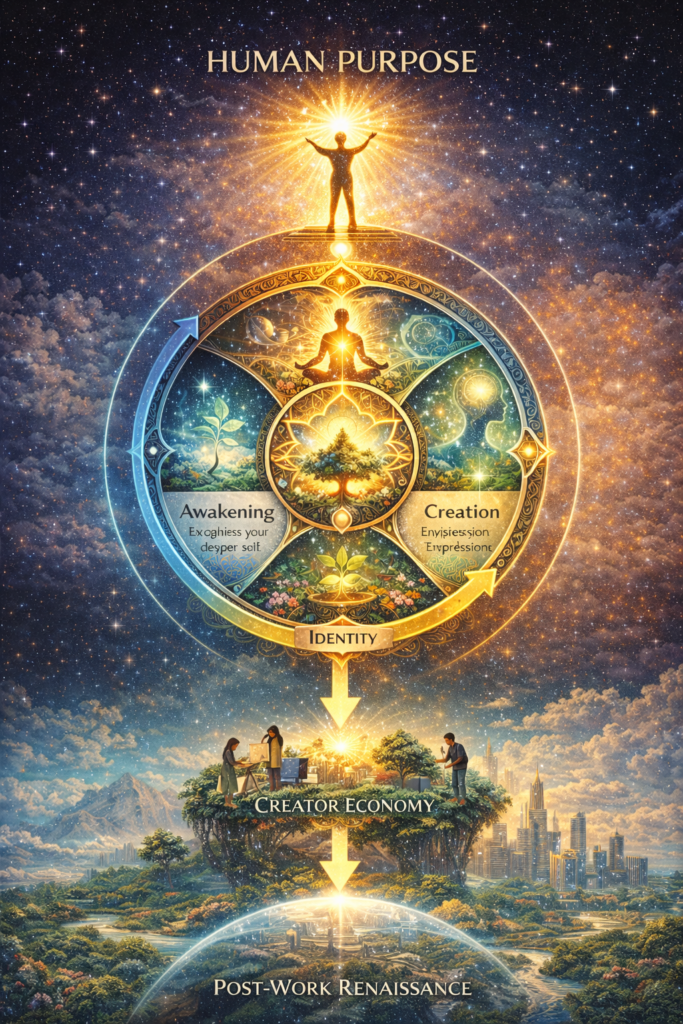
This is where frameworks for exploring identity become increasingly valuable.
One approach to navigating this shift is the Identity Awakening System (IAS), which helps individuals move through four stages of transformation:
Clarity
Creation
Expression
Rather than defining themselves solely through work, individuals learn to explore their deeper motivations, talents, and creative impulses.
In a rapidly changing world, identity becomes something consciously explored, not passively inherited.
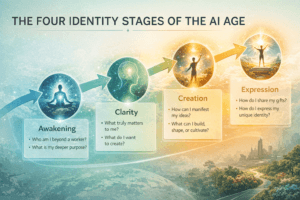
How identity evolves as humanity transitions from a work-based society to a creator society.
The Four Identity Stages of the AI Age
As artificial intelligence reshapes the structure of work, many people are moving through a deeper psychological transition — a shift in how they understand themselves.
This transition often follows four stages.
-
Awakening
The moment people realise their identity cannot be defined solely by work. -
Clarity
They begin asking deeper questions about meaning, values, and what truly matters. -
Creation
Individuals start building projects, ideas, or expressions that reflect their unique identity. -
Expression
Their creations become contributions to the world — ideas, systems, art, communities, or innovations.
This journey represents a shift from the industrial identity of the worker to the emerging identity of the creator.
The Global Search for Meaning in the AI Age
What we are witnessing today may be the beginning of a much larger cultural transition.
Across the world, people are asking deeper questions:
-
What gives life meaning?
-
What does it mean to be human?
-
What should we create with our time and intelligence?
These questions are not new.
Philosophers, artists, and thinkers have explored them for centuries.
What is new is the scale.
For the first time in modern history, millions of people may soon face the same realization simultaneously:
work alone cannot define human purpose.
And when that realization spreads, a new era of exploration begins.
The Future May Belong to Creators
The rise of AI does not have to lead to human irrelevance.
Instead, it may push humanity toward something deeper.
Automation can handle production.
But only humans can provide:
-
meaning
-
imagination
-
storytelling
-
philosophy
-
art
-
purpose
In that sense, the AI age may not diminish humanity.
It may reveal what humans were always meant to be.
Not just workers.
But creators of meaning, beauty, ideas, and culture.
And those who learn to embrace that identity may shape the future of the post-work world.
————————————————————————————————————————-
 WHAT IS HUMAN PURPOSE IN AN AGE OF AI (FAQ)
 WHAT IS HUMAN PURPOSE IN AN AGE OF AI (FAQ)
 What is human purpose in the age of AI?
Human purpose in the AI age is shifting from productivity and survival toward meaning, creativity, and self-expression.
As AI replaces tasks, humans are freed to explore who they truly are and what they are here to create.
Will AI make human purpose obsolete?
No. AI replaces tasks, not purpose.
In fact, AI makes purpose more important by removing distractions and forcing humans to define themselves beyond work.
How do I find purpose when work is no longer central?
You find purpose by exploring identity:
What resonates with you
What you feel drawn to create
What gives you energy
What feels meaningful
Purpose emerges from who you are, not what you do.
Why is purpose becoming more important now?
Because as survival becomes easier, meaning becomes essential.
Without purpose, people feel lost—even in abundance.
How does IAS help with purpose?
The Identity Awakening System helps you:
Discover your true identity
Recognise what resonates
Clarify your direction
Align your life with meaning