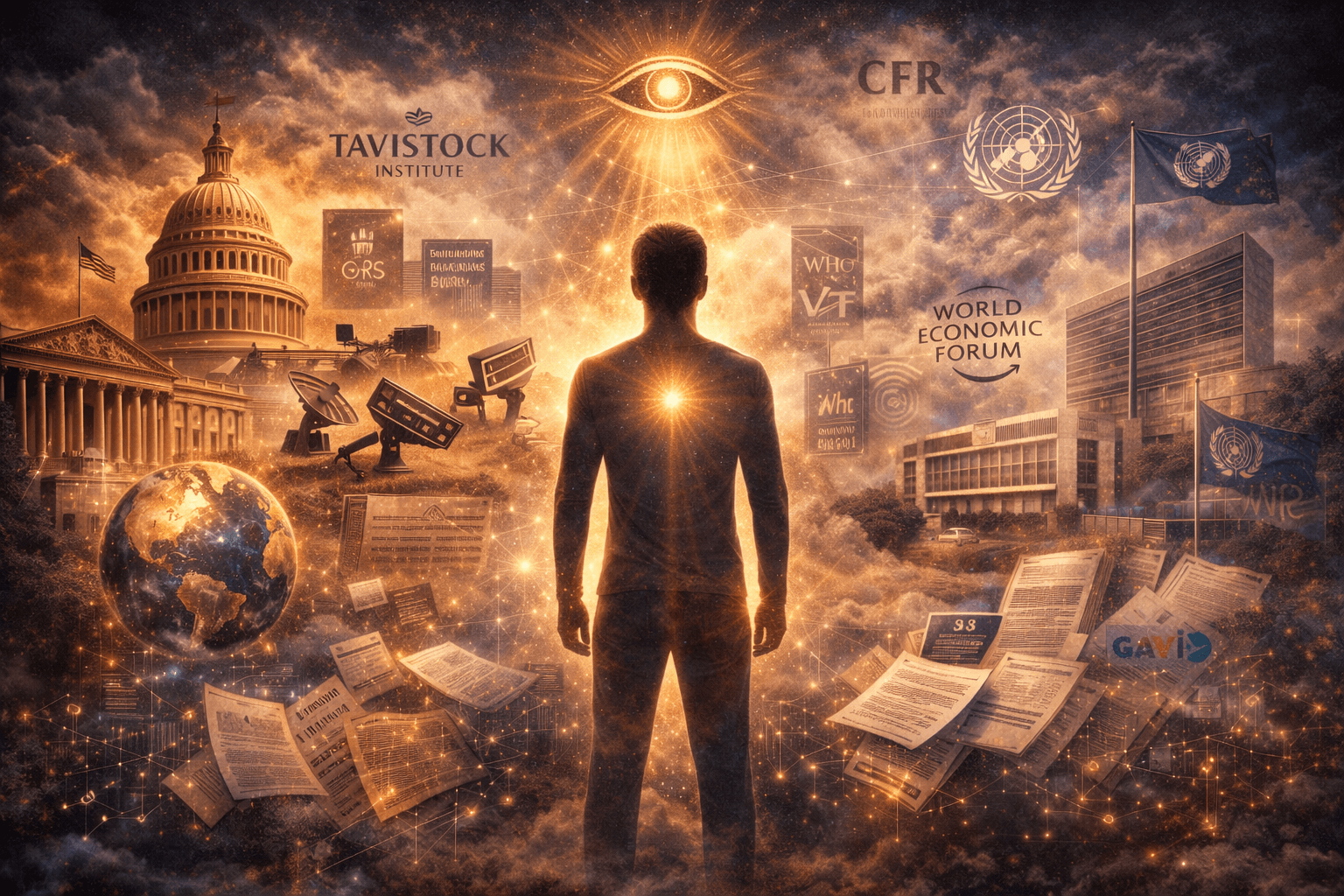
Most people think belief systems are personal.
They think their views were formed by experience, common sense, education, family, and a fair reading of reality.
But the older you get, and the more closely you observe the world, the more you begin to see that belief systems are not formed in a vacuum. They are shaped inside environments. And those environments are carefully influenced by institutions with enormous reach, money, prestige, and access.
Governments shape what is normal.
Intelligence agencies shape what is visible and what stays hidden.
Think tanks shape what is considered respectable.
Global bodies shape what is treated as consensus.
Health institutions shape what is framed as responsible.
Academic and behavioural organisations shape how populations are studied, nudged, and managed.
And over time, these layers do not just influence policy.
They influence perception.
They influence language.
They influence what people are permitted to question.
They influence what feels true long before most people have examined whether it is.
That is why this matters.
Because the deeper issue is not only who runs the world.
It is who shapes the mental atmosphere in which the public interprets the world.
The battle is not just for territory. It is for consciousness.
Power has always understood something that ordinary people often forget:
If you can shape what people believe, you do not need to control every action directly.
You simply shape the boundaries of thought.
You create the vocabulary.
You define the acceptable questions.
You signal which positions are safe.
You attach morality to obedience.
You attach shame to dissent.
You manufacture consensus.
You make the artificial feel inevitable.
This is one of the great hidden powers of modern institutional life.
The public imagines it is responding freely to reality.
But often it is responding to a reality that has already been framed, filtered, and emotionally prepared for it.
That is not an accident.
That is governance at the level of mind.
Government does not only govern behaviour. It governs meaning.
Governments are not neutral administrators of public life. They are also meaning-making engines.
They define emergencies.
They define threats.
They define responsibility.
They define public duty.
They define what counts as social harm.
They define which narratives are “helpful” and which are “dangerous.”
In theory, this can be done for legitimate reasons. Every society needs some degree of coordination and shared language.
But in practice, the power to define reality is one of the most dangerous powers any government possesses.
Because once the State can consistently shape how people interpret events, it no longer needs to rely on raw force alone. It can govern through internalised belief.
People begin to police themselves.
They repeat official language without noticing.
They absorb assumptions as facts.
They defend frameworks they never consciously chose.
And all of this becomes easier during periods of fear, uncertainty, conflict, or crisis.
That is when belief systems can be re-engineered most quickly.
Intelligence agencies and the invisible architecture of perception
Most people think intelligence agencies exist to gather information and protect national security.
That is certainly part of the official story.
But intelligence work has always been about more than collecting facts. It is also about managing narratives, assessing psychological environments, influencing outcomes, and shaping the information field around events.
That does not mean every rumour is true or that every event is scripted.
But it does mean that any serious reflection on power has to include the hidden layer: the part of the machine that studies populations, maps influence, tracks networks, analyses vulnerabilities, and understands how perception can be directed.
Because once you understand that perception is strategic terrain, you realise something profound:
The public conversation is not merely a conversation.
It is often an operational environment.
And if that sounds dramatic, good. It should.
Because a population that does not understand it is being shaped psychologically is a population that is easy to steer.
Tavistock and the behavioural lens
When people refer to “Tavistock,” they are often speaking loosely about a wider tradition of behavioural research, systems thinking, group dynamics, and the study of how institutions and human beings interact.
The modern Tavistock Institute of Human Relations describes itself as pioneering approaches to organisational and societal challenges, and its “Tavistock approach” explicitly studies group dynamics, leadership, authority, and organisational behaviour, including unconscious dynamics within groups.
That is already significant.
Because once you begin studying how groups behave, how authority is perceived, how unconscious dynamics influence decision-making, and how organisations can be guided through change, you are no longer just dealing with abstract theory.
You are dealing with the mechanics of human response.
Again, that knowledge can be used for constructive purposes. It can help organisations function better, lead better, and understand themselves better.
But it would be naïve to assume that knowledge about mass psychology, authority, compliance, social pressure, and behavioural influence will only ever be used benevolently.
Tools do not stay innocent just because they were introduced politely.
The Council on Foreign Relations and the shaping of elite consensus
The Council on Foreign Relations openly describes itself as a nonpartisan, independent membership organisation, think tank, educator, and publisher whose mission is to “inform U.S. engagement with the world.” It says it generates policy-relevant ideas and analysis, convenes experts and policymakers, and promotes informed public discussion.
That sounds respectable — and in one sense, it is.
But notice what it really means.
It means there are institutions whose purpose is not merely to observe the world, but to help frame how key actors understand it.
They gather elites.
They shape discussion.
They circulate assumptions.
They influence the policy atmosphere.
They help define what serious people are allowed to say seriously.
That matters because elite consensus often reaches the public only after it has already been formed in rooms most people will never enter.
By the time an idea reaches the population, it may already have been refined, normalised, and pre-approved by powerful networks.
In that sense, belief systems are often downstream of elite socialisation.
The World Economic Forum and the management of global narratives
The World Economic Forum says its mission is to “improve the state of the world through public-private cooperation,” and describes itself as a convener of leaders across sectors, regions, ideologies, and generations to address global challenges.
Again, that may sound noble.
But it also raises a serious question:
Who gets to define the world’s problems — and who gets to define the acceptable solutions?
Whenever public and private power blend too closely, the danger is not only corruption in the crude sense.
It is the creation of a managerial class that begins to see itself as the natural steward of humanity.
That class may speak in the language of cooperation, sustainability, resilience, inclusion, and innovation.
But behind the polished language lies a familiar risk: the concentration of authority in networks that are unelected, transnational, and increasingly insulated from ordinary people.
That is not paranoia.
That is a structural concern.
Because once policy, commerce, technology, and global governance become tightly interwoven, belief systems can be shaped at scale without most citizens ever feeling they consented.
The UN, WHO, and Gavi: from coordination to worldview formation
The United Nations describes itself as an international organisation founded in 1945 that serves as a forum for member states, with core purposes including keeping peace, developing friendly relations among nations, improving lives, and harmonising international action.
The World Health Organization says it is the UN agency that connects nations, partners, and people to promote health, keep the world safe, and serve the vulnerable, while coordinating the world’s response to health emergencies and promoting universal health coverage.
Gavi describes itself as a public-private partnership whose mission is to save lives and protect health by increasing equitable and sustainable use of vaccines.
Now, taken at face value, these are humanitarian missions.
And many people within these institutions undoubtedly believe deeply in that work.
But there is another layer to reflect on.
Institutions that coordinate globally do not only deliver programmes. They also shape frameworks.
They influence what counts as health.
They influence what counts as risk.
They influence what counts as responsibility.
They influence which interventions become morally charged.
They influence how citizens, governments, schools, and professionals speak about life.
In other words, they do not just affect policy.
They affect consciousness through policy.
When a framework becomes global enough, repeated enough, and morally elevated enough, it starts to function like a belief system.
That is when institutional language stops being administrative and starts becoming civilisational.
The issue is not only control. It is internalisation.
The most powerful institutions are not always those that force obedience.
They are often the ones that make obedience feel like common sense.
This is the subtle genius of belief management.
People are not only told what to do.
They are taught how to think about what they are doing.
They are given the moral framing in advance.
They are offered a ready-made emotional script.
They are trained to associate compliance with goodness and questioning with danger.
Once that happens, power no longer has to shout.
It whispers through culture.
It hides inside expert language.
It arrives wearing credentials.
It borrows the tone of compassion.
It speaks in the name of safety, health, order, responsibility, and progress.
And because it sounds intelligent and moral, people lower their guard.
That is how belief systems are captured.
This is why discernment matters more than ever
We are living in an age of institutional saturation.
There are more bodies, councils, partnerships, frameworks, summits, agencies, and transnational networks than ever before.
Some may do good.
Some may do mixed good and harm.
Some may drift from mission into ideology.
Some may become vehicles for elite coordination under the banner of public service.
The point is not to flatten everything into one simplistic theory.
The point is to wake up to the scale of influence.
Because once you see that governments, intelligence structures, think tanks, behavioural institutions, and global bodies all help shape the atmosphere of belief, then you stop asking only, “What happened?”
You start asking:
Who framed this?
Who benefits from this framing?
What assumptions am I being asked to internalise?
Why does this narrative feel so emotionally loaded?
Why are some questions welcomed and others treated as forbidden?
Those are the questions of a free mind.
The spiritual dimension: reclaiming your inner authority
At the deepest level, this is not only political.
It is spiritual.
Because the battle over belief is ultimately a battle over inner authority.
Do you know how to think without being fed a script?
Can you feel the emotional pressure inside official narratives?
Can you sense when language is being used to bypass discernment?
Can you remain calm enough to perceive what is actually being done to your mind?
This is where awakening becomes practical.
Not airy-fairy.
Not abstract.
Practical.
A person with inner stillness is harder to manipulate.
A person with discernment is harder to herd.
A person who can sit with uncertainty is harder to program.
A person who has reclaimed spiritual centre does not need every institution to tell them what reality is.
That does not mean rejecting everything automatically.
It means refusing to surrender your conscience, perception, and moral intelligence to institutional power.
That is the line that matters.
Final thoughts
Government, intelligence agencies, and institutions such as Tavistock, the CFR, the WEF, the UN, WHO, and Gavi do not need to control every thought directly in order to shape public belief.
They only need to help shape the environment in which belief is formed.
That is already immense power.
Some of that power may be used sincerely.
Some of it may be used manipulatively.
Much of it may be a mixture of both.
But if we are serious about freedom, we must be serious about this question:
Who is shaping the mind of society?
Because if belief systems are being quietly engineered from above, then awakening is not optional.
It is necessary.
And the first step in awakening is simple:
To notice that what you call your worldview may not be entirely your own.
The Real Work Begins Within
If Governments, intelligence agencies, global institutions, and elite networks all play a role in shaping the atmosphere of belief, then the question becomes deeply personal:
How much of what you think is truly yours?
That is not a comfortable question.
But it is an important one.
Because real freedom is not just about resisting outer control. It is about recognising where that control has already been internalised. It is about noticing the inherited scripts, the fear patterns, the borrowed beliefs, and the conditioned identities that quietly shape the way you see yourself and the world.
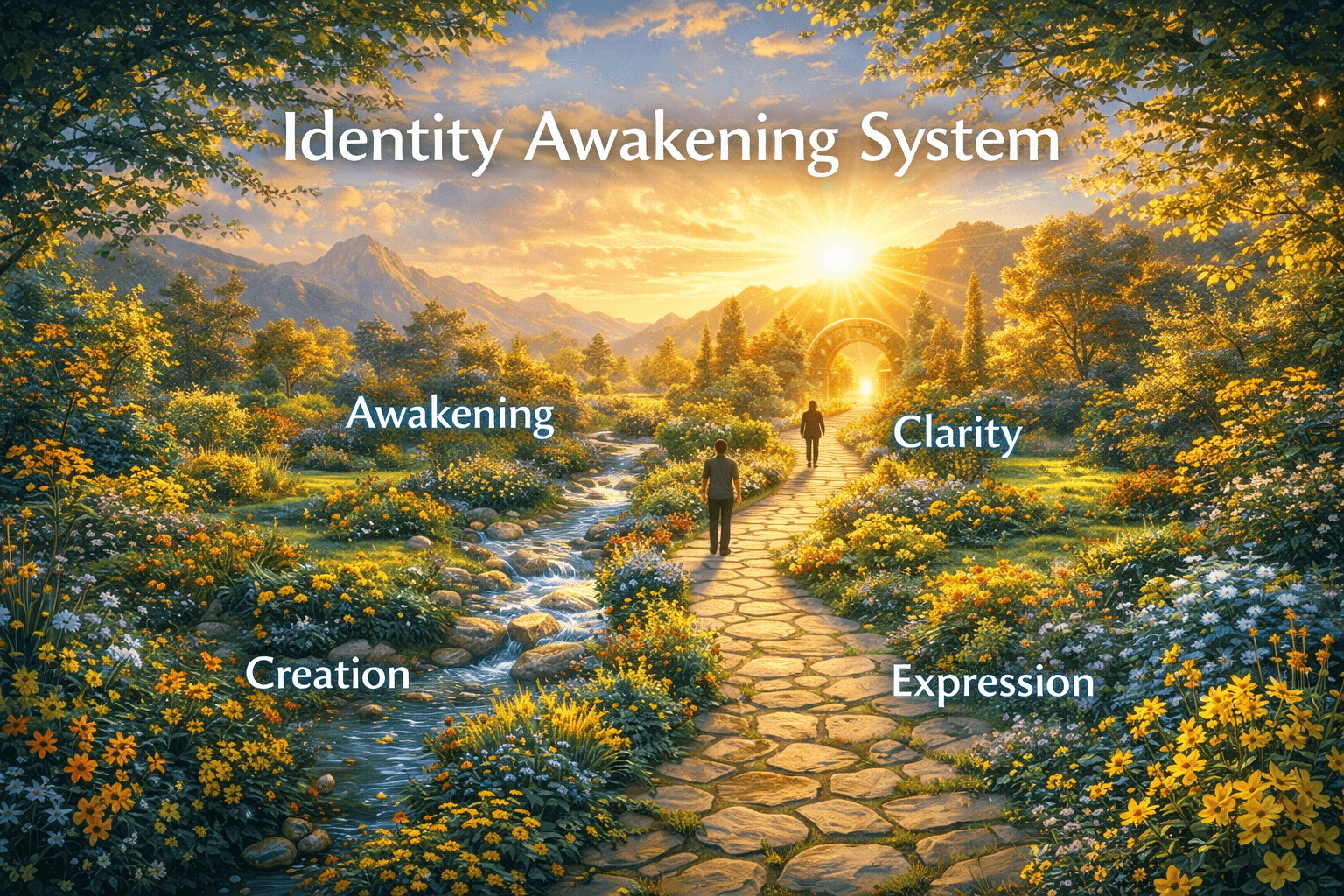
And that is exactly why I created the Identity Awakening System.
The Identity Awakening System is designed to help you step back from the noise, question the programming, and reconnect with the deeper truth of who you are beneath the pressure of external narratives. It is a guided path for people who want more than information. It is for those who want clarity, sovereignty, discernment, and transformation.
Inside the system, you will begin to:
- uncover the patterns and belief structures that no longer serve you
- separate your true inner voice from fear, conditioning, and social programming
- develop deeper discernment in a world full of manipulation and noise
- use AI as a mirror for reflection, clarity, and conscious self-discovery
- build a stronger, calmer, more authentic identity rooted in truth rather than reaction
Because the ultimate goal is not just to understand how the world shapes belief.
The ultimate goal is to reclaim your inner authority.
That is where awakening becomes real.
That is where fear begins to loosen.
That is where you stop living as a product of the system and begin living from a deeper level of consciousness.
If you are ready to step out of confusion, question what you have inherited, and begin the journey back to your true self, explore the Identity Awakening System here: