There comes a moment in many people’s lives when an unsettling question begins to arise:
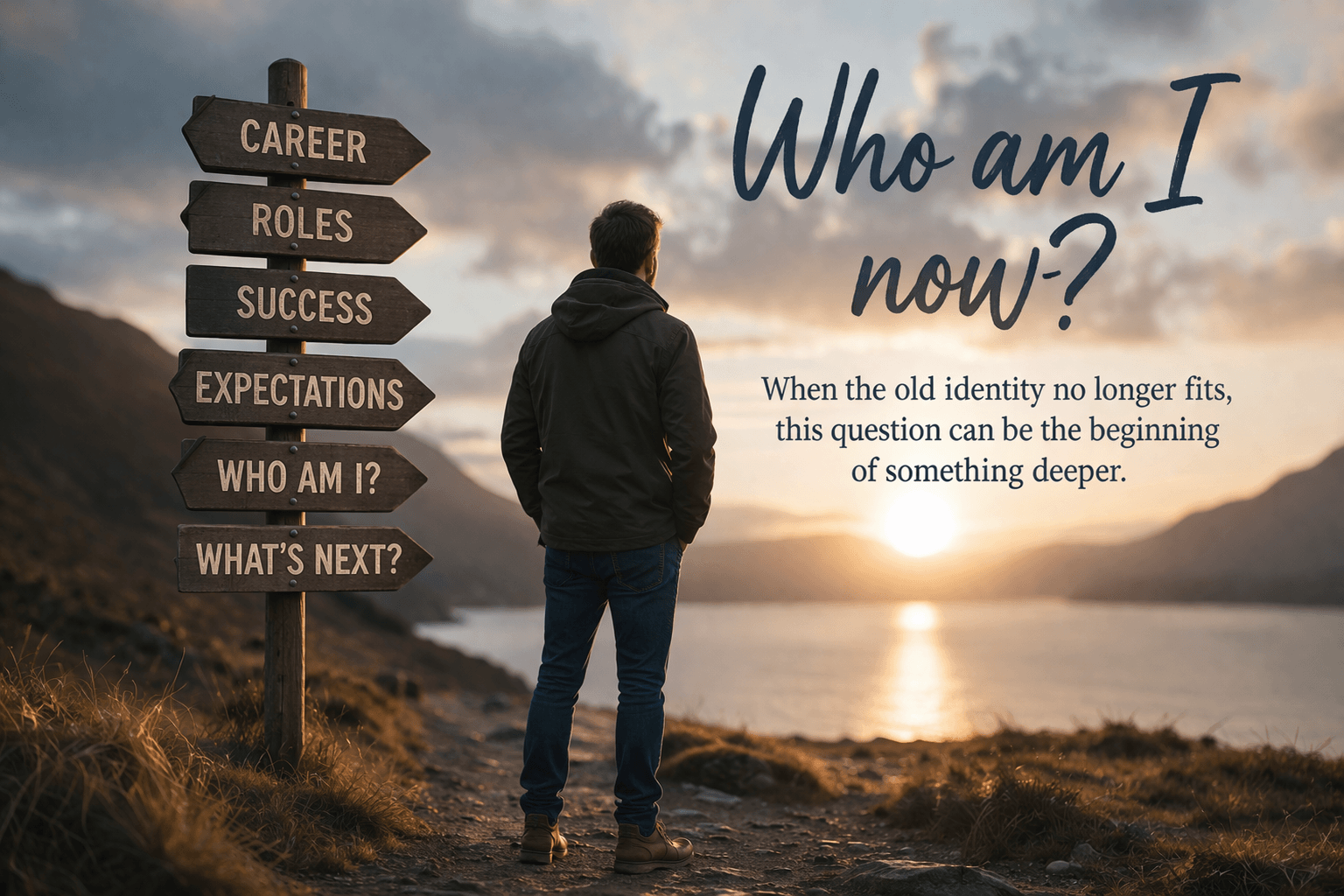
Who am I now?
It can come after leaving a job.
After divorce.
After burnout.
After loss.
After children grow up.
After success that somehow feels empty.
Or simply in a quiet season when the old self no longer fits.
For many people, this question feels frightening.
It can feel like confusion.
Disorientation.
A loss of self.
A kind of inner disappearance.
You may look at your life and think:
“I do not know who I am anymore.”
“What happened to me?”
“Why does everything feel unfamiliar?”
“Why does the life I built no longer feel like me?”
If this is where you are, you are not alone.
And you are not broken.
The question “Who am I now?” often appears when an old identity no longer fits
Most people are never taught to think about identity.
They are taught to think about goals, responsibilities, roles, success, survival, and what other people expect of them.
So they build a life.
They become:
- the professional
- the parent
- the provider
- the achiever
- the dependable one
- the one who holds everything together
- the one who never stops
- the one who pleases
- the one who copes
For a while, that identity may work.
It may even bring security, recognition, status, and structure.
But there often comes a point when the identity that once held life together begins to feel too small, too heavy, too false, or simply no longer alive.
That is often when the question appears:
Who am I now?
This is not always a crisis to fear
When people begin to lose contact with an old identity, they often think something has gone wrong.
They assume they are failing.
Falling apart.
Becoming unstable.
Losing direction.
But sometimes something much deeper is happening.
Sometimes the old identity is beginning to loosen because it is no longer true enough for who you are becoming.
That can feel uncomfortable.
Even painful.
Because identity gives people a sense of:
- certainty
- continuity
- belonging
- meaning
- direction
- safety
When that begins to shift, the ground can feel unsteady.
But unsteadiness is not always a sign of failure.
Sometimes it is the beginning of awakening.
Why this question can feel so intense
The question “Who am I now?” is not just intellectual.
It touches something much deeper.
Because identity shapes:
- how you see yourself
- how you make decisions
- what you think you deserve
- what feels possible
- what roles you play
- what others expect from you
- how you organise your life
So when identity starts to change, it is not like changing an opinion.
It can feel like changing the whole inner structure you have been living from.
That is why people can feel:
- lost
- tired
- emotionally exposed
- strangely detached
- restless
- empty
- called toward something they cannot yet name
It is not always because they are broken.
It may be because the life they built was shaped by an identity they are now outgrowing.
The old self may have been useful — but no longer true
This is important to understand with compassion.
Old identities are not usually mistakes.
They often helped us survive.
They helped us:
- be accepted
- stay safe
- succeed
- be needed
- avoid rejection
- earn love
- hold life together
- keep going through difficult seasons
But what once protected us can later limit us.
An identity that once worked may become a kind of invisible cage.
You may still be living from an old version of yourself long after life has been asking you to grow beyond it.
This is why the question “Who am I now?” matters.
It is not a meaningless question.
It is often the soul’s way of saying:
The old answer no longer fits.
Signs this question is part of a real identity shift
If this question is alive in you, you may notice things like:
- what used to motivate you no longer does
- old goals feel empty
- your usual roles feel heavier than before
- you feel disconnected from the life you built
- success does not feel the way you thought it would
- you are less willing to pretend
- you feel drawn toward something more honest, but cannot yet define it
- you want peace more than performance
- you sense that the old version of you is fading
These are not always signs that you are lost.
They may be signs that you are changing.
Why most people struggle here
Most people do not have language for this stage.
They know how to talk about:
- career change
- stress
- burnout
- life transition
- midlife
- feeling stuck
But they do not often realise that what they are experiencing is deeply connected to identity.
So they try to solve it on the surface.
They look for:
- more motivation
- a new goal
- better productivity
- a quick answer
- external certainty
But the real question may be deeper.
Not:
What should I do next?
But:
Who have I been being?
What identity have I been living from?
And who am I becoming now?
This is where Identity Awakening matters
The Identity Awakening System (IAS) exists for moments like this.
It helps people slow down and look beneath the surface of their patterns, roles, confusion, and life transitions.
Instead of forcing a quick reinvention, IAS helps you explore more honestly:
- what identity you have been living from
- where that identity came from
- what roles have become too central
- what no longer feels true
- what deeper values are trying to emerge
- who you may really be beneath conditioning and survival
This matters because lasting change does not begin with a new performance.
It begins with truth.
You cannot build a peaceful life from a false identity.
You cannot create meaningful change while still living from an old self that no longer fits.
“Who am I now?” is not a weakness
It may actually be one of the most important questions you will ever ask.
Because it signals that you are no longer willing to live entirely inside inherited roles, old conditioning, or identities built from fear and function alone.
It signals that something in you is becoming more conscious.
More honest.
More awake.
That does not mean the answer appears instantly.
Often it comes gradually.
Through:
- reflection
- noticing
- loss of fit
- deeper values
- new longings
- simpler truth
- the courage to stop pretending
You do not need to force the answer
This is important.
You do not need to rush to define your new identity perfectly.
You do not need to invent a polished version of yourself.
You do not need to panic just because the old one is loosening.
Sometimes the wisest thing you can do is slow down and begin listening more honestly.
Ask:
- What no longer feels true?
- What roles have I outgrown?
- What feels alive in me now?
- What matters more than it used to?
- What feels more like me than the old life did?
These are gentle questions.
But they can begin to change everything.
A gentler truth
If you are asking, “Who am I now?”, something important may already be happening.
You may not be losing yourself.
You may be losing what was never the whole of you.
And that is a very different thing.
Closing
The question “Who am I now?” is not always the sign of a life falling apart.
Sometimes it is the beginning of a life becoming more true.
If the old identity is loosening, if the old roles feel heavy, and if something deeper is trying to emerge, the Identity Awakening System offers a gentle place to begin.
Not with pressure.
Not with performance.
But with truth.
Explore the Identity Awakening System
———————————————————————————————————————
Continue the Awakening Journey