Personal Story:
True story – I spent 5 years of my early life at boarding school in an environment where any weakness or vulnerability was mercilessly exploited by colleagues. My mask of coping and toughness was a protection from bullying.
Windows and doors were open on classes and dorm rooms to circulate fresh air – still today I cope with cold better than those around me as I found a way of coping with the cold. Still today I go the gym in a sleeveless vest in winter when others are shivering in track suits.
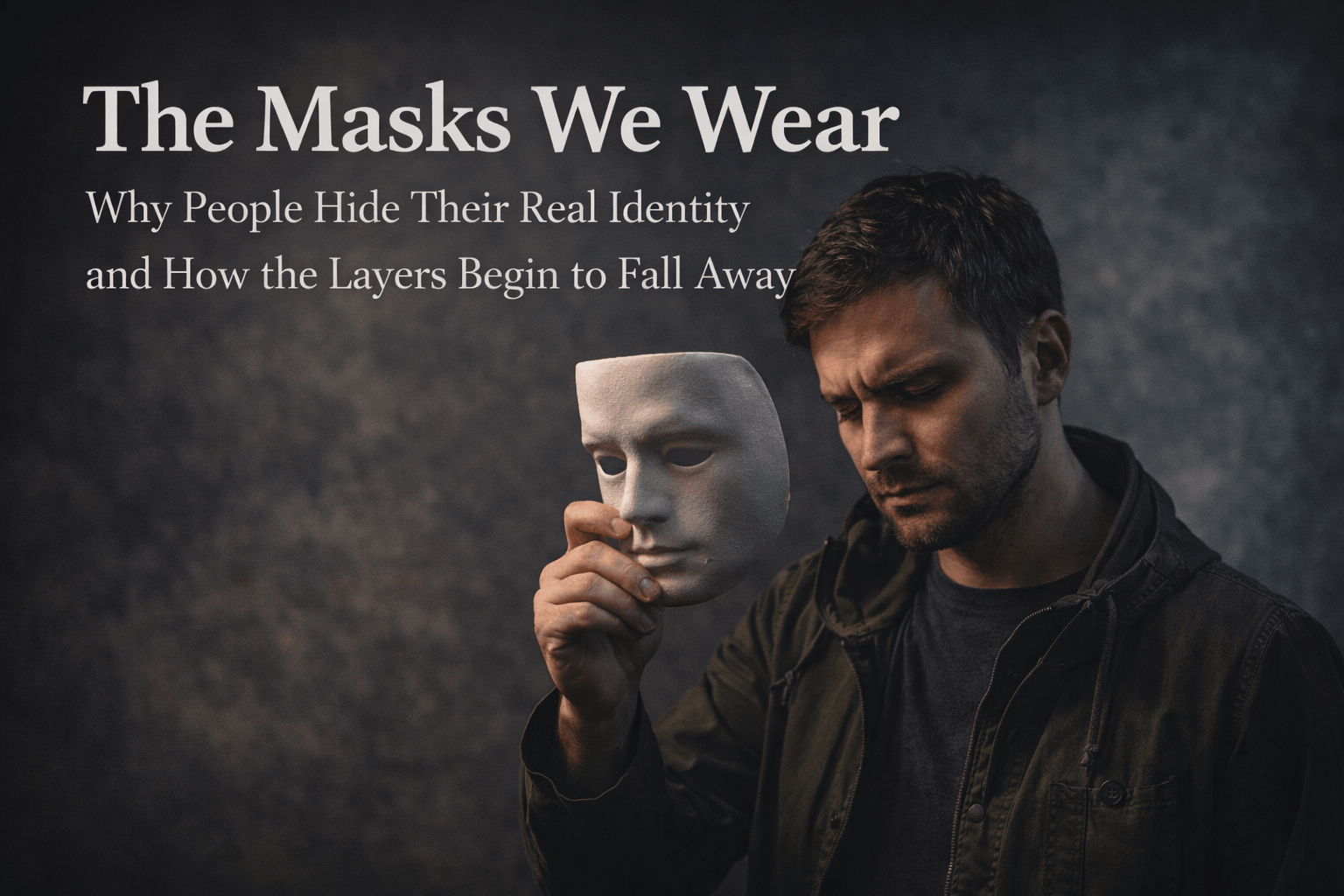
Most people wear masks.
Not literal masks, of course.
But emotional masks.
Social masks.
Protective masks.
Identities shaped around what feels safe, acceptable, useful, admired, or less vulnerable.
These masks can become so normal that people no longer realise they are wearing them.
They simply think:
This is who I am.
But often, it is not the whole truth.
It is a version of self that was built to survive.
The mask is more universal than most people realise
Almost everyone wears some kind of mask.
Not because people are bad or deceptive in a simple sense, but because human beings adapt.
We learn how we need to appear.
How we need to behave.
How we need to manage other people’s perceptions.
How to seem acceptable, safe, strong, kind, spiritual, capable, or unaffected.
Many people are not consciously pretending.
They are simply living through a persona that became normal long ago.
In that sense, the mask is not rare.
It is deeply human.
Why people wear masks
People do not usually create masks because they want to be fake.
They create them because, at some point in life, the mask felt necessary.
A mask may have helped someone:
- stay safe
- avoid rejection
- gain approval
- be loved
- feel in control
- survive chaos
- function in a family
- succeed in a system
- avoid shame
- hide pain
The mask is usually not the enemy.
It is a strategy.
A way the self learned to cope with life.
That is why identity work must be compassionate.
Because when you look closely, the mask is often protecting something tender underneath.
What a mask really is
A mask is a protective identity.
It is the version of self we present when we believe the deeper, more vulnerable, more natural self is not safe to show.
It may look like:
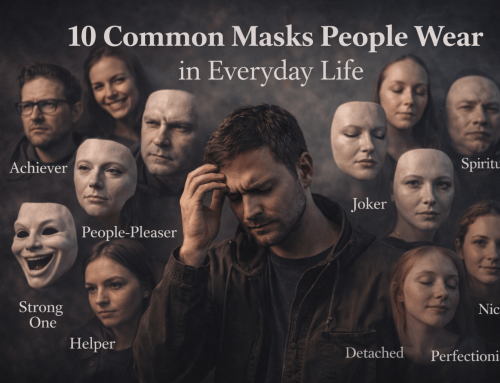
- the strong one
- the nice one
- the achiever
- the helper
- the calm one
- the spiritual one
- the clever one
- the one who never needs anything
- the one who always holds it together
- the one who keeps everyone happy
Each of these masks can become so practiced that they stop feeling like masks.
They start to feel like personality.
But often they are survival-based adaptations.
The mask often looks like the opposite of what it hides
This is one of the most revealing things to understand.
A mask is often designed to hide the exact thing the person most fears being seen as.
So the loud, overdone, hyper-confident person may be covering deep fear of being powerless or hurt.
The endlessly agreeable person may be covering fear of rejection.
The harshly critical person may be covering shame they cannot bear in themselves.
The constant overachiever may be covering the fear that without performance, they are not enough.
The class clown may be covering a deep fear of being truly seen.
In other words, what someone pushes hardest to project is often the very place where they feel most unsafe.
This does not mean we should reduce people to a formula.
But it does mean behaviour often has something underneath it.
The mask usually begins early
Many masks begin in childhood.
A child quickly learns what is welcomed and what is not.
They learn:
- what gets praise
- what gets punished
- what brings closeness
- what causes withdrawal
- what earns approval
- what makes them feel safe
- what parts of themselves need to be hidden
If a child learns that neediness is too much, they may become independent too early.
If they learn that anger is unsafe, they may become overly nice.
If they learn that being useful brings love, they may become the helper.
If they learn that achievement brings worth, they may become the achiever.
This is how a mask forms.
Not through conscious decision.
But through adaptation.
We are shaped by childhood pain and childhood reward
This is one of the simplest ways to understand masks.
People are shaped by what hurt them, and by what brought them reward.
If openness brought pain, they may become guarded.
If pleasing brought safety, they may become compliant.
If success brought love, they may become driven.
If being invisible reduced danger, they may learn to disappear.
The mask is often built at the meeting point of:
- what once hurt
- what once worked
That is why peeling back the mask can feel so emotional.
It is not only a social habit.
It is often connected to deep memory in the nervous system.
Masks are also rewarded by the adult world
Masks do not only form in childhood.
They are often reinforced by the world we live in.
Corporate culture may reward:
- confidence
- control
- productivity
- certainty
- performance
Family systems may reward:
- self-sacrifice
- peacekeeping
- emotional restraint
- responsibility
Spiritual communities may reward:
- calmness
- positivity
- transcendence
- detachment from ordinary pain
Social life may reward:
- image
- likability
- charm
- appearing successful
- saying the right thing
So the mask continues.
And because the world rewards it, people often mistake it for identity.
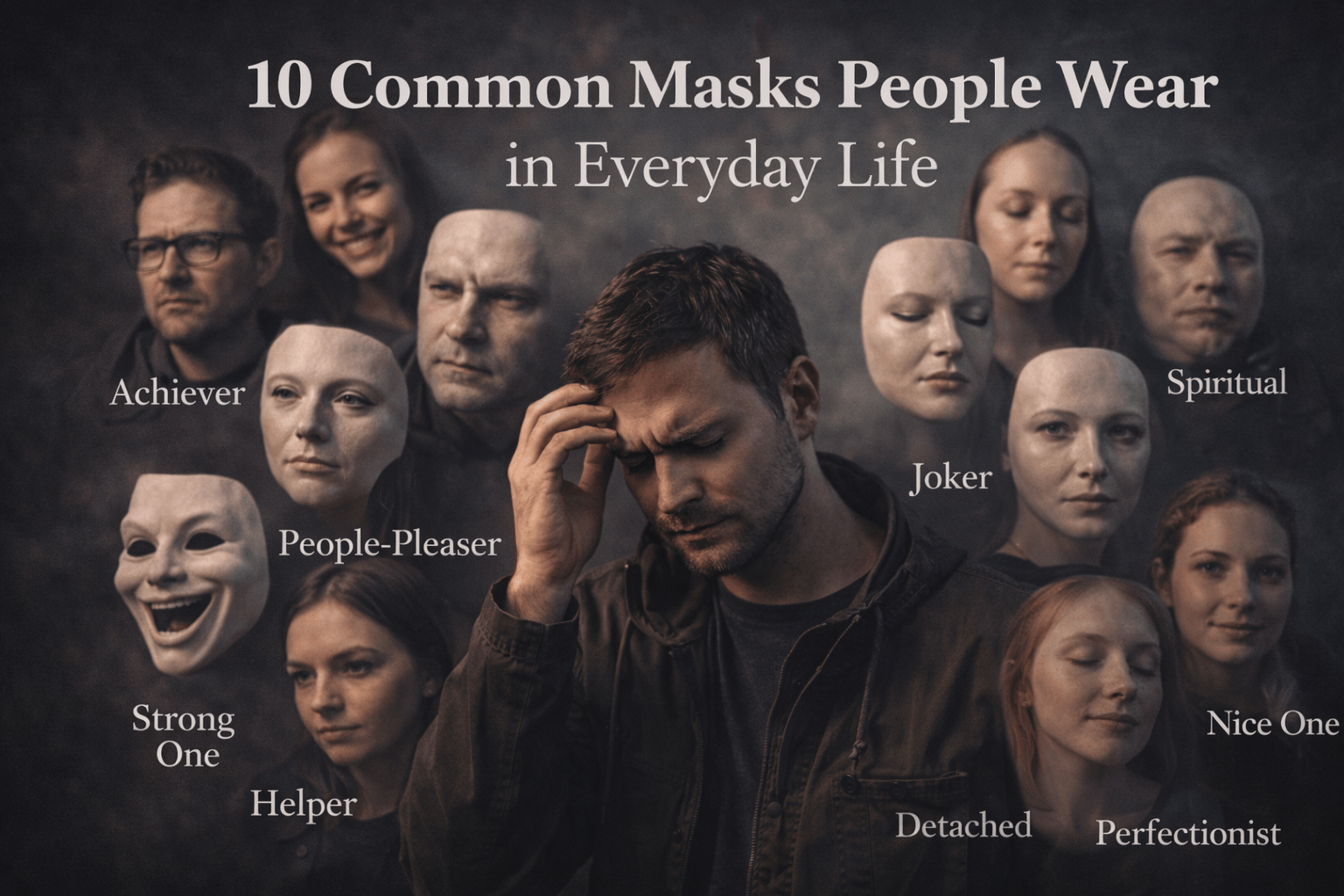
Common masks people wear
There are many forms of masking, but some appear again and again.
The achiever
This mask says:
If I succeed, I am worthy.
This person may seem driven, capable, and impressive.
But underneath there may be fear of not being enough without accomplishment.
The people-pleaser
This mask says:
If everyone is happy with me, I am safe.
This person may seem kind and agreeable.
But underneath there may be fear of conflict, rejection, or abandonment.
The strong one
This mask says:
If I never fall apart, I will not be hurt.
This person may seem resilient and dependable.
But underneath there may be exhaustion, grief, and a deep longing to rest.
The helper
This mask says:
If I take care of everyone else, my place is secure.
This person may seem generous and caring.
But underneath there may be unmet needs and difficulty receiving.
The spiritual one
This mask says:
If I stay elevated, I do not have to feel pain.
This person may seem wise, calm, or evolved.
But underneath there may still be fear, hurt, anger, or unresolved humanity.
The detached one
This mask says:
If I do not care too much, I cannot be wounded.
This person may seem independent or cool.
But underneath there may be loneliness and fear of being truly known.
The joker
This mask says:
If I stay funny, no one will see how vulnerable I feel.
This person may seem light, entertaining, or always easy to be around.
But humour can sometimes become a way of preventing deeper contact.
Why masks become exhausting
At first, a mask can feel useful.
It helps you get through life.
It helps you belong.
Function.
Cope.
Avoid danger.
Succeed.
But over time, the cost grows.
A mask can create:
- exhaustion
- inner tension
- loneliness
- feeling unseen
- inauthentic relationships
- identity confusion
- fear of being exposed
- emotional numbness
- a sense of performing life
- disconnection from deeper truth
This is one of the great pains of living through a mask:
you may be accepted, admired, or even loved — but not fully known.
Because what is being met is the mask.
Not the deeper self beneath it.
Many people do not know they are wearing one
This is important.
Not everyone is consciously putting on an act.
Often the mask has been worn for so long that it feels natural.
People may honestly believe:
- this is just my personality
- this is just how I am
- this is just how I survive life
- this is what being a good person looks like
- this is what strength is
That is why awakening can be disorienting.
Because people are not only seeing that they have a mask.
They are realising that what they thought was identity may have been protection.
What sits underneath the mask
Under the mask there is often something the person learned to hide.
It may be:
- shame
- grief
- fear
- tenderness
- sensitivity
- uncertainty
- unmet need
- anger
- loneliness
- the wish to be loved without performing
A simple question can sometimes point toward it:
What would feel embarrassing, exposing, or unbearable if other people fully saw it?
That is often very close to what the mask is protecting.
Not always.
But often.
Why it feels risky to take the mask off
This is where people often get stuck.
They may start to realise they are wearing a mask.
They may feel the strain of it.
They may long to be more real.
But removing the mask can feel frightening.
Why?
Because the mask is not just falsehood.
It is protection.
If the mask formed around safety, attachment, or shame, then loosening it can feel like stepping into danger.
That is why peeling back the layers must be gentle.
Not dramatic.
Not aggressive.
Not another performance.
The aim is not to rip the mask off.
The aim is to build enough safety, honesty, and self-awareness that the mask no longer has to run everything.
How the layers begin to fall away
1. Notice the mask without attacking it
Start by asking:
- Who do I become around other people?
- What version of me feels automatic?
- What image do I work hard to maintain?
- Where do I feel most performative?
Do not begin with shame.
Begin with curiosity.
2. Ask what the mask is protecting
Every mask has a function.
Ask:
- What does this protect me from?
- What does it help me get?
- What would feel risky without it?
- When did I first need this version of me?
This moves the work from self-judgment into understanding.
3. Look for the inversion
Ask:
What might be the opposite of what I am projecting?
If I am always strong, what weakness am I hiding?
If I am always agreeable, what truth am I afraid to say?
If I am always achieving, what fear of inadequacy is driving me?
If I am always entertaining, what deeper feeling am I avoiding?
This can be very revealing.
4. Notice where your life feels false
Masks often show up where life feels overly managed.
Ask:
- Where do I feel I am acting rather than being?
- Where do I feel overly polished?
- Where do I feel least spontaneous?
- Who do I become in order to be accepted?
These questions help locate the mask in real life.
5. Feel what is underneath in small doses
The layers do not fall away through analysis alone.
At some point, you begin allowing yourself to feel what the mask has been covering.
This may be sadness.
Fear.
Longing.
Anger.
Need.
Tenderness.
The key is gentleness.
Not flooding yourself.
Just allowing more truth to be present.
6. Tell more truth in ordinary moments
Real change often begins quietly.
You say no when you mean no.
You admit you are tired.
You stop pretending to agree.
You let yourself be uncertain.
You express a real preference.
You stop performing “fine” when you are not.
These are small moments.
But they matter.
7. Let identity form from truth, not defence
Eventually the deeper question becomes:
Who am I when I am no longer trying to earn safety, approval, or belonging through performance?
That is where identity awakening begins.
Not in becoming someone special.
But in becoming more real.
How Identity Awakening System (IAS) helps with this
The Identity Awakening System helps people recognise the identities they have been living from, especially the ones built around survival, approval, role, and protection.
It helps you ask:
- What mask have I mistaken for myself?
- What old role is still shaping me?
- What fear sits beneath this persona?
- What feels more true underneath the performance?
- What kind of identity wants to emerge now?
IAS does not shame the mask.
It helps you understand why it formed, what it has been doing for you, and how to begin living more truthfully.
That is why the work can be deep and gentle at the same time.
A gentler truth
The mask is not the enemy.
The mask is a survival intelligence from an earlier time.
It deserves understanding.
But it does not have to remain in charge forever.
You do not heal by humiliating the mask.
You heal by understanding what it protected, and slowly becoming safe enough to live without hiding so much.
Closing
Most people are not living as pure, open truth all the time.
They are living through layers.
Roles.
Defences.
Adaptations.
Masks.
That is human.
But there comes a point when the mask becomes too costly.
When performance becomes exhausting.
When the role no longer fits.
When the deeper self begins asking to breathe.
That is where identity awakening begins.
Not in becoming perfect.
But in becoming more honest.
And letting the layers begin to fall away.