If you’ve ever looked at humanity and thought, “How are we this clever… and this chaotic?” — this interview with Australian biologist Jeremy Griffith is aimed straight at that ache.
The host, Craig Conway, introduces Griffith’s central claim: the root cause of human suffering (what we call “good vs evil”, conflict, selfishness, aggression, alienation) can be explained — and that explanation can heal the human psyche at scale.
Big promise. Possibly the biggest promise ever made on a podcast. (If you’re going to swing, swing for the solar system.)
This post breaks down the core ideas from the transcript in plain English, adds a grounded creator’s lens (how to use this without joining a cult, burning your calendar, or starting arguments at dinner), and ends with a practical “inner work → outer work” action plan for IMMachines readers.
1) The core claim: humans aren’t “bad animals” — we’re psychologically conflicted humans
Griffith says we’ve been taught a story like this:
Humans are selfish and aggressive because we’re driven by savage “survival of the fittest” instincts.
He rejects that explanation and argues something different:
-
Many words we use for humans (egocentric, guilt-ridden, cynical, depressed, inspired, deluded, etc.) point to a psychological dimension — not just animal instinct.
-
Humans also have moral conscience (cooperative, caring, selfless impulses), which conflicts with the “pure savage instinct” idea.
-
Therefore, our worst behaviour isn’t proof we’re genetically doomed — it’s evidence we’re internally divided.
He frames it as a “human condition” — a conscious-mind-based disturbance — not an “animal condition”.
Whether you buy his full theory or not, this part lands for many people because it offers something rare:
A way to see humanity’s darkness without concluding humanity is damned.
That alone can soften the heart and sharpen the mind — and both are useful if you’re building anything worth building.
2) The engine of the theory: “instinct vs intellect” (the Adam Stork story)
Griffith’s main explanation is a simple thought experiment:
-
Imagine an animal that runs mostly on instinct.
-
Now give it a powerful conscious mind (intellect).
-
The mind begins to question, experiment, and choose.
-
But instincts don’t explain themselves — they just push.
-
Conflict begins: instinct condemns intellect’s deviation.
-
The new conscious being can’t explain why it’s defying instinct… so it starts to feel “bad”, “wrong”, even “evil”.
In the story, “Adam Stork” diverts from the migration path to explore an island. Instinct “pulls him back” like an inner judge.
From that pressure, Griffith says three defensive behaviours arise:
-
Retaliation (anger, aggression)
-
Reinforcement-seeking (status, wins, validation, power, attention)
-
Denial (blocking out criticism, avoiding self-reflection)
This becomes the familiar human pattern: ego, competition, insecurity, alienation.
His key point:
Our “bad behaviour” is not the cause — it’s the coping strategy.
That’s a powerful reframe.
3) The “Garden of Eden” angle: we once lived more like bonobos
Griffith argues humans must have originated from a more cooperative, nurturing primate social base — otherwise our moral conscience wouldn’t exist.
He points to Bonobo society as an example of high compassion and cooperation (as described via various researchers in the interview).
Then he links this to ancient “Golden Age” myths — especially Plato and Hesiod — as echoes of a pre-“fallen” human memory: a more innocent, less alienated state.
You don’t have to treat this literally to find value in it.
Read it symbolically and it becomes:
-
We carry a deep memory/intuition of wholeness.
-
We also carry the pain of separation from it.
-
Our entire civilisation can be viewed as a compensation for that pain.
That’s… uncomfortably plausible.
4) How “moral instincts” could evolve: the nurturing imprint
This is one of the most interesting parts of the transcript, because it’s at least mechanistically easy to understand:
-
A mother’s care is genetically “selfish” in the sense that it helps her offspring survive.
-
But to the infant, that care feels like unconditional love.
-
If infancy is extended (as in primates), the infant is “trained” (indoctrinated) into that experience.
-
That experience then shapes cooperative social behaviour.
So the claim is: selfless morality can emerge via prolonged nurtured development, even if the underlying evolutionary mechanism started from gene survival.
Whether or not you agree with all details, it’s a reminder of something we can verify today:
Nurture shapes nervous systems.
Nervous systems shape behaviour.
Behaviour shapes culture.
Creators: this matters because your audience is a nervous system too. Calm content calms people. Alarm content alarms people. Your brand is a frequency tuner.
5) The “rehabilitation” claim: understanding removes guilt, which removes the need for defence
Griffith’s proposed “healing mechanism” is:
-
Humans have carried deep guilt/conflict for millions of years (in his framing) because we felt condemned by our own moral instincts.
-
If we can truly understand why the conflict happened (instinct vs intellect), we can finally accept: we are fundamentally good, not evil.
-
That relief makes the old coping methods (anger, denial, validation addiction) obsolete.
This is where he uses the language of “psychological rehabilitation”.
Important grounding note (IMMachines style — tell it like it is):
-
This is a worldview and a psychological model, not a proven clinical protocol.
-
It can be inspiring and useful without being treated as absolute truth.
-
The moment any idea claims “this fixes everything”, your job is not to sneer — it’s to apply discernment.
Discernment is spiritual maturity wearing a sensible jacket.
6) What this means for IMMachines readers (and the Identity Awakening path)
If you’re building a business, a body of work, or a new life chapter, you’ve probably noticed:
-
You can have the perfect plan…
-
and still sabotage it with fear, ego, procrastination, comparison, or self-judgement.
Griffith’s model maps neatly onto the inner creator journey:
-
Instinct = safety, familiar identity, old programming, “don’t rock the boat.”
-
Intellect = experimentation, learning, new identity, “what if I build something real?”
-
Conflict = inner criticism, guilt, self-protection.
-
Healing = understanding the conflict so you stop fighting yourself.
This is basically “Identity Awakening” in different language:
When you stop seeing yourself as broken, you stop building from defence.
When you build from wholeness, your work becomes cleaner, calmer, and more useful.
And usefulness is how you win long-term — without needing to become loud, bitter, or chronically online.
7) A practical “Creator Rehab” protocol (no therapy couch required)
Here’s a grounded way to use the best of this interview without swallowing it whole.
Step 1 — Name your inner judge (instinct voice)
Write down the recurring thoughts that show up when you try to grow:
-
“Who do you think you are?”
-
“It’s too late.”
-
“People will judge you.”
-
“You’ll look stupid.”
-
“You’re not consistent.”
Don’t argue with it. Just write it.
Step 2 — Translate it (what it’s trying to protect)
Next to each thought, add:
-
“This is trying to protect me from ____.”
Usually: rejection, embarrassment, uncertainty, or loss of identity.
Step 3 — Offer understanding (the missing bridge)
Now add:
-
“The reason I’m doing this is ____.”
-
“The experiment is safe because ____.”
-
“I don’t need to be perfect — I need to be consistent.”
This is you giving the “instinct system” a calmer update.
Step 4 — Replace “validation seeking” with “service seeking”
Whenever you catch yourself chasing likes, praise, or a “win”, ask:
-
“What would be genuinely useful to one real person today?”
Then ship that.
Step 5 — Build your business like a nervous system
Adopt one rule for your content and offers:
No manipulation. No panic. No shame hooks.
Calm clarity sells to mature people — and doesn’t corrode your soul.
(Yes, you can still be persuasive. Just don’t be possessed.)
8) The real takeaway
This interview is ultimately an invitation to a different stance toward humanity:
-
Less condemnation.
-
More understanding.
-
More responsibility — without self-hatred.
And for creators, that’s the secret sauce:
A nervous-system-safe message + a consistent system + a clean conscience = unstoppable.
Not overnight. But over time? Extremely hard to beat.
Instinct vs Intellect: Why Your Old Self Fights Your New Life (and how to integrate them)
If you’ve ever tried to change your life — start a business, get fit, post content consistently, leave a job, speak your truth, stop people-pleasing — you’ll know this strange thing happens:
You feel a pull toward freedom…
…and an equal pull back toward the familiar.
Most people interpret that as proof they’re lazy, broken, undisciplined, or “not meant for it”.
IAS has a better interpretation:
You’re not broken. You’re split.
And the split is understandable.
The two forces inside you
Think of your inner world as having two core systems:
1) Instinct (the Safety System)
This part of you is ancient. Its job is to keep you safe, accepted, and alive. It loves familiarity. It prefers predictable outcomes. It avoids social risk. It clings to what has worked before — even if it made you miserable.
Instinct says things like:
-
“Don’t rock the boat.”
-
“Don’t embarrass yourself.”
-
“Who do you think you are?”
-
“Wait until you’re ready.”
-
“It’s safer to stay small.”
2) Intellect (the Growth System)
This part of you is curious. It learns. It experiments. It sees possibility. It can imagine a better future and take steps toward it.
Intellect says things like:
-
“We could build something real.”
-
“Let’s test this.”
-
“We can learn as we go.”
-
“The old story isn’t true anymore.”
-
“I want to become who I really am.”
When you decide to evolve, these two systems don’t automatically agree.
That’s the root of the tension: your Growth System challenges your Safety System.
Why your old self resists your new life
Here’s the trap most people fall into:
When Instinct senses you changing, it sends a signal that feels like fear, doubt, or shame.
And because you don’t understand the mechanics of it, you interpret the signal as truth.
-
Fear becomes: “This is dangerous.”
-
Doubt becomes: “This won’t work.”
-
Shame becomes: “I’m not good enough.”
But in many cases, it’s not truth — it’s protection.
Instinct isn’t evil. It isn’t your enemy.
It’s just outdated software trying to keep you alive in a world that no longer matches the old rules.
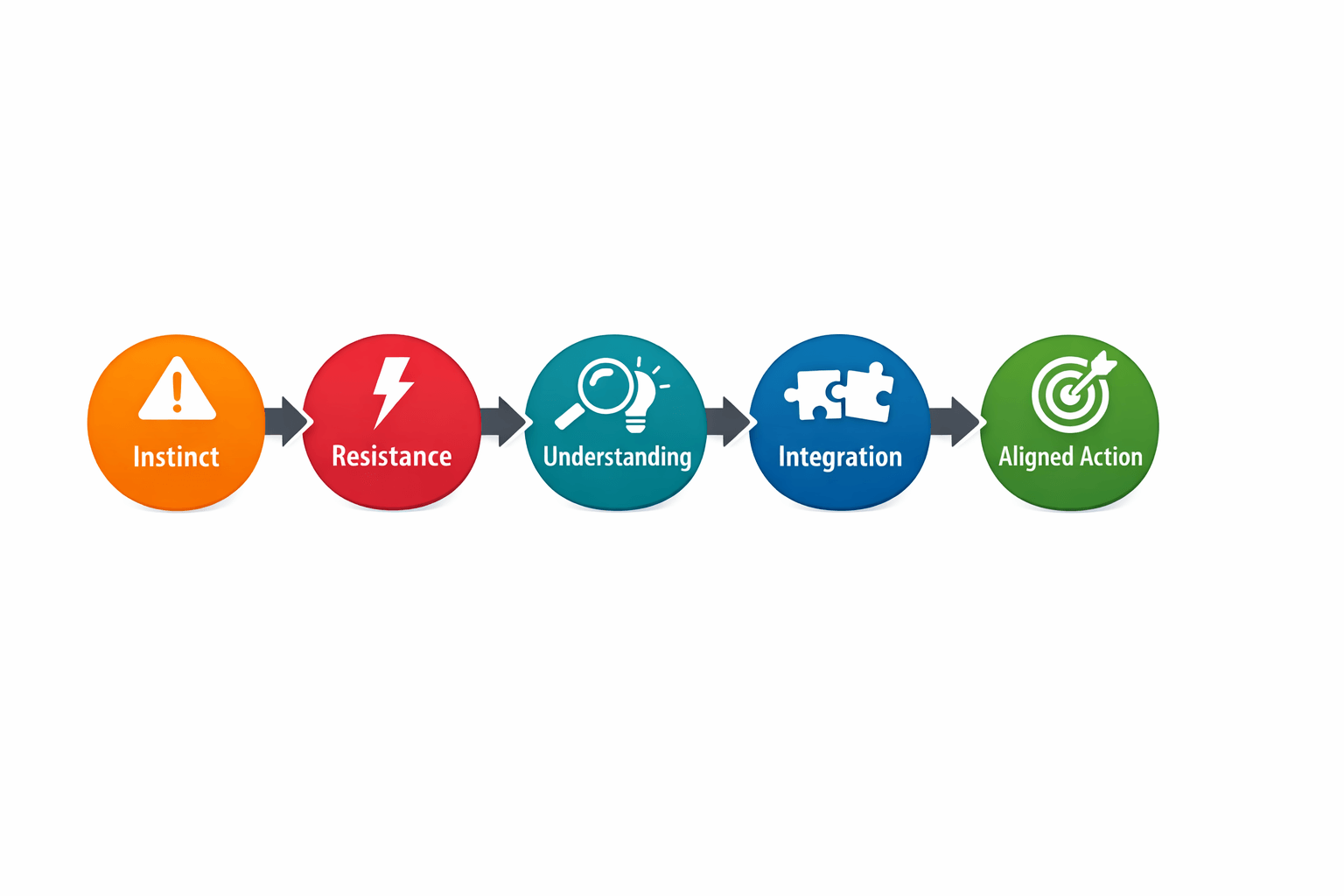
The IAS reframe: you don’t need to defeat Instinct — you need to educate it
The Identity Awakening System is not a war against the self.
It’s an integration.
IAS teaches this quietly powerful move:
Instead of fighting your fear, translate it.
When resistance shows up, ask:
-
What is this trying to protect me from?
(Rejection? Embarrassment? Being seen? Losing control? Being judged?) -
What identity is it trying to preserve?
(The old “safe you” — the one who stays consistent with past expectations.) -
What does my deeper self actually want now?
(Truth? Freedom? Expression? Service? Creation? Connection?)
This is where awakening becomes practical: you stop arguing with your resistance and start listening to what it’s guarding.
The “Inner Split Translator” (a 3-minute practice)
Use this whenever you feel stuck.
Step 1 — Name the voice
Write the exact thought:
-
“Don’t post that.”
-
“You’ll fail.”
-
“People will judge you.”
Step 2 — Validate the protective intention
Reply:
-
“I see you. You’re trying to keep me safe.”
Step 3 — Offer an upgrade
Then say:
-
“We’re not doing this to be perfect. We’re doing this to be true.”
-
“We’re taking a small step, not jumping off a cliff.”
-
“It’s safe to learn in public.”
-
“I can handle discomfort. I’m not 12 anymore.”
This is the key: you don’t silence the Safety System by force.
You calm it with understanding and small, steady proof.
How integration creates aligned action
Most people take action from one of two places:
-
Action from fear (proving, pleasing, hustling, hiding)
-
Action from truth (clarity, service, steadiness)
Integration moves you into the second.
When Instinct feels respected and Intellect is guided by your deeper values, something shifts:
-
You don’t need “motivation” as much.
-
You stop negotiating with the same old excuses.
-
You become consistent without being harsh.
-
You create without the constant need for validation.
That’s IAS in motion:
Identity → Awareness → Action
Or, in this language:
Safety (Instinct) + Truth (Intellect) → Integration → Aligned Creation
A final reminder
Your resistance is not proof you’re failing.
It’s proof you’re crossing a threshold.
You are not here to destroy your old self.
You are here to include it — and lead it.
Because the awakened path isn’t becoming someone else.
It’s becoming whole.