Most people do not begin life by choosing what they believe.
They begin by absorbing.
They absorb the atmosphere around them.
The emotions in the home.
The rules no one explains.
The things that are praised.
The things that are punished.
The truths that are spoken.
And the truths that are never allowed to be spoken.
This is where belief begins.
Not first in logic.
But in relationship.
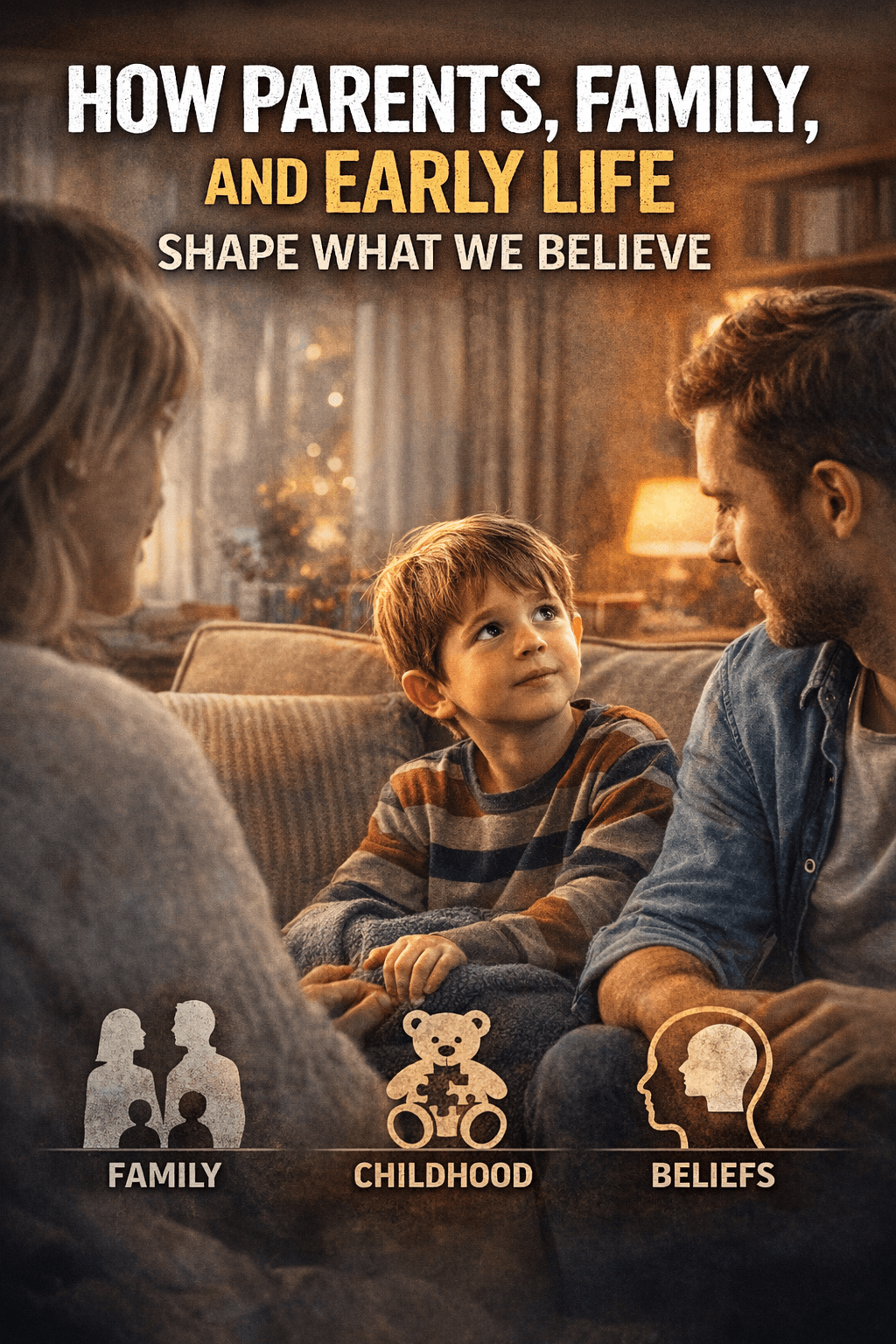
Family is our first belief system
Before school, before media, before society becomes fully visible, family is our first world.
It is where we learn:
- what feels safe
- what feels dangerous
- what gets love
- what gets disapproval
- what earns closeness
- what causes withdrawal
- what kind of person we need to be
A child does not step back and analyse this.
A child adapts.
That is why family shapes belief so deeply.
Because what is learned there is not just heard.
It is lived.
Early beliefs are often emotional before they are verbal
Many of the beliefs formed in early life are not even conscious sentences at first.
They begin as felt realities.
For example:
- If the home is tense, a child may learn that life is unpredictable.
- If love is conditional, a child may learn that they must perform to be accepted.
- If anger is dangerous, a child may learn to suppress truth.
- If achievement is praised, a child may learn that worth comes through success.
- If emotional needs are dismissed, a child may learn not to have them.
- If obedience is rewarded, a child may learn not to question authority.
Later in life, these emotional learnings often become beliefs such as:
- I must not be too much
- I must keep others happy
- I am only safe when I behave
- I have to earn love
- My feelings are not important
- I must stay in control
- I should not question
This is how early life shapes identity.
Children believe what they must believe to belong
This is one of the deepest truths about belief.
Children depend on connection.
They need love.
Safety.
Belonging.
Attachment.
Protection.
So they will often form beliefs that help them stay connected to the people they depend on.
Not because those beliefs are objectively true.
But because they are adaptive.
A child may come to believe:
- Mum must be right
- Dad must be right
- My family’s view is the safe view
- If I disagree, I may lose connection
- If I question, I may create danger
- If I become the version they want, I will be loved
This is not manipulation in a simplistic sense.
It is how human beings adapt to relationship.
But the result is that many beliefs we carry into adulthood were not consciously chosen.
They were formed to preserve attachment.
Parents shape belief through more than words
Parents do not only shape beliefs through what they say.
They shape beliefs through:
- tone
- mood
- reactions
- silence
- emotional availability
- stress patterns
- how they treat themselves
- how they treat each other
- how they talk about money, work, trust, authority, and life
A parent may never say, “The world is dangerous.”
But if they are constantly fearful, watchful, and distrustful, the child may absorb that belief.
A parent may never say, “Your worth depends on achievement.”
But if praise only comes through performance, the child may absorb it anyway.
This is why belief is often shaped through atmosphere as much as language.
Siblings shape beliefs too
Siblings matter more than people sometimes realise.
They shape identity through comparison, role, and contrast.
A child may unconsciously become:
- the clever one
- the difficult one
- the quiet one
- the responsible one
- the funny one
- the overlooked one
- the peacekeeper
- the rebel
These roles can become deeply fixed.
Not because they are the whole truth of the child, but because the family system gives them a place.
A belief may form around that role:
- I must be the good one
- I must not need too much
- I have to stand out to matter
- I should stay small
- I only get seen when I make people laugh
- I am the one who carries things
What starts as family positioning can become long-term identity.
Family beliefs are often inherited, not examined
Every family carries beliefs.
Beliefs about:
- money
- love
- work
- status
- religion
- success
- gender
- authority
- loyalty
- safety
- what is acceptable
- what is shameful
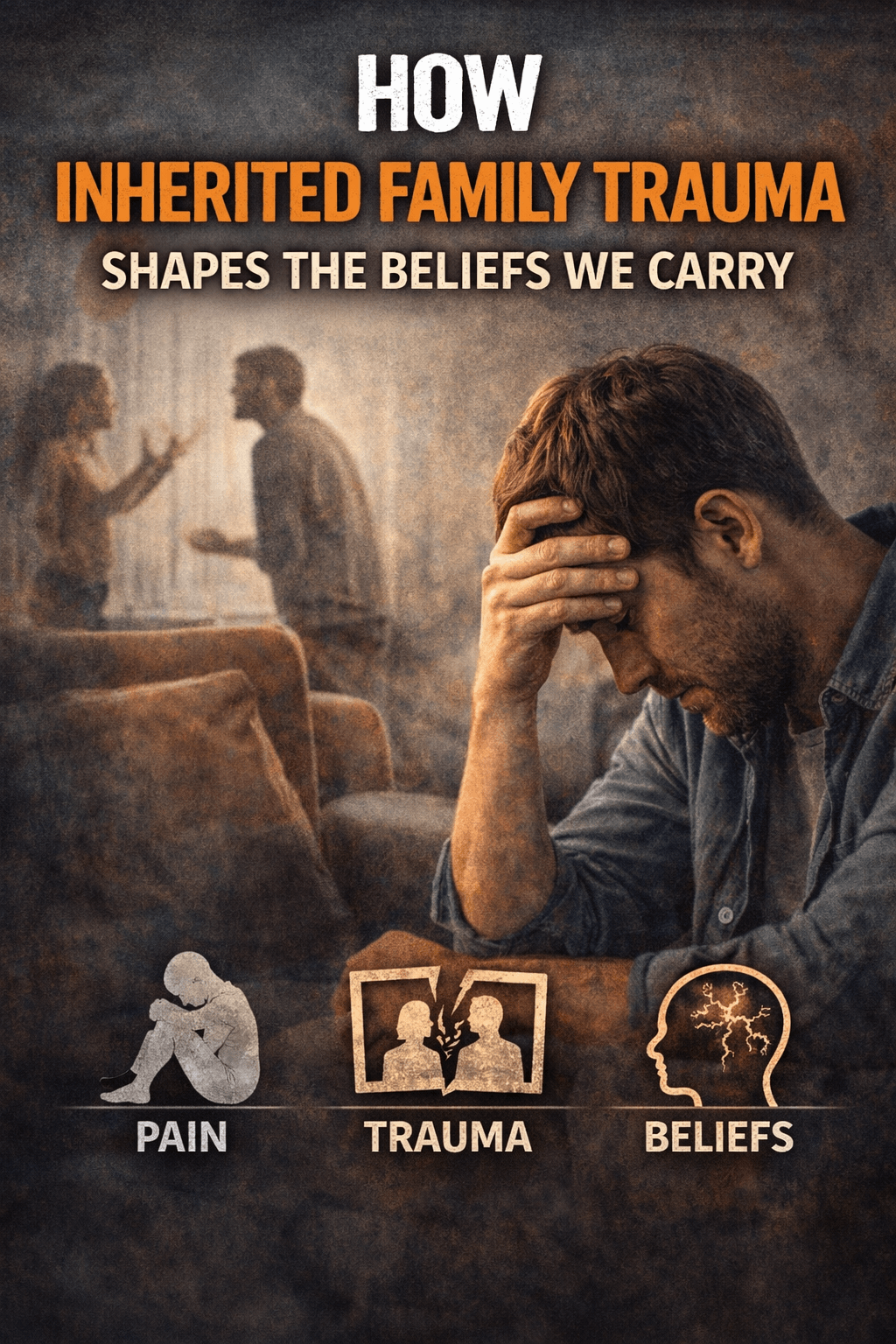
Many of these beliefs have been passed down for generations.
They may never be openly discussed.
They are simply lived.
Examples include:
- money is hard to get
- authority knows best
- good people do not make trouble
- you should not talk about private things
- men must be strong
- women must be self-sacrificing
- family comes before truth
- success matters more than joy
- survival comes before self-expression
These beliefs can feel so normal that a person mistakes them for reality.
But often they are inherited scripts.
Why early beliefs feel so hard to question
This is important.
Questioning early beliefs can feel emotionally risky, even in adulthood.
Why?
Because those beliefs are often tied to:
- belonging
- loyalty
- identity
- safety
- love
- family coherence
- the child’s way of surviving
So when an adult begins to question what they were taught, they may not only feel intellectual doubt.
They may feel guilt.
Fear.
Disorientation.
Grief.
Inner conflict.
Part of them may feel they are not just questioning an idea.
They are questioning the world that formed them.
That is why awakening can feel so tender.
What family gives us — and what it leaves us to untangle
Family gives many things.
Love.
Care.
Protection.
Culture.
Belonging.
Memory.
Language.
Orientation.
But family can also leave us with beliefs that no longer fit who we are becoming.
That does not mean we must reject everything we came from.
It means we may need to look more honestly at what we inherited.
Ask:
- What beliefs about life did I absorb early?
- What did I learn about love?
- What did I learn about safety?
- What did I learn about truth?
- What roles did I take on in my family?
- What beliefs still shape me now?
- Which ones actually feel true?
- Which ones feel inherited?
These questions matter.
Because many people are still living from childhood beliefs in adult bodies.
This is where identity awakening begins to deepen
The moment a person starts to see that not every belief they carry is truly theirs, something important begins.
They begin separating:
- self from conditioning
- truth from inheritance
- essence from adaptation
- present identity from old family roles
This does not always happen dramatically.
Often it begins quietly.
A person notices:
- this no longer feels true
- I do not want to live this way anymore
- I can feel my family’s voice inside me
- I have been loyal to beliefs that are no longer alive for me
- I want something deeper and more honest
That is a significant shift.
Because once belief becomes visible, identity can begin to change.
How My Identity Awakening System (IAS) helps with this
The Identity Awakening System helps people recognise which parts of self were shaped by conditioning, inherited role, emotional survival, and early belief.
It helps you ask:
- What did I absorb from my family?
- What role did I become in order to belong?
- What beliefs still shape my life now?
- Which of these beliefs actually feel true?
- What am I outgrowing?
- Who am I beneath what I inherited?
This matters because awakening is not only about learning new truths.
It is about seeing the old truths you were handed and deciding whether they are really yours.
That is how inner authority begins.
Not in rebellion for its own sake.
But in honest recognition.
A gentler truth
Most people did not choose their earliest beliefs.
They absorbed them in love, fear, dependence, adaptation, and belonging.
That is why this work needs compassion.
You are not foolish if old beliefs still shape you.
You are human.
But there comes a point when inherited beliefs begin to feel too small, too heavy, or no longer true.
That is often the beginning of awakening.
Closing
Parents, family, and early life shape what we believe long before we know how to question it.
That is why those beliefs can feel so natural, so unquestionable, and so personal.
But not everything that shaped you is the deepest truth of you.
Some beliefs were inherited.
Some were adaptive.
Some were protective.
Some were necessary for a season.
Awakening begins when you start to see that clearly.
And ask, with gentleness:
What did I inherit?
What did I become in order to belong?
And what feels truly mine now?
That is where identity begins to return to itself.