Most people like to think they arrived at their beliefs independently.
They imagine they examined the evidence, made up their own mind, and chose what feels true.
Sometimes that happens.
But very often, belief is shaped long before careful thinking begins.
It is shaped by culture.
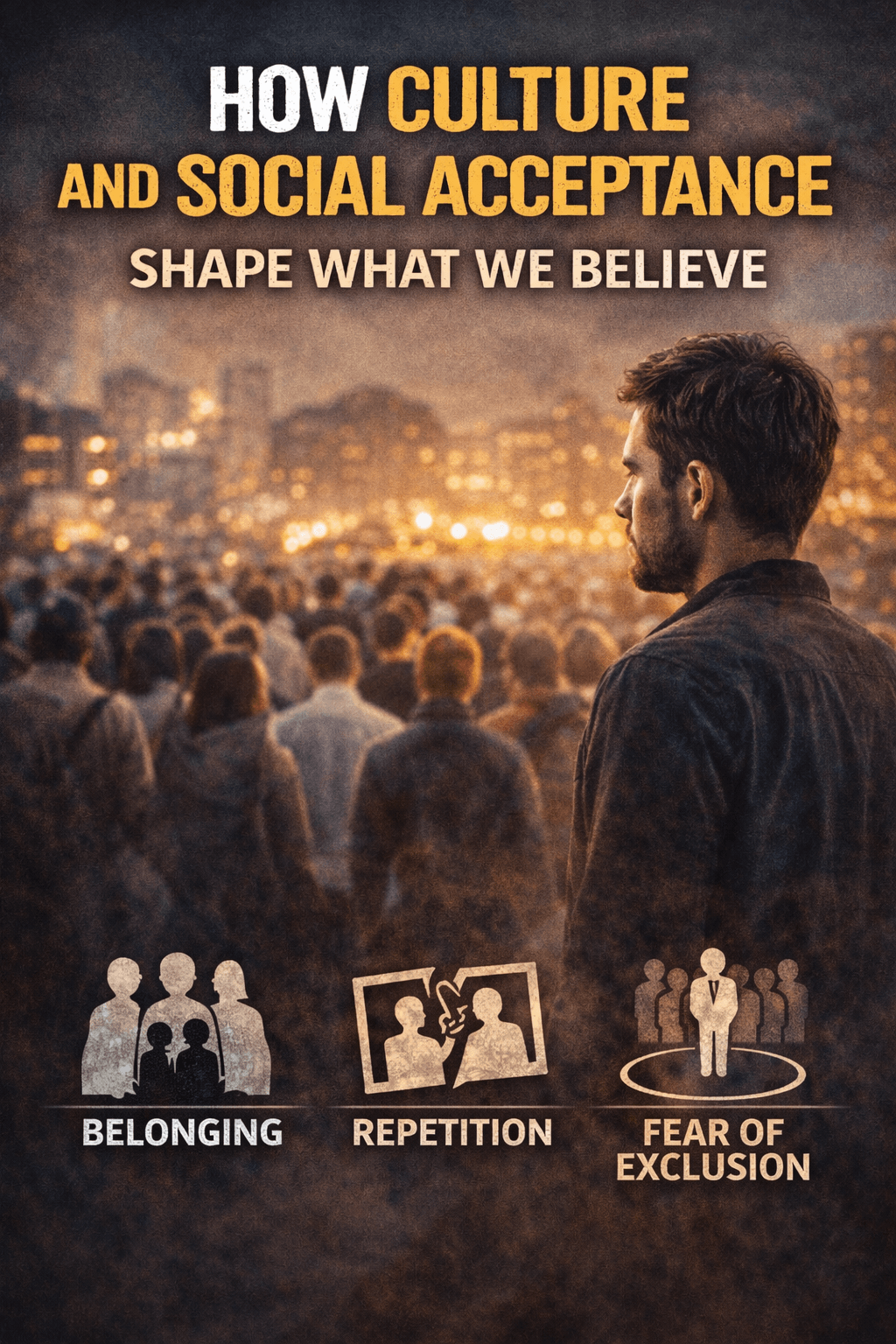
By belonging.
By what is normal.
By what is rewarded.
By what gets you accepted.
And by what risks making you an outsider.
This is one of the quietest forces in human life:
many people do not only believe what feels true.
They believe what helps them belong.
Culture is a belief-making environment
Culture is not just music, fashion, language, or tradition.
Culture is also a system of signals.
It tells people:
- what is normal
- what is admirable
- what is embarrassing
- what is successful
- what is shameful
- what is acceptable to say
- what should never be questioned
- what kind of person is respected
- what kind of person is rejected
This matters because human beings are not neutral observers.
We are social creatures.
We pay attention to the emotional atmosphere around us.
And over time, culture tells us what kind of beliefs feel safe to hold.
Social acceptance is more powerful than most people realise
Beliefs are not formed only through logic.
They are also formed through social reward and social risk.
If a person notices that certain views bring:
- approval
- belonging
- praise
- inclusion
- status
- safety
they are more likely to lean toward them.
If they notice that other views bring:
- ridicule
- conflict
- exclusion
- embarrassment
- punishment
- social loss
they may stay silent about them, doubt themselves, or avoid them entirely.
This does not always happen consciously.
Often it happens quietly.
A person feels what is welcome.
And adjusts.
That is one way culture shapes belief.
We often absorb what the group treats as obvious
Every culture has “obvious truths.”
These are the ideas people rarely examine because they are simply everywhere. For example, in the early 2020’s the majority of people were persuaded to take the Covid vaccine because they were told it was supposedly ‘safe and effective’. Or granny may die if you don’t take it! Or wear a mask to stop transmission.
Other examples, a culture may quietly teach:
- your worth comes from productivity
- success means status
- busyness is admirable
- questioning authority is dangerous
- appearances matter
- fitting in matters more than truth
- financial success proves value
- being different is risky
- the mainstream view is the safe view
- comfort matters more than integrity
These beliefs may never be stated so directly.
But they are repeated through tone, messaging, institutions, entertainment, conversation, and social expectation.
And after enough repetition, they begin to feel like reality.
Belonging shapes belief early and deeply
Human beings want to belong.
Not in a weak or superficial way.
In a deep, nervous-system way.
To belong has historically meant:
- safety
- connection
- protection
- identity
- survival
To be rejected has often meant pain.
So many people will unconsciously shape their beliefs around what keeps them inside the group.
This may happen in:
- family
- school
- religion
- friendship circles
- class groups
- work culture
- political groups
- online communities
- national identity
- generational identity
A person may think they are choosing a belief.
But part of what they may be choosing is:
continued belonging.
Culture often teaches us what to fear questioning
This is a powerful part of the story.
Culture does not only shape what we believe.
It also shapes what feels too dangerous to question.
Every social environment has its own forbidden zones.
Things you are not supposed to challenge.
Things you are supposed to accept.
Things you are expected to repeat.
Things that, if questioned, may make people uncomfortable.
Sometimes those zones relate to:
- politics
- religion
- health
- identity
- class
- success
- gender roles
- authority
- historical narratives
- institutional trust
The point here is not that every cultural belief is false.
It is that unexamined cultural consensus can become a substitute for truth.
And that makes independent discernment much harder.
Social acceptance can train people to perform belief
Sometimes a person does not fully believe what they are saying.
But they have learned that saying it keeps life smoother.
So they perform agreement.
They repeat what is acceptable.
They mirror the group.
They say the right thing in the right tone.
They stay away from what creates friction.
Over time, something important can happen:
the performance becomes internalised.
A belief repeated for belonging can start to feel like a personal belief.
This is one reason awakening can feel so strange.
A person may realise:
- I don’t know what I actually think
- I have been saying what fits
- I have been loyal to acceptance more than truth
- some of my beliefs may not really be mine
That can be unsettling.
But it is also clarifying.
Shame is one of culture’s strongest tools
Culture often does not control belief through force alone.
It uses shame.
Shame says:
- do not be that kind of person
- do not say that out loud
- do not embarrass yourself
- do not make people uncomfortable
- do not step outside the accepted range
- do not become someone the group cannot digest
This is powerful because shame is social pain.
And many people would rather doubt themselves than risk becoming socially exposed.
That is why social conformity is not just intellectual.
It is emotional.
Sometimes very deeply emotional.
Identity becomes attached to social positioning
Culture also shapes belief through identity groups.
People begin to define themselves through:
- profession
- class
- political tribe
- religion
- nationality
- social status
- education level
- lifestyle identity
- moral signalling
- ideological communities
At that point, belief is no longer only about facts.
It becomes part of self-image.
A person may not simply believe something because it seems true.
They may believe it because:
- this is what people like me believe
- this is what my group believes
- this is how I show who I am
- this is how I stay inside the tribe
- this is how I remain respectable
This is why belief can become very hard to question.
Because changing belief may feel like changing social identity.
Social fear can be stronger than inner truth
There are times when people can feel something is off.
They may sense:
- this does not fully add up
- I do not fully believe this
- something in me is unconvinced
- I am repeating this more than I actually understand it
But if social pressure is strong enough, many people override that inner signal.
Not because they are foolish.
But because belonging, reputation, and acceptance carry enormous emotional weight.
That is one of the great costs of unexamined culture:
people can lose contact with their own inner authority.
This is how culture shapes identity
When beliefs are shaped through culture and social acceptance, identity often begins organising around external permission.
A person may become:
- the acceptable one
- the respectable one
- the successful one
- the informed one
- the progressive one
- the traditional one
- the loyal one
- the good citizen
- the one who says the right things
- the one who stays inside the approved range
From the outside, this may look normal.
But inwardly, the person may be living far more from adaptation than truth.
That is why cultural conditioning matters.
It does not only shape opinion.
It shapes identity.
Why questioning culture can feel lonely
One reason people resist questioning cultural beliefs is because it can feel isolating.
When a person begins to examine what everyone around them treats as obvious, they may feel:
- awkward
- disoriented
- exposed
- rebellious
- disloyal
- misunderstood
- lonely
- uncertain who they are without the shared script
This is especially true if their social world is heavily built around conformity.
That is why awakening often requires courage.
Not aggressive rebellion.
But quiet courage.
The courage to sit with the discomfort of not automatically agreeing with what surrounds you.
This is not about rejecting everything
This matters.
Awakening is not about rejecting every social belief simply because it is mainstream.
That would just be another reflex.
The real work is deeper.
It is to ask:
- Is this actually true for me?
- Did I arrive here consciously?
- What social rewards keep this belief in place?
- What fears make this hard to question?
- What happens in me when I imagine stepping outside it?
- What feels true beneath the pressure to belong?
That is discernment.
And discernment is different from blind conformity or blind opposition.
How Identity Awakening System helps with this
The Identity Awakening System helps people recognise the beliefs they are carrying from culture, group identity, social reward, and the need to belong.
It helps you ask:
- What have I absorbed from culture without examining?
- What beliefs help me feel accepted?
- What have I performed rather than deeply chosen?
- What social fears keep me from questioning?
- What identity have I built around belonging?
- What feels genuinely true beneath social pressure?
This matters because awakening is not only about seeing family conditioning.
It is also about seeing how the wider world has shaped your sense of what is real, acceptable, and possible.
That is where inner authority begins to strengthen.
A gentler truth
Most people do not believe only from truth.
They also believe from belonging.
That does not make them weak.
It makes them human.
But there comes a point when social agreement can no longer substitute for inner knowing.
A point when what is culturally acceptable no longer feels sufficient.
A point when the deeper self begins asking:
What do I actually believe?
What have I inherited from the group?
What am I afraid to question?
That is often where awakening begins.
Closing
Culture and social acceptance shape what we believe in ways that are often quiet, invisible, and emotionally powerful.
They shape what feels normal.
What feels safe.
What feels speakable.
What feels embarrassing.
What feels respectable.
And what feels too dangerous to question.
That is why many beliefs feel personal when they may actually be social.
Awakening begins when we notice that.
And ask, with honesty:
What do I believe because it is true?
What do I believe because it helps me belong?
And who am I beneath the pressure to be acceptable?
That is where identity begins to free itself.