There is a quiet paradox at the heart of modern life.
Human beings are the most creative species that has ever existed.
We build cities.
We invent technologies.
We write music, stories, and philosophies.
Creation is woven into our nature.
Not because they lack intelligence.
Not because they lack opportunity.
But because they spend most of their lives consuming instead of creating.
Modern systems are incredibly effective at keeping people passive.
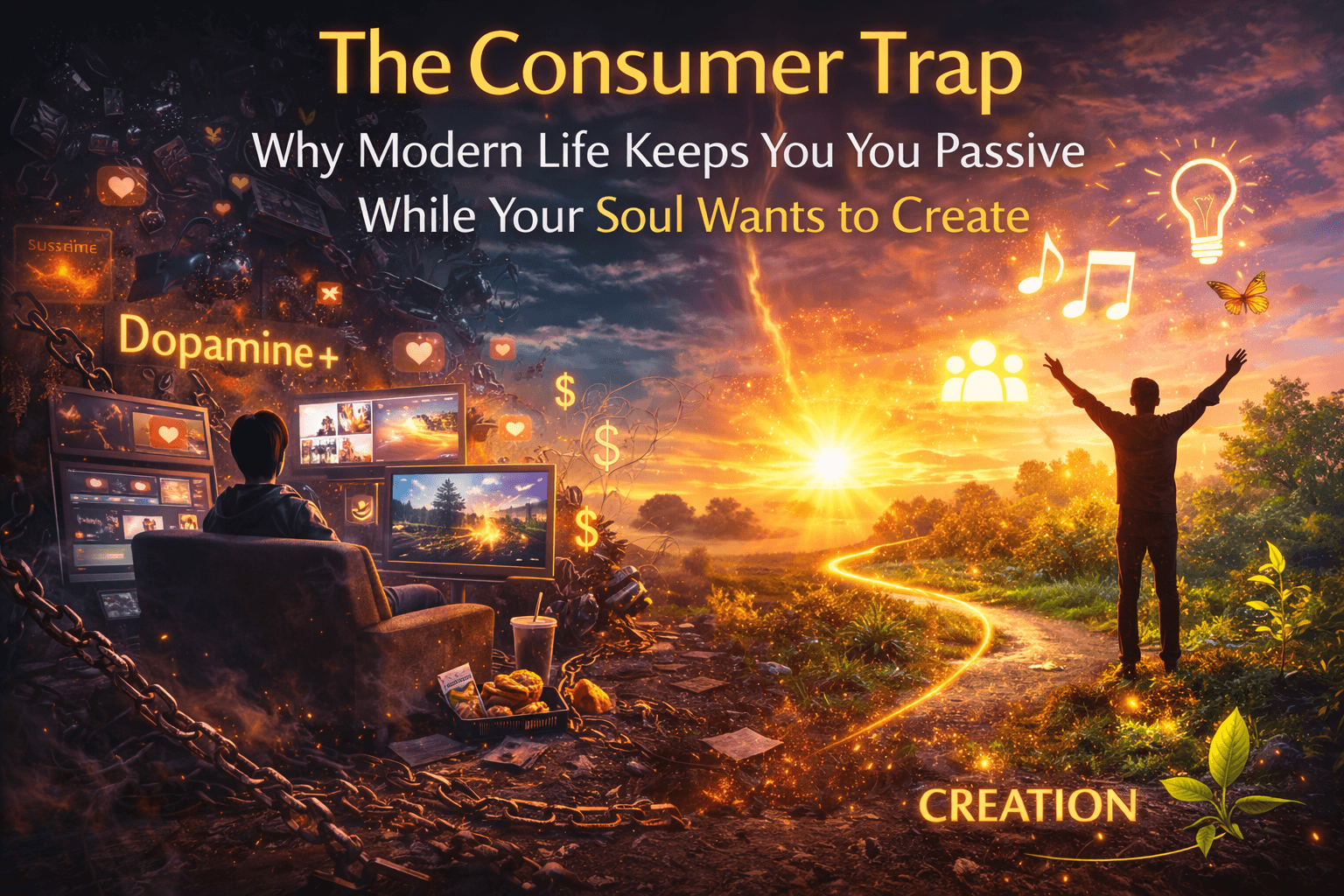
And the result is what we might call the consumer trap.
The Age of Infinite Consumption
Never in human history has it been so easy to consume.
Within seconds we can access:
Endless entertainment
Social media feeds
Breaking news
Online shopping
Streaming platforms
Infinite information
At first glance this seems like abundance.
But something subtle happens when consumption becomes the dominant mode of living.
Our minds become busy.
But our lives remain unchanged.
We scroll.
We watch.
We react.
But we rarely create.
And over time, something inside us begins to feel dormant.
The Dopamine Economy
Modern digital platforms are not neutral environments.
They are designed to capture attention.
Every notification, like, and scroll is carefully engineered to trigger dopamine — the chemical associated with reward and anticipation.
This creates a feedback loop.
You open your phone for a moment.
Minutes become hours.
Your mind is stimulated but not fulfilled.
Because dopamine-driven engagement is not the same as meaningful action.
The result is a strange state of mental exhaustion.
We feel busy.
But we are not building anything.
The Illusion of Participation
Social media creates another illusion.
It gives the impression that we are participating in the world simply by reacting to it.
We like posts.
We comment.
We share opinions.
But reacting is not the same as creating.
Creation requires initiative.
It involves producing something that did not exist before.
A piece of writing.
A new idea.
A project.
A solution to a problem.
Creation changes both the creator and the world around them.
Consumption rarely does.
Why Passivity Feels So Uncomfortable
Humans are not designed to live as passive observers.
For most of history, survival required creativity.
People built tools.
They cultivated land.
They crafted goods.
They told stories.
Creation was inseparable from daily life.
When modern systems remove this creative participation, something important is lost.
Many people experience this loss as:
restlessness
boredom
anxiety
a vague sense of purposelessness
They feel busy, but not alive.
The problem is not laziness.
The problem is misalignment with human nature.
The Identity Connection
The consumer trap is not only about technology.
It is also about identity.
When people spend most of their time consuming, they gradually begin to see themselves as audiences rather than participants.
They watch the world unfold instead of shaping it.
Over time this weakens identity.
Identity grows stronger when we take action.
When we build something.
When we contribute something meaningful.
When we experiment and learn.
Without these experiences, identity becomes uncertain.
And this uncertainty is one of the reasons so many people feel lost today.
From Consumer to Creator
Escaping the consumer trap does not require rejecting modern technology or abandoning society.
It requires a shift in orientation.
Instead of asking:
What should I watch next?
We begin asking a different question:
Creation does not need to be grand.
Small acts of creation are often the most powerful.
Writing an idea.
Starting a small project.
Building something useful.
Sharing insight with others.
Every act of creation strengthens identity.
It moves us from passive observation to active participation.
The Next Small Step
Many people feel intimidated by the idea of creating.
They imagine that creation requires talent, resources, or perfect ideas.
In reality, creation begins much more simply.
It begins with the next small step.
A seed of curiosity.
A question.
A thought that refuses to disappear.
These seeds appear naturally in our lives.
But they often go unnoticed because we are distracted by constant consumption.
The Identity Awakening System encourages people to rediscover these seeds.
Then nurture them gradually through experimentation and exploration.
Over time those seeds can grow into meaningful projects, ideas, or contributions.
Creation Restores Meaning
When people begin creating again, something remarkable happens.
Energy returns.
Curiosity awakens.
Direction becomes clearer.
This is because creation activates parts of the mind that passive consumption does not.
Creation engages:
imagination
problem solving
self-expression
learning
adaptation
These are the very qualities that make human beings unique.
The more we use them, the stronger our sense of identity becomes.
And with identity comes clarity.
The Identity Awakening System
The Identity Awakening System (IAS) was developed to help people navigate this transition.
Many individuals sense that the consumer-driven model of life no longer satisfies them.
But they are unsure what should replace it.
IAS offers a framework for rediscovering identity through conscious reflection and creative action.
Instead of defining yourself by external expectations, IAS encourages you to explore:
What interests you deeply.
What problems you care about solving.
What ideas feel alive within you.
From these signals, direction begins to emerge naturally.
Creation becomes not just a hobby, but a way of living.
The Future Belongs to Creators
As technology continues to evolve, the nature of work and contribution will change.
Automation and artificial intelligence will increasingly handle repetitive tasks.
This will place greater value on uniquely human abilities.
Creativity.
Curiosity.
Insight.
Connection.
In this emerging world, identity will matter more than ever.
Those who cultivate their creative identity will shape the future.
Those who remain passive consumers may find themselves feeling increasingly disconnected from it.
The choice is not about abandoning technology or modern life.
It is about reclaiming the role humans have always played.
Not just observers of the world.
But creators within it.
Escaping the Consumer Trap
The consumer trap is powerful because it is invisible.
It feels normal.
Everyone else seems to be doing the same thing.
But the moment you begin creating again, you start to see the difference.
Creation restores agency.
It reminds you that your life is not simply something that happens to you.
It is something you can shape.
The first step is small.
But small steps lead to meaningful change.
And meaningful change begins with a simple question.
What is the next small thing I can create?
Continue the Journey
If these ideas resonate with you, you may want to explore the deeper framework behind them.

This guide explains how identity shapes the life we create and how individuals can rediscover clarity in a rapidly changing world.