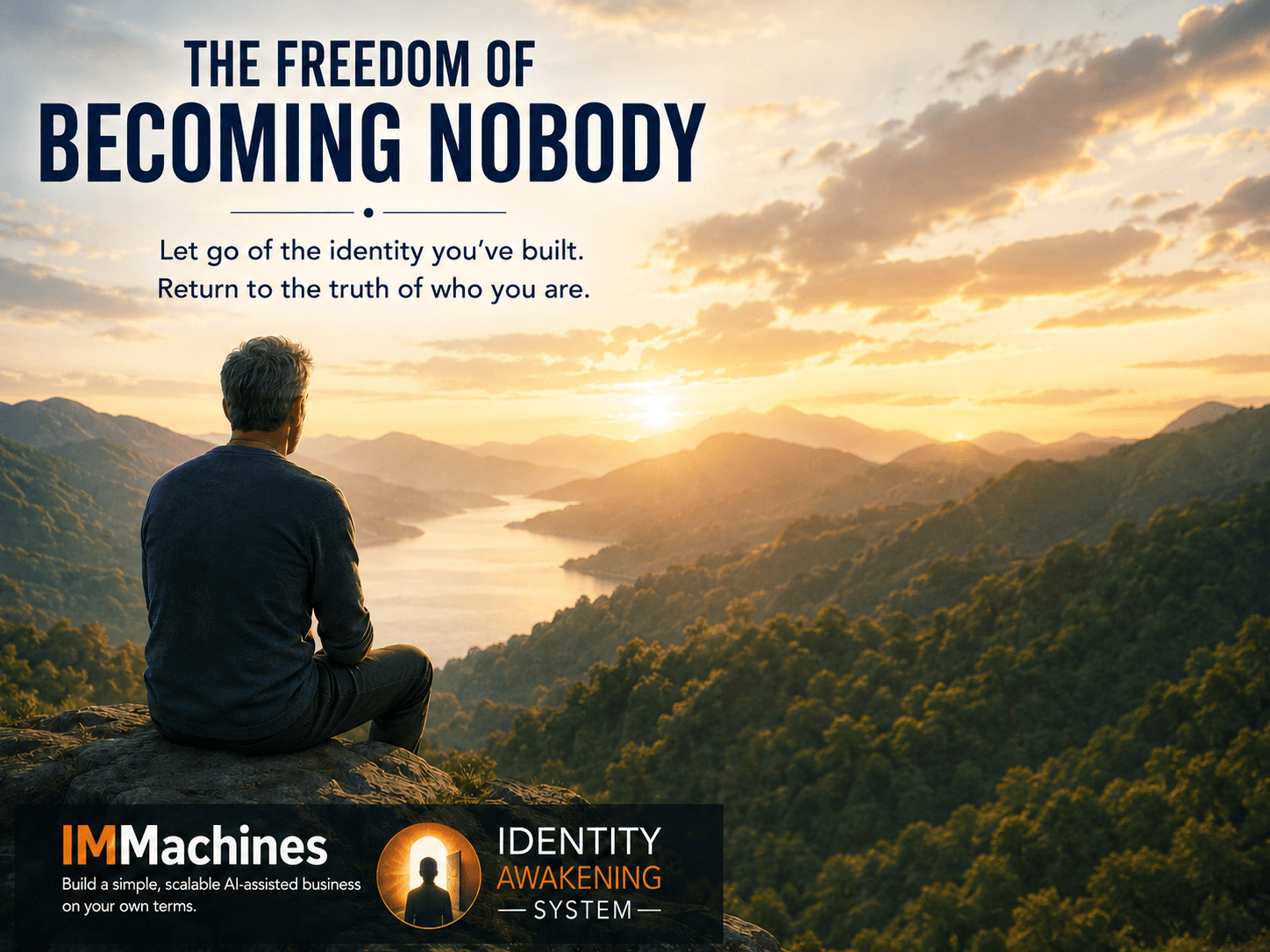

There comes a point in life when we have to ask a difficult question:
Am I defending who I really am, or am I defending who I learned to be?
For many of us, identity is not something we consciously choose. It is built slowly through family expectations, work, responsibility, success, fear, praise, criticism, and the need to survive.
Over time, we begin to say, “This is who I am.” But often, what we really mean is, “This is the version of me that helped me get through life.”
And there is no shame in that.
The identity that once protected us may have been necessary. It may have helped us earn money, support a family, gain respect, build confidence, and feel that we had a place in the world. At one stage of life, that identity may have been exactly what we needed.
But what once protected us can later imprison us.
We defend the old identity because it once gave us value. We cling to it because it once made sense. We protect it because without it, we fear we may become nobody, or at least become someone of less value.
Somewhere beneath the surface, a quiet discomfort begins to grow. It may feel like a weight inside us, holding back the creative power beginning to stir beneath the surface.
The role no longer fits the identity that is emerging.
The life that once gave us certainty starts to feel too small. The title may still sound respectable. The achievements may still look impressive from the outside. But inside, the soul begins to feel constrained.
The world often calls this a midlife crisis. But perhaps it is really a midlife awakening.
A job title is not a soul.
A career is not a calling.
A reputation is not an identity.
A former version of ourselves is not a life sentence.
In my own case, I spent 25 years in banking. From the outside, it may have looked like a secure and respectable career. I had the institution, the regular salary, the credibility, and the familiar structure that came with being “a banker.”
But emotionally, I felt stressed, overworked, and spiritually dead inside.
For around five years before I finally left, I knew something in me was coming to an end. I could feel it before I could fully explain it. The role still existed, but my energy was withdrawing from it. I began positioning my finances so I could survive a transition, because beneath the desire for freedom was a very real fear.
I feared losing the safety of the institution.
I feared losing the salary that dropped into my bank account each month.
I feared going it alone when I had no real experience as an entrepreneur.
What I did not particularly fear was a loss of status. But other people noticed the change. One golfing partner disappeared from my life after I left banking, which says something rather revealing. Sometimes people are not attached to you; they are attached to the version of you they understand.
And if that version comes with a respectable job title, so much the better.
Even after leaving, part of me still clung to the banker identity. For several years, it remained the only thing that gave me credibility as a business consultant. It was the badge I could point to. The proof that I had been serious, professional, responsible, and trustworthy.
But it was no longer the whole truth of who I was becoming.
After leaving the bank, I trained as a profit improvement business consultant. I did some small contracts, then bought a manufacturing business out of liquidation. That led to twelve months of grinding work before I eventually sold the business for a good profit after creating a product that attracted a large buyer.
On paper, that looked like success.
But I had always known that success without soul was not enough.
Being a service provider did not truly appeal to me because, deep down, I wanted to create my own legacy. I did not simply want to build someone else’s dream, solve someone else’s problems, or spend the rest of my life proving my usefulness. I wanted to create something that expressed something true in me.
That desire eventually led me into internet marketing. And unexpectedly, that world began to awaken the artistic side of me.
Colours. Fonts. Images. Layouts. Words. Ideas. Persuasive content. Inspiring messages.
For the first time, I began to feel that business could involve creativity, not just analysis. Communication could be beautiful. A website could be more than a sales tool; it could become a canvas. Words could do more than inform; they could awaken.
Looking back, I can see that the banker, the consultant, the business owner, the marketer, the creator, and the seeker were all chapters. But none of them was the entire book.
Many people suffer because they remain loyal to an identity that has already expired. They continue to think, speak, work, and make decisions from an old version of themselves, even when life is quietly asking them to grow beyond it.
Sometimes the hardest cage to escape is not built by other people. It is built by our own need to be seen in a certain way.
We may defend being “the responsible one,” even when we are exhausted.
We may defend being “the strong one,” even when we need support.
We may defend being “the successful one,” even when success no longer feels meaningful.
We may defend being “the practical one,” even when our soul is asking for creativity, beauty, and truth.
The old identity says, “Stay where you are. This is safe. This is familiar. This is what people understand.”
But the deeper self whispers, “You are allowed to become more honest.”
Leaving an old identity does not mean rejecting everything it gave us. It means honouring what it taught us, then refusing to be trapped by it. The discipline, intelligence, resilience, experience, and wisdom we gained are not wasted. They become raw material for the next chapter.
The former identity is not the enemy. It is simply not the whole story.
At some point, life asks us to stop polishing the cage and start looking for the door.
That door often opens through honesty. We begin by admitting, “This role once served me, but it no longer fully expresses me.” That is not failure. That is awakening.
The soul does not usually shout. It nudges. It unsettles. It withdraws energy from things that once excited us. It makes old victories feel strangely empty. It draws us toward new forms of expression — writing, painting, teaching, healing, creating, serving, meditating, or speaking truth.
At first, this can feel frightening. We may wonder, “Who am I if I am no longer that person?”
But perhaps the better question is:
Who might I become if I stopped defending the identity that is keeping me small?
The cage may once have protected you. It may once have helped you build a life. But if your soul is now pressing against its bars, perhaps it is not because you are lost.
Perhaps it is because you are being called out.
Not to become someone false.
But to return to someone deeper.