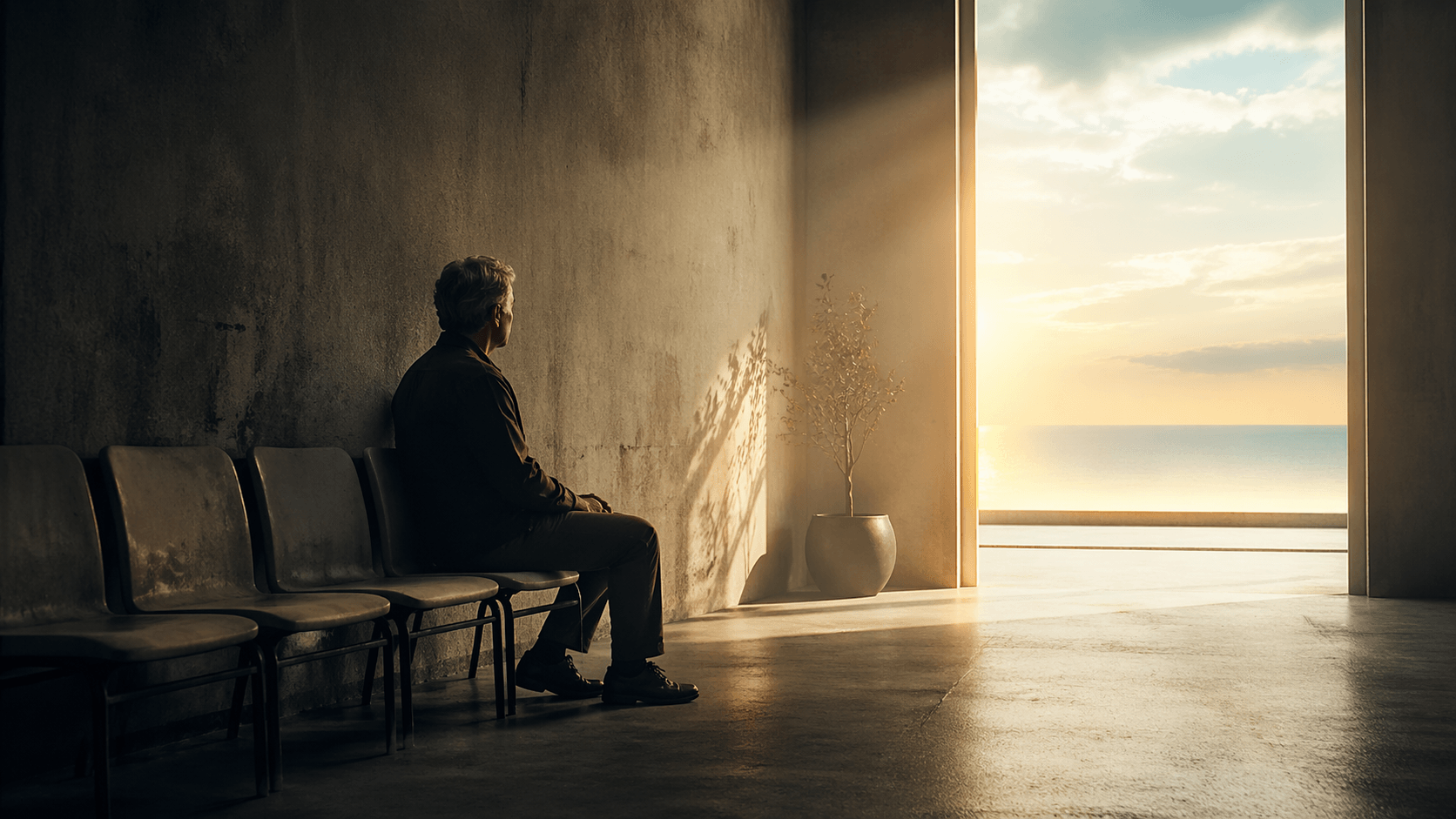
There is a strange place many people enter after awakening begins.
It is not a physical place.
It is not something you plan.
And once you are in it, you realise you cannot simply go back to who you were before.
It is the place between worlds.
The place where the old reality no longer feels believable, but the new reality you sense so clearly has not fully arrived.
You might call it confusion.
You might call it transition.
You might call it grief.
You might call it awakening.
But another name for it is this:
the waiting room.
What is the waiting room?
The waiting room is the strange in-between state that can happen after you begin to see more clearly.
You start questioning things you once accepted.
You begin to notice cracks in the stories, structures, and assumptions that once felt normal.
You see that much of what shaped your life may have been inherited, conditioned, manipulated, or simply untrue.
And once you see that, something changes.
You cannot fully return to the old level of innocence.
You cannot completely unknow what you now sense.
You cannot easily go back to living as though everything still makes sense in the old way.
So you find yourself in between.
No longer fully inside the old world.
Not yet living in the new one you feel is possible.
That is the waiting room.
Why this stage can feel so lonely
One of the hardest parts of awakening is that it can feel deeply isolating.
You may feel:
- different from the people around you
- unable to fully explain what has changed
- misunderstood by friends or family
- less interested in old conversations
- disconnected from mainstream ways of thinking
- aware of things others do not seem ready to question
This can make life feel strange.
You may still be living in the same house.
Doing the same daily tasks.
Speaking to the same people.
And yet inwardly, you are no longer in the same reality.
That gap can feel very lonely.
Especially when you begin waiting for others to catch up.
The waiting room is not only outer — it is inner
At first, many people think they are simply waiting for the world to change.
Waiting for truth to come out.
Waiting for more people to wake up.
Waiting for the systems to shift.
Waiting for a better world to become visible.
And some of that may be true.
But over time, you begin to realise something deeper:
The waiting room is not just about the world outside you.
It is also a state of being.
It is the place you inhabit when you have outgrown one reality, but have not yet fully embodied the next.
So the waiting is not only external.
It is also:
- identity waiting
- nervous system waiting
- soul waiting
- purpose waiting
- embodiment waiting
You are not only waiting for the world.
You are also waiting to become fully at home in the self that is now emerging.
Why you cannot simply “go back to normal”
Many people try.
They try to switch off.
Try to return to surface life.
Try to stop questioning.
Try to fit back into the old conversations, old identities, old assumptions.
Sometimes they can for a while.
But it rarely lasts.
Because once awakening begins, something fundamental has changed.
You have seen enough to know that the old version of reality is no longer whole.
And once you know that, the old normal often starts to feel artificial.
That can be painful.
Because it means the old life may no longer fit, but the new life has not fully formed.
This is why the waiting room can feel so exhausting.
It is not just uncertainty.
It is the strain of living between identities, between worlds, between levels of seeing.
You wait for others to see what you see
This is one of the most emotionally difficult parts.
You wait for friends to question more deeply.
You wait for family to notice what feels obvious to you.
You wait for the wider culture to wake up to what you believe is broken, false, manipulated, or deeply out of alignment.
You wait for truth to matter.
You wait for goodness to return to the centre.
You wait for a more coherent world.
You wait for a reality that feels more in harmony with what life could be.
And yet often, while you wait, things seem to get worse.
The noise gets louder.
The contradictions grow.
The old systems strain harder to hold themselves together.
The world feels more confused, not less.
That can create a deep ache.
Not only because the world feels difficult, but because you begin to wonder:
Will it ever really change?
The waiting room carries grief
This is important to acknowledge.
The waiting room is not only about clarity.
It is also about grief.
You may grieve:
- the innocence you once had
- the old identity that once felt stable
- the trust you once placed in systems
- the relationships that no longer feel the same
- the shared reality you thought everyone lived inside
- the time you spent living from what no longer feels true
This grief is real.
And it needs compassion.
Because awakening is not always exciting in the way people imagine.
Sometimes it is slow.
Tender.
Disorienting.
Heavy.
Sacred.
Exhausting.
Sometimes it feels less like breakthrough and more like being quietly dismantled.
The waiting room is also a preparation space
And yet, for all its difficulty, the waiting room is not meaningless.
It is doing something.
It is refining you.
It is teaching you:
- what no longer fits
- what you truly value
- what kind of world you want to help create
- what kind of person you want to be in times of confusion
- what inner anchors matter most when outer structures feel unstable
This stage may feel passive, but it is not empty.
A great deal is happening here.
You are being shaped.
Your discernment is deepening.
Your inner authority is strengthening.
Your old identity is loosening.
Your relationship with truth is becoming more intimate.
Your role in the world is quietly clarifying.
The waiting room may not look productive from the outside.
But it is often a place of profound formation.
The deepest tension: what if the world never changes?
This may be the hardest question of all.
Deep down, many people in the waiting room are not only waiting for the world to change.
They are also wondering whether it ever truly will.
That question can create despair if we are not careful.
Because if your peace depends entirely on outer transformation arriving soon, then you may remain trapped in permanent emotional suspension.
Always waiting.
Always watching.
Always longing.
Always just not yet.
This is where something important begins to shift.
At some point, you realise that although the world may change slowly, and although collective awakening may take longer than you hoped, your life still needs to be lived now.
Not after the world catches up.
Not after all truth is revealed.
Not after every system falls.
Not after everyone else finally understands.
Now.
This is where waiting becomes embodiment
This is the turning point.
The waiting room begins to loosen when you stop seeing yourself only as someone waiting for the world, and begin becoming the qualities of the world you long for.
If you long for truth, become more truthful.
If you long for peace, become more peaceful.
If you long for beauty, create beauty.
If you long for compassion, embody compassion.
If you long for a more awakened humanity, live in a way that reflects that awakening now.
This does not mean pretending everything is fine.
It means refusing to postpone your being until the outer world changes.
That is powerful.
Because then the waiting room stops being only a holding pattern.
It becomes a place of conscious becoming.
My own sense of the waiting room
Some people pass through this stage for months.
Others for years.
Some live in it for a very long time.
And if you have been here for many years, that does not mean you have failed.
It may simply mean that your awakening has been asking you not only to see differently, but to live differently in a world that has not fully caught up.
That is not easy.
It requires patience.
Discernment.
Hope.
Inner grounding.
And often a great deal of faith.
How Identity Awakening System (IAS) helps in the waiting room
The Identity Awakening System is especially valuable for this stage.
Because the waiting room is not only about the outer world.
It is about identity.
It is about:
- who you are now that the old self no longer fits
- what beliefs you have outgrown
- what values are becoming clearer
- what role you want to play in this time
- how to stop drifting in the in-between
- how to embody the next version of yourself before the world fully changes
IAS helps you move from:
- disorientation into clarity
- waiting into becoming
- collapse of old identity into emergence of new identity
- passive longing into aligned expression
- confusion into inner authority
It helps you stop treating the waiting room as only a place of delay.
And start recognising it as a threshold.
A gentler truth
If you are in the waiting room, you are not broken.
You are not behind.
You are not failing at awakening.
You may simply be living in the honest tension of seeing a world that no longer fits, while sensing a deeper world that is not yet fully here.
That is difficult.
But it is also sacred.
Because it means something in you has already remembered more than the old world can hold.
Closing
The waiting room of awakening is one of the strangest places a person can inhabit.
You cannot go back.
You cannot fully arrive.
You wait, and watch, and hope, and ache.
But perhaps the waiting room is not only where we sit until the world changes.
Perhaps it is where we are prepared to become the kind of people who can help shape what comes next.
And that changes everything.