Work, Identity, and the Quiet Reshaping of Home
The family unit is not collapsing.
It is transforming.
For centuries, family structures were shaped by necessity.
Men worked outside the home.
Women raised children.
Survival required clear economic roles.
Then industrialisation shifted that model.
Then dual-income households became normal.
Now AI, automation, economic pressure, and cultural change are reshaping it again.
The question is no longer:
“What is the correct family structure?”
The question is:
“How do we build family structures that honour identity, love, and presence — rather than economic compulsion?”
A Personal Lens on Change
In my own life, I’ve seen two very different family realities.
In my first marriage, I was able to earn enough for my former wife to stay at home and raise our children. That was a gift. It gave her time, presence, and immersion in motherhood.
My current partner did not have that luxury. She had to work continuously to pay bills and support her children — even though she deeply loves being a mother and would have preferred more time at home with them.
She often reflected that my former wife had been fortunate.
Not because one model is morally superior.
But because choice matters.
And many modern parents do not feel they have it.
That is where the tension lies.
The Economic Compression of Family Life
Across much of the developed world:
-
Housing costs have risen dramatically
-
Real wages have stagnated
-
Childcare costs are high
-
Working hours remain demanding
-
Job insecurity is increasing
-
Attention fragmentation is constant
Many families are not choosing dual-income structures freely.
They are responding to economic pressure.
When both parents must work simply to maintain stability, time becomes scarce.
And when time becomes scarce:
-
Emotional regulation becomes harder
-
Presence becomes thinner
-
Connection becomes scheduled
-
Guilt increases
-
Exhaustion compounds
This is not a moral failing.
It is structural pressure.
The Post-Work Possibility
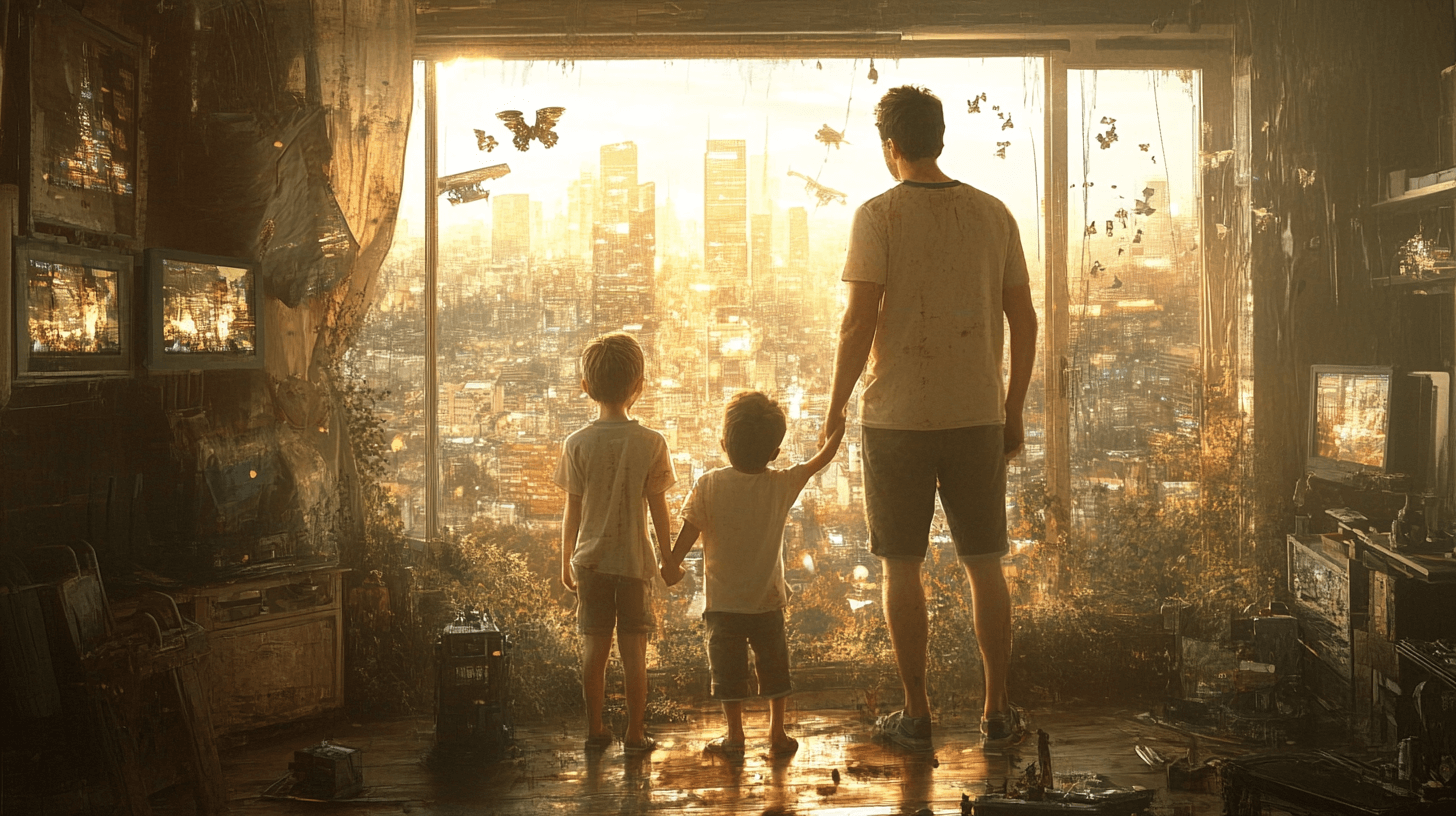
Now imagine a different future.
AI reduces labour demand.
Automation lowers production costs.
Universal basic income stabilises survival.
Technology increases efficiency.
Suddenly, survival may require less labour.
This could transform the family unit in profound ways.
Parents may:
-
Choose more time with children
-
Share roles more fluidly
-
Create flexible micro-enterprises
-
Educate children outside rigid systems
-
Build stronger local communities
The family could become less economically driven and more identity-driven.
But only if identity stabilises first.
The Hidden Identity Crisis Inside the Family
The modern family is not just under economic pressure.
It is under identity pressure.
Parents are asking:
-
Am I successful enough?
-
Am I present enough?
-
Am I earning enough?
-
Am I doing enough?
-
Am I failing my children?
Children are asking:
-
Who am I in a world that is unstable?
-
What does adulthood even look like?
-
What is work for?
-
What is family for?
If identity is outsourced to systems, the family becomes fragile.
If identity stabilises internally, the family becomes adaptive.
What AI and Abundance Might Change
If technology reduces the economic burden of survival, families may shift in three directions:
1. Greater Freedom of Structure
Families may choose:
-
One parent at home
-
Both parents part-time
-
Remote creative work
-
Community-based childcare
-
Multi-generational living
Structure becomes optional rather than compulsory.
2. Higher Demand for Emotional Maturity
When survival pressure reduces, emotional patterns surface.
Without identity stabilisation:
-
Conflict may increase
-
Comparison may intensify
-
Digital escapism may rise
Technology cannot replace emotional regulation.
That must be cultivated.
3. A Re-evaluation of What “Success” Means
If income is less tied to survival, the family may redefine success as:
-
Presence
-
Stability
-
Health
-
Meaning
-
Character
-
Contribution
That is a profound shift.
The Real Question: Freedom or Drift?
If economic pressure reduces, families may flourish.
Abundance does not automatically create coherence.
Coherence comes from identity.
Without identity:
-
Time becomes distraction
-
Freedom becomes confusion
-
Choice becomes anxiety
With identity:
-
Time becomes intentional
-
Freedom becomes creative
-
Choice becomes aligned
Ending “Slavery to the System” — Carefully Framed
Many parents today feel trapped by:
-
Debt cycles
-
Housing costs
-
Institutional rigidity
-
Cultural comparison
-
Constant digital exposure
The feeling is not ideological.
It is nervous-system level.
When people say they feel “enslaved to the system,” what they often mean is:
They have no breathing space.
No agency.
No margin.
No time.
If the coming decades reduce that pressure, it could be deeply healing.
But only if identity strengthens as pressure weakens.
Otherwise, external systems simply change form.
The Future of the Family Unit
The family unit is not dying.
It is being re-negotiated.
The next version of family will likely be:
Less economically rigid.
More psychologically demanding.
Less role-defined.
More identity-dependent.
The strongest families in the next era will not be the wealthiest.
They will be the most internally stable.
The parents who can:
-
Regulate stress
-
Decouple identity from role
-
Choose presence intentionally
-
Model self-trust
-
Teach discernment
-
Build community
Will create resilient children — even in unstable times.
Why Identity Awakening Matters Here
Identity Awakening System is not about ideology.
It is about stabilisation.
When identity stabilises:
-
Parenting becomes less reactive
-
Partnership becomes less transactional
-
Work becomes less ego-driven
-
Money becomes less fear-based
And the family becomes:
A conscious unit, not an economic survival machine.
A Final Reflection
I experienced one version of family stability through provision.
My partner experienced another through economic pressure.
Neither is a moral judgment.
But both reveal something important:
When survival dominates, identity narrows.
When identity stabilises, choice expands.
The future of the family will not be decided by AI alone.
It will be decided by whether we stabilise identity before structure shifts again.